

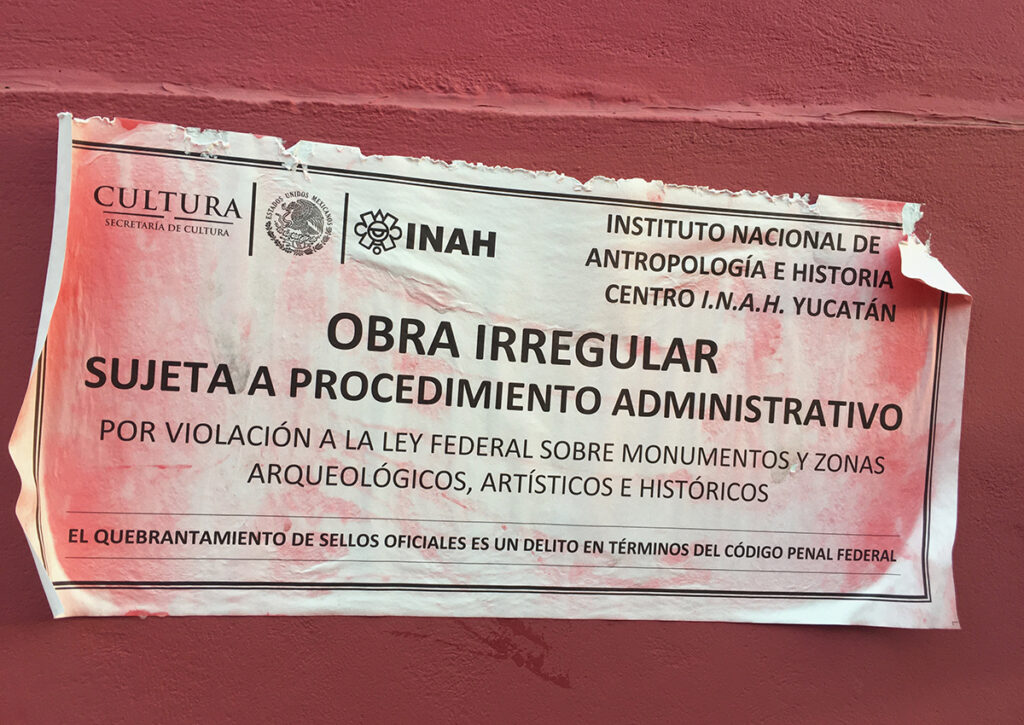
Twenty-two construction projects in Mérida’s Centro Histórico were suspended during 2025 for proceeding without proper authorization from Mexico’s federal heritage authority, according to the Centro INAH Yucatán, the regional office of the National Institute of Anthropology and History.
The suspensions did not permanently close the properties involved. Rather, they halted work in progress — placing official seals on the sites — until owners can demonstrate compliance with the legal requirements that govern any construction, renovation, or demolition within the protected zone.
The distinction matters. A stopped project is not a shuttered building. But breaking those official seals is no minor infraction: doing so carries administrative penalties and can trigger requirements to demolish or restore any unauthorized work at the owner’s expense.
The legal framework behind the action is Mexico’s Federal Law on Archaeological, Artistic and Historical Monuments and Zones, which requires prior authorization before any work of restoration, conservation, or modification is carried out on properties classified as historical monuments or located within a protected heritage zone. Under Article 12 of that law, Inah is empowered to order an immediate halt when work proceeds without the required permits or outside the terms of any permit already granted.
In addition to private owners, the obligation applies to government agencies at every level — federal, state, and municipal — reinforcing that responsibility for protecting the historic center is collective, not just a burden on individual property owners. In urgent situations, the city government can step in as an auxiliary authority and order a provisional work stoppage.
Mérida’s Centro Histórico covers roughly three square miles centered on the Plaza Grande. It is one of the largest colonial-era downtown districts in Latin America, and its 19th-century architecture and street grid are the city’s most recognizable feature. Under Inah rules, virtually any work that touches a historic structure — facade repairs, excavations, new foundations — requires advance clearance, because even changes to adjacent properties can compromise the structural integrity of protected buildings.
The permit process is layered. Owners must first secure Inah authorization and then obtain a separate construction permit from the city. Getting it right matters financially: fines for unauthorized work can reach the equivalent of US$20,000, and in extreme cases authorities can order full demolition of the unauthorized construction.
The real estate boom that has transformed the Centro over the past decade has sharply increased the volume of permit applications. By 2019, Inah was processing roughly 1,000 annual renovation permits in the Centro — more than double the figure from two years earlier — driven largely by foreign buyers converting colonial casonas into short-term rentals, boutique hotels, and restaurants.
The 22 suspended projects remain under review. Owners must demonstrate technical and legal compliance before work can resume. Centro INAH Yucatán retains oversight authority over all authorizations in the zone.
Fast Facts
- Mérida’s Centro Histórico is a federally designated zone of historical monuments, overseen jointly by Inah and the city government
- Any construction, renovation, excavation, demolition, or facade work in the zone requires advance Inah authorization before a municipal building permit can be issued
- Breaking an official Inah suspension seal is an administrative offense that can result in fines and mandatory restoration at the owner’s expense
- Owners of properties adjacent to historical monuments must also obtain permits before excavating or building new foundations, even if their own property is not classified as a monument
- In urgent cases, municipal authorities may issue a provisional suspension order on Inah’s behalf
- The 22 suspended projects remain in a review process; work cannot resume until owners regularize their situation with Inah
Sources: PorEsto, Yucatán Magazine