

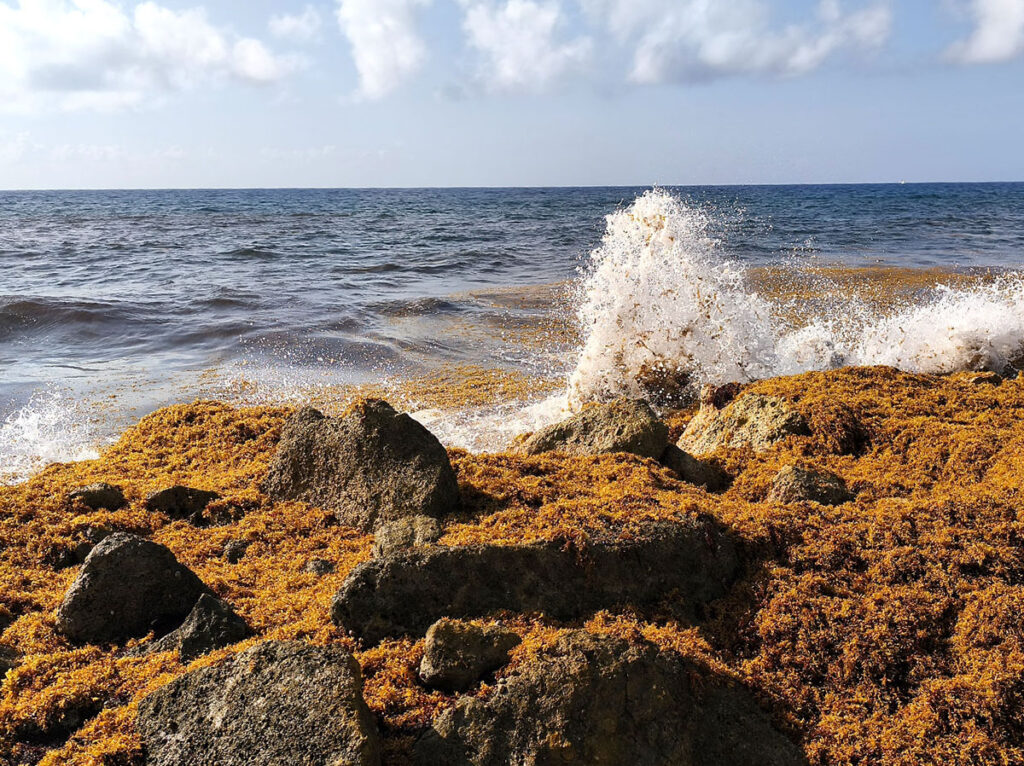
Satellite imagery is tracking three distinct masses of sargassum — the brown, free-floating seaweed that has been choking Caribbean beaches since 2011 — moving simultaneously toward Mexico and the wider Caribbean. Scientists at the University of South Florida’s Optical Oceanography Laboratory, which monitors Atlantic sargassum via satellite, say 2026 is on track to be a record year. The season has already started earlier than usual, and the volumes involved are alarming.
The lab’s most recent bulletin confirms three separated large masses in the eastern Atlantic, western Atlantic, and the western Caribbean, including the Gulf. Every region except the eastern Atlantic has seen record-high amounts for the period. A researcher at the National Autonomous University of Mexico told local outlets: “This year is going to be terrible.”
The first wave has already reached the western Caribbean. Sargassum first washed onto Isla Mujeres in the second week of January, and 244 tonnes were collected from Tulum in February alone — up from 59 tonnes during the same period last year. The second mass, a dense belt stretching across the central Caribbean, is expected to affect islands including the Dominican Republic, Puerto Rico, and Jamaica in the coming weeks. The third cluster is still building off the coast of Africa and could represent the season’s biggest surge.
For the Yucatán Peninsula and Quintana Roo, the implications are significant. Tulum is consistently the worst-hit destination on the coast because its open-facing shoreline catches the full brunt of Atlantic currents. Akumal is frequently impacted for similar reasons. Playa del Carmen faces moderate risk, though aggressive cleanup operations keep its beaches manageable most days. By mid-April, Tulum alone had collected more than 244 tonnes — a fivefold increase compared to the same period in 2025.
Mexico has ramped up its response. The government of Quintana Roo has deployed 16 surface units — including one ocean sargassum ship, 11 coastal vessels, and four amphibious collectors — along with 9,500 meters of containment barriers, with plans to add 6,000 more. The Mexican Navy has also made sargassum collection a permanent year-round operation rather than a seasonal response, a decision prompted by atypical January arrivals hitting multiple Quintana Roo beaches.
Longer-term solutions are in development. In coordination with the federal government, Quintana Roo is building a facility designed to produce clean energy from sargassum collected at sea, expected to be operational in the second half of 2026. A plant already operating in Yucatán is converting collected seaweed into biofertilizers and animal feed. You can read about that project at yucatanmagazine.com.
The health dimension is also worth noting. Once sargassum reaches shore, it decomposes rapidly and releases hydrogen sulfide gas, depleting oxygen from nearshore waters and producing the rotten-egg smell that has become a fixture of peak season. Officials in the British Virgin Islands issued a formal warning in mid-April about decomposing algae affecting desalination systems, along with health advisories for people with respiratory conditions staying in beachfront accommodations.
The economic toll is well documented. According to the Inter-American Development Bank, even a moderate bloom cut tourist arrivals in Quintana Roo by 11.6% between 2016 and 2019. In 2024, the state government spent roughly MX$125 million (about US$6.5 million) on cleanup and beach defenses.
For the latest satellite tracking data, the University of South Florida’s Sargassum Watch System publishes monthly bulletins with regional forecasts.
Sargassum Facts
- Three separate sargassum masses are currently moving toward Mexico and the Caribbean, tracked by satellite
- The University of South Florida forecasts 2026 could be a record or near-record year
- Tulum collected more than 244 tonnes in February 2026 — five times the same period in 2025
- The season began in January, months earlier than the typical April start
- Mexico has deployed 16 naval vessels and 9,500 meters of offshore barriers in Quintana Roo
- Decomposing sargassum releases hydrogen sulfide gas, posing risks for people with respiratory conditions
- Yucatán’s beaches on the Gulf of Mexico coast are largely unaffected
- Cenotes across the Peninsula are not impacted by sargassum and offer a reliable alternative for swimmers
Sources: Focus on Travel News, University of South Florida Optical Oceanography Laboratory, Cayman Compass, TravelPulse
=