

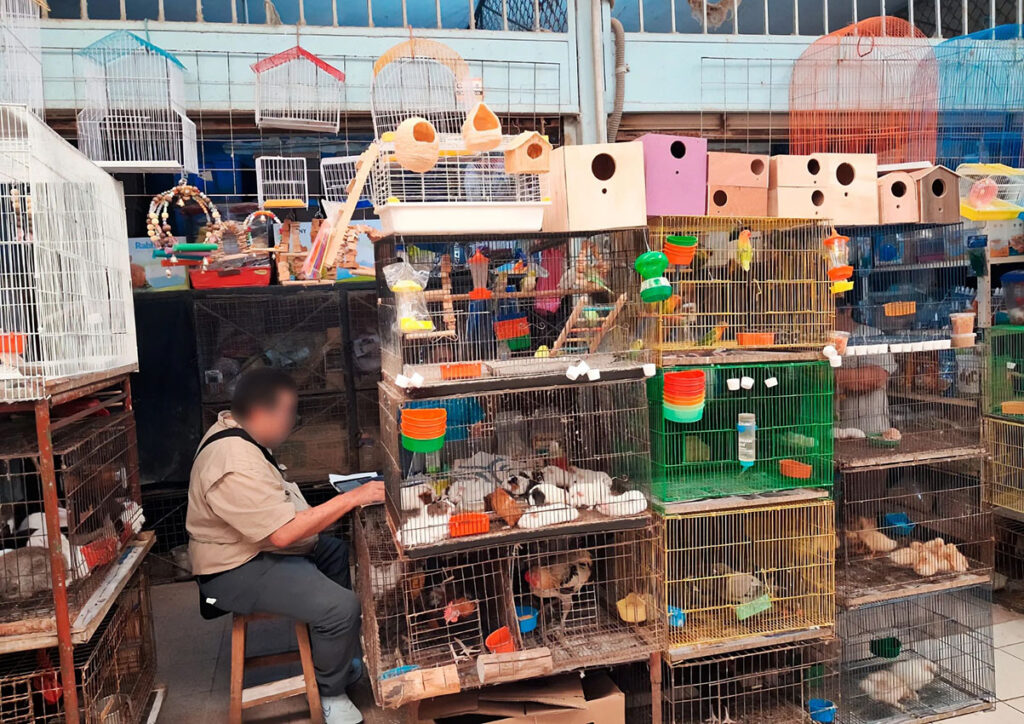
Federal environmental inspectors seized 34 protected wild animals from vendors at Mérida’s historic Lucas de Gálvez market in late March, acting on citizen complaints about the illegal sale of wildlife in one of the city’s most visited public spaces.
Agents from Profepa, Mexico’s federal environmental enforcement agency, conducted four inspections at the market on March 24. Most vendors were found selling only domestic animals, but two stalls were hiding something else — protected wild species with no documentation of legal origin, as required under Mexico’s General Wildlife Law.
The first stall yielded 27 animals: 11 green iguanas, four lovebirds of the rosy-faced variety (Agapornis roseicollis), seven masked lovebirds (Agapornis personatus), and five zebra finches. The second produced seven birds: a blue grosbeak, four painted buntings, a white-fronted parrot (Amazona albifrons), and a rose-breasted grosbeak. All species carry some form of protected status under Mexican law.
Profepa officials said all 34 animals appeared to be in good health, with normal plumage coloration and structure. Animals from the first stall were left in the custody of the vendor under precautionary seizure, pending further proceedings. The seven birds from the second stall were transferred to a Wildlife Conservation Management Unit — known by its Spanish acronym UMA — for care.
The enforcement action at Lucas de Gálvez fits into a broader and persistent problem. Wildlife trafficking is one of the most profitable illegal industries in the world, with global estimates ranging from US$7 billion to US$23 billion annually. Mexico, home to roughly 10% to 12% of the world’s biodiversity, is both a major source country and a transit point for animals headed to markets in the United States, Europe, and Asia.
Open-air markets have long been vectors for this trade. Undercover investigations have found species such as sloths, howler monkeys, crocodiles, and parrots being traded openly across Mexico, with social media platforms expanding traffickers’ reach well beyond physical stalls. Birds are among the most commonly trafficked animals in Latin America, and the annual illegal capture of parrots in Mexico alone is estimated at between 34,000 and 41,500 birds.
The mortality rate in this trade is brutal. According to Proyecto Santa María, a parrot conservation sanctuary operating near Mérida, eight out of every 10 parrots captured for sale in Yucatán die before they are ever sold. You can read more about the illegal bird trade and local conservation efforts at Yucatán Magazine.
In January 2026, Profepa signed a collaboration agreement with Humane World for Animals to strengthen the agency’s implementation of Mexico’s National Strategy to Combat Wildlife Trafficking, with priorities focused on enforcement capacity, public awareness, and international coordination. The Lucas de Gálvez seizure came just two months later.
The Lucas de Gálvez market, opened in 1897, is the largest and most historically significant traditional market in Yucatán, drawing both local shoppers and tourists daily. It sits at the heart of Mérida’s historic center, a few blocks from the Plaza Grande. Its reputation for variety is a draw — and, apparently, a cover.
Profepa has emphasized that anyone with information about illegal possession or trade of wild animals can file an anonymous complaint through official channels. For a broader look at how illegal wildlife trafficking operates across Mexico, the Center for Biological Diversity has published detailed findings from its undercover investigations.
Fast Facts
- Profepa inspectors visited Lucas de Gálvez market on March 24 and conducted four inspections
- 34 wild animals were seized from two of the four stalls inspected
- Species included green iguanas, two types of lovebirds, zebra finches, painted buntings, a white-fronted parrot, and a rose-breasted grosbeak
- All species carry protected status under Mexico’s General Wildlife Law
- Animals from the first stall remain under precautionary custody; birds from the second were transferred to a wildlife conservation unit (UMA)
- All 34 animals were reported in good apparent health at the time of seizure
- Citizens can report illegal wildlife activity anonymously to Profepa at 800-770-3372
Sources: La Jornada Maya, Humane World for Animals, Center for Biological Diversity