

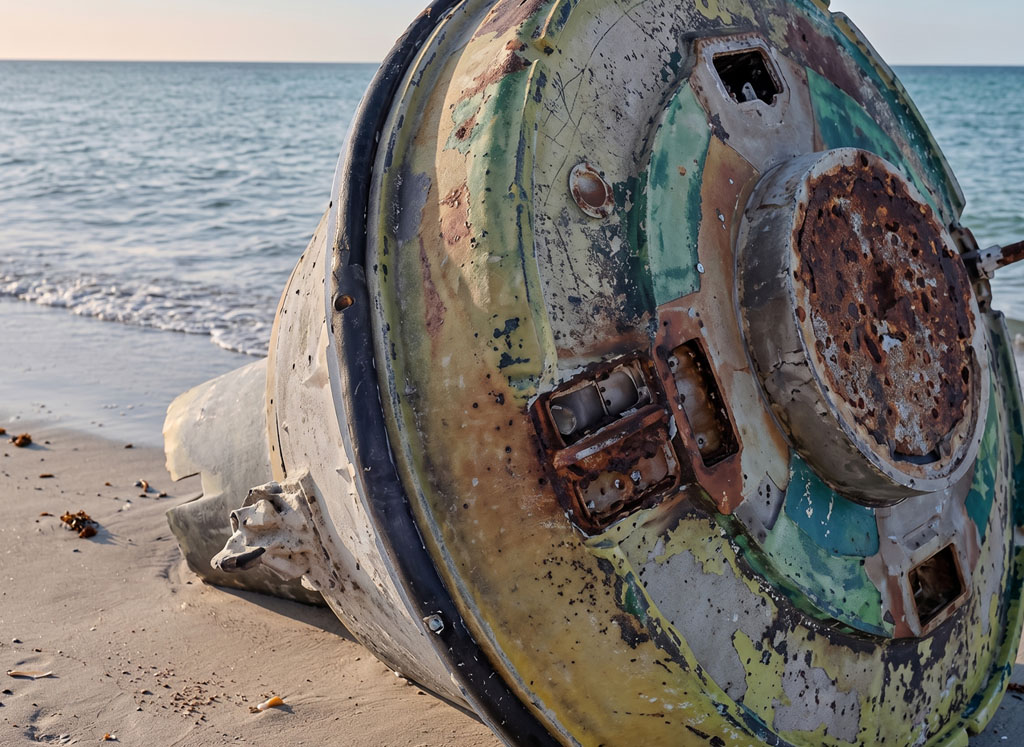
A mysterious metal object washed up on a beach in Mexico’s Yucatán Peninsula, causing a stir among locals and tourists. While some initially suspected it could be space debris, a closer look revealed a far more mundane explanation.
The object was found on Cancunito beach, between the fishing villages of Río Lagartos and Las Coloradas. Marked by corrosion and remnants of yellow and blue paint, its large size and conical shape sparked immediate speculation on social media that it might be an unidentified object that had fallen from space. However, the mystery was quickly resolved.
Sources from the local fishing sector identified the structure as a mooring buoy, a standard piece of maritime equipment used to secure boats without the need to drop an anchor. Experts explained that this type of structure is normally fixed to the seabed with chains and shackles. Over time, strong currents, large waves, or wear-and-tear from saltwater can dislodge them, causing them to drift to shore.
The incident is a reminder that when strange objects appear, “space debris” is often the first thing people think of. And for good reason: the problem of falling space junk is real and growing. Approximately 45,000 objects larger than 10 cm are actively tracked in orbit, but an estimated 130 million objects ranging from 1 mm to 1 cm remain untracked. With around three objects re-entering Earth’s atmosphere daily, the likelihood of people and property being affected is rising. One 2024 report estimated the collective casualty probability for people on the ground from uncontrolled re-entries could be between 5 and 10% that year alone, up by a factor of three to four compared to just five years prior.
The danger is not theoretical. A 0.7 kg metal fragment from the International Space Station punched through the roof of a Florida home. Other incidents include a 1.5-meter piece of a Falcon 9 rocket landing near a warehouse in Poland and a 2.5 kg fragment from a Starlink satellite crashing on a farm in Canada.
Mexico itself has also had direct experience with falling hardware. In June 2025, Mexican President Claudia Sheinbaum threatened to sue SpaceX over possible environmental contamination from its rocket launches, which have rained debris across the border. Earlier that year, a Starship rocket exploded during a test, breaking apart and raining debris over the Gulf of Mexico and Caribbean islands. In another incident, the second stage of a Falcon 9 rocket launched in 2017 re-entered the atmosphere over Mexico, breaking up in a fireball visible from the ground.
Despite these incidents, the probability of being hit remains very low. However, as the number of objects in orbit increases dramatically, the risk is rising. With over 12,900 active satellites currently in orbit and a potential for 100,000 within a decade, the traffic jam in space is only getting worse. This congestion increases the chance of a chain reaction known as Kessler Syndrome, where a single collision creates a cascade of debris that could render some orbits unusable. In 2024 alone, there were a record 120 uncontrolled rocket debris reentries, with more than 2,300 rocket bodies still in orbit awaiting an uncontrolled fall to Earth.
Space Debirs and Mitigating the Risks
In response to the growing hazard, international bodies and agencies have developed guidelines to mitigate the creation of space junk. The United Nations Office for Outer Space Affairs (UNOOSA) and the Inter-Agency Space Debris Coordination Committee (IADC) have issued recommendations for debris mitigation, including limiting debris released during normal operations and planning for post-mission disposal.
At a technical level, agencies like the European Space Agency (ESA) are exploring innovative solutions for removing existing debris. Active Debris Removal (ADR) missions are being designed to capture large debris and safely de-orbit them. Meanwhile, passive systems like drag sails can be deployed on satellites at the end of their life to increase atmospheric drag and accelerate their re-entry, helping them burn up sooner and reducing the chance of a collision. Such systems could help ensure that in the future, the only mysterious objects appearing on remote beaches are old buoys, not falling rocket parts.