

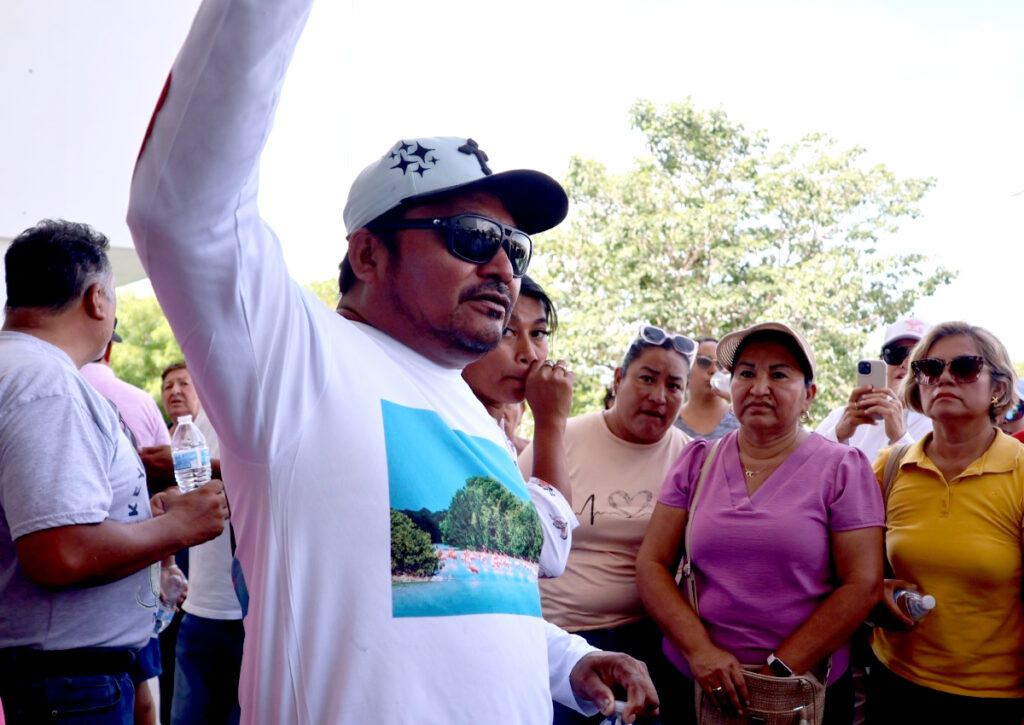
Residents of Celestún blocked the only road into their community on Wednesday, the day after a head-on crash killed five people — including two teachers, two children, and a tourist — on the notoriously dangerous highway connecting the port to Mérida. The protest shut down access to the town for hours and sent a small group of residents to the state capital to demonstrate outside the Palacio de Gobierno.
The collision occurred Monday on the Kinchil–Celestún stretch of the federal highway, around kilometer 52. According to initial reports, a pickup truck carrying tourists bound for Celestún crossed into the oncoming lane and struck a car carrying preschool teachers returning to Mérida after their shift. The crash killed all five immediately.
The deaths were the breaking point for a community that says it has been filing formal complaints about the road for years.
“We’re tired of band-aids”
Residents organized at a community meeting Tuesday night and agreed to block the main entrance to the port at dawn. By a little after 7 a.m., they had dragged branches, signs, and vehicles across the road. Emergency vehicles were initially not allowed through. Parents reported that some schools in Celestún suspended classes because teachers couldn’t get in.
Protesters carried signs demanding that state and federal authorities commit to a full overhaul of the road — not just patching. Residents said the highway is too narrow, lacks shoulders, and has deteriorated to the point where a serious accident is almost inevitable. They said they would hold the blockade indefinitely until officials gave them firm dates and a concrete plan.
A second group traveled to Mérida to demonstrate outside the governor’s office.
Governor Cites Lack of Federal Funds
Yucatán Gov. Joaquín Díaz Mena addressed the situation during his regular Monday livestream, acknowledging that the road needs work but saying the federal government had told him there was no money for a full expansion. He said he had recently met with Infrastructure Secretary Jesús Esteva Ramírez, who told him a complete widening of the highway would cost close to MX$1 billion (roughly US$50 million) — funds the federal government currently doesn’t have.
What the state can do, Díaz Mena said, is widen five two-kilometer segments at the most dangerous points along the route, bringing those stretches to at least 10 meters wide with proper shoulders. He said more than MX$100 million (about US$5 million) would be allocated for that work and that he had ordered it to begin this year. He did not give a start date.
A Highway With a Long Record
The Mérida–Celestún highway has been flagged as one of the most dangerous roads in western Yucatán for years. The route — the only paved road connecting Mérida to the flamingo sanctuary and fishing port — carries a steady mix of families, fishing workers, and tourists, many of them unfamiliar with the road’s conditions. It is narrow, has minimal shoulders, and passes through several intersections where stop signs are frequently ignored.
Monday’s crash was not an isolated event. A head-on collision in the same general area in July 2025 left two women seriously injured. The road’s reputation for accidents has been a source of community frustration for well over a decade, but formal complaints have gone unanswered.
Yucatán’s roads have claimed a troubling number of lives in recent years. Through April of last year, 78 people had died in traffic accidents across the state, according to reporting by Noticaribe. The Mérida ring road is ranked among the three most dangerous highways in the country.
Residents said they plan to coordinate with neighboring municipalities to maintain pressure on authorities without indefinitely cutting off access to the region’s economy.
Fast Facts: Celestún and the Highway
- Celestún is a fishing port and ecotourism destination roughly 90 kilometers west of Mérida, known for its flamingo colonies and biosphere reserve
- The Mérida–Celestún highway is the only paved road linking the port to the state capital
- Monday’s crash occurred near kilometer 52 on the Kinchil–Celestún segment and killed five people: two preschool teachers, two children, and a tourist
- Gov. Díaz Mena said a full expansion would cost close to MX$1 billion (approx. US$50 million) — funds the federal government says it doesn’t have
- The state has proposed widening five two-kilometer stretches at the highway’s most dangerous points, with more than MX$100 million (approx. US$5 million) earmarked
- Protesters say they will maintain the blockade until they receive official commitments with specific timelines
Sources: Diario de Yucatán, Noticaribe, PorEsto, Diario Cambio 22, El Cronista Yucatán, 24 Horas Yucatán