

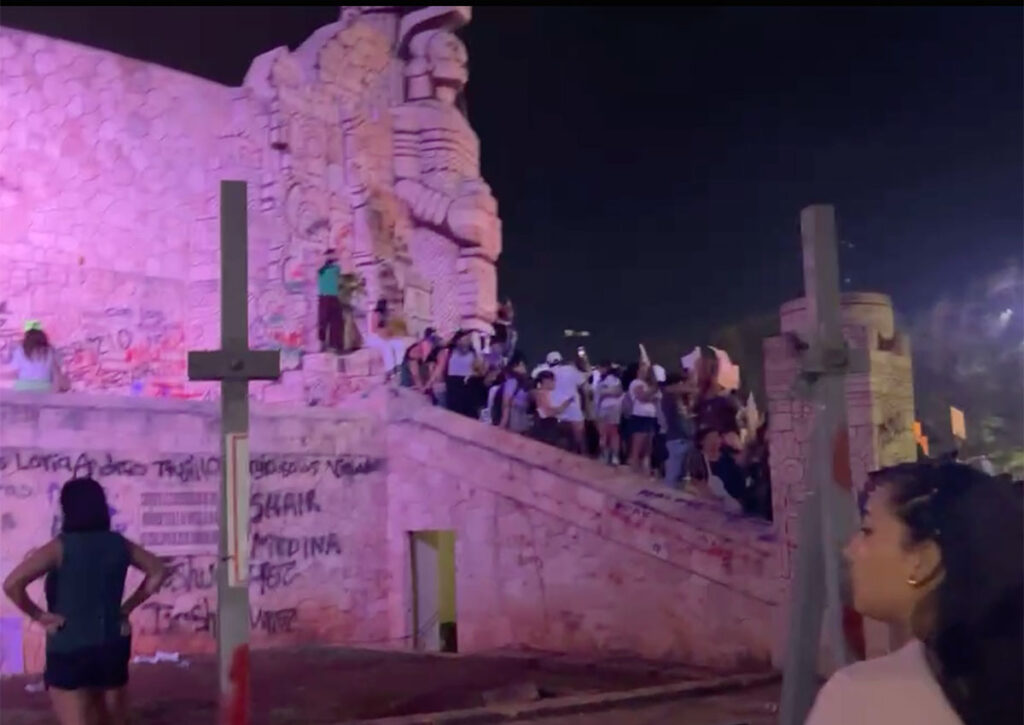
A sea of purple flooded the streets of Mérida on Sunday as more than 9,000 women, children, and allies marched through the city center to mark International Women’s Day. This time, city authorities stayed out of the way of the M8 rally, letting protestors paint up public and private property and set fires at one of the city’s most iconic monuments.
The M8 march, organized to demand an end to gender violence and femicide, began at Parque de la Mejorada (Mejorada Park) late Sunday afternoon and wound through the Corredor Gastronómico (Gastronomic Corridor) along Calle 47, where restaurant workers handed out water and snacks to marchers as a gesture of solidarity. From there, the crowd moved north along Paseo de Montejo — the city’s grand boulevard — before arriving at the Monumento a la Patria (Monument to the Fatherland), the landmark stone frieze that serves as Mérida’s most recognizable outdoor monument.
A Different Kind of March
What set Sunday’s demonstration apart from recent years was the absence of confrontation. In 2025, authorities deployed tear gas against protesters outside the Government Palace, and clashes were reported at City Hall. This year, no such scenes unfolded. The city had already moved to accommodate the march by suspending its weekly “Mérida en Domingo” cultural program and pledging to make the route available without interference.
The contrast stretches back further. In 2019, the march turned divisive when the sculpture at the Parque de la Madre (Park of Motherhood) — a monument honoring maternity — was vandalized, sparking a fierce public debate that reverberated for years.
Sunday’s crowd was notably inclusive. The march was not separatist; men were welcomed as long as they stayed in a protective role alongside children and families. The contingent was led by relatives of femicide victims and people with disabilities. Activists of long standing marched beside young women newly drawn to the movement, and the chants reflected that breadth.
Monuments Marked, Flag Replaced
The march made deliberate stops at several monuments along Paseo de Montejo. At the bust of Felipe Carrillo Puerto — the socialist governor assassinated in 1924 — a black bloc contingent tore down protective metal barriers and covered the statue in protest graffiti. Demonstrators chanted “Esas morras sí me representan” (“Those women represent me”) as others scaled the monument. The scene repeated at the nearby monument to Justo Sierra, the 19th-century liberal statesman.
At the Monumento a la Patria, protesters pulled down metal fencing to open the space to the wider crowd, painted slogans on the monument’s stone surfaces, and raised a modified Mexican flag — green, white, and purple — in place of the national tricolor. The crowd sang “Canción sin Miedo” (Song Without Fear), the feminist anthem by singer Vivir Quintana that has become an unofficial hymn of the 8M movement across Latin America.
Mexico’s Persistent Crisis
The Mérida march is part of a national mobilization that drew hundreds of thousands into streets across Mexico on Sunday. According to CBC News, roughly 10 women are killed every day in Mexico — a statistic that drives the annual marches and has made Mexico’s 8M demonstrations among the largest in the world.
Yucatán is not immune. In the weeks before Sunday’s march, activists in Mérida held a “tendedero” — a public clothesline of denunciations — naming men accused of withholding child support, a form of what organizers call violencia vicaria (vicarious violence), the use of children as a weapon against mothers.
Sunday’s Mérida demonstration was part of a nationwide mobilization. In Mexico City alone, more than 120,000 women took to the streets, with an all-female police unit providing security and city authorities reporting no major incidents. For full coverage of the national rallies, see the Mexico Tribune report.
For more on how International Women’s Day marches have unfolded in Mérida and across Yucatán, see our coverage at Yucatán Magazine.
Key M8 facts:
- More than 9,000 people took part in the International Women’s Day march in Mérida on March 8, 2026
- The route ran from Parque de la Mejorada through Calle 47 to Paseo de Montejo and the Monumento a la Patria
- Monuments to Felipe Carrillo Puerto and Justo Sierra were covered in protest graffiti
- Protesters scaled the Monumento a la Patria and raised a purple-modified Mexican flag
- The march was led by relatives of femicide victims and people with disabilities
- Men were permitted as participants in a protective capacity alongside children and families
- Mérida authorities suspended the weekly “Mérida en Domingo” program to accommodate the march
- No police interference was reported, in contrast to clashes in 2025 and the vandalism controversy of 2019
- An average of 10 women are killed per day in Mexico, according to advocacy groups