

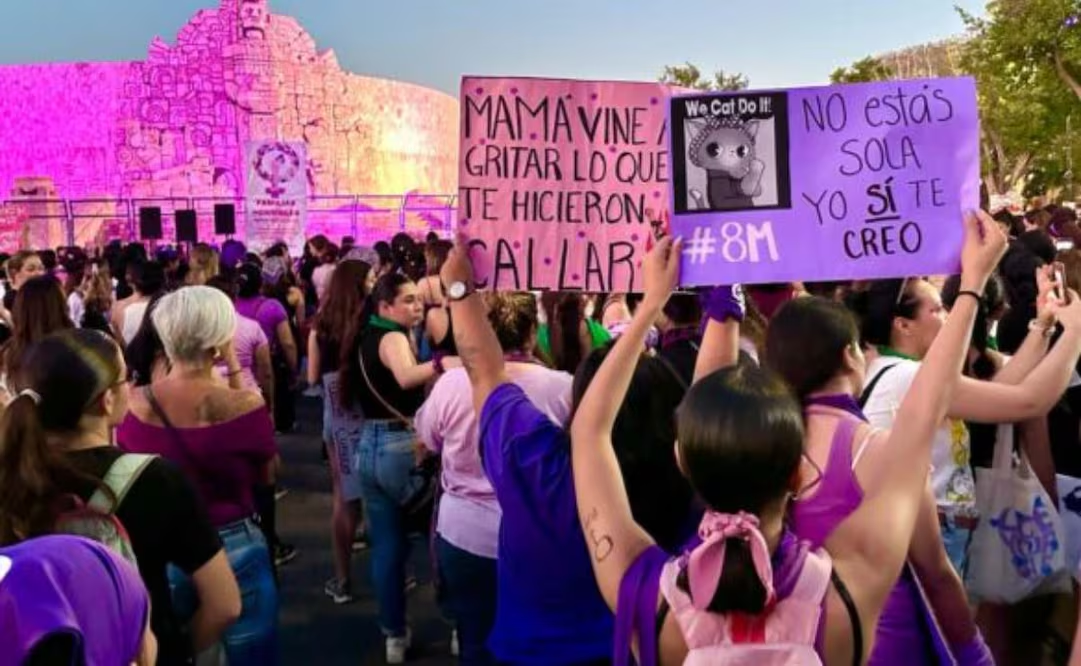
Mérida’s most iconic landmark will need a full restoration project after International Women’s Day demonstrators covered it in paint, eggs, and adhesive posters on March 8 — but the city’s rush to clean it up may have made a complicated job even harder.
City workers began washing down the Monumento a la Patria shortly after midnight on March 9, working continuously for more than 12 hours. INAH specialists have since flagged that as a problem. Unauthorized cleaning interventions on historic stone — even well-intentioned ones — can cause chemical or physical damage, potentially compounding the original harm from the march.
Mexico’s National Institute of Anthropology and History (INAH) issued a formal technical assessment this week, concluding the monument suffered the most severe damage of any structure affected along Paseo de Montejo during the 8M demonstrations. Karla Martínez López, coordinator of the Conservation and Restoration Section at Centro INAH Yucatán, documented spray-painted slogans in multiple colors, direct application of acrylic paints, stencils, paint “bombs,” egg impacts on the upper sections, and adhesive-backed posters on the lower portions. The damage covered virtually the entire perimeter — columns, low walls, the interior of the reflecting pool, the base of the eagle sculpture, and the access stairs.
Cleanup is unusually complicated because no single material or procedure can remove all the markings. Specialists will need individualized approaches for different sections of the carved stone surface, Martínez López said.
An Unprotected Monument
The absence of any protective coating on the Monumento a la Patria made the damage worse from the start. It was last restored between 2016 and 2017, but no direct protective strategies were applied at that time, leaving the original stone surfaces exposed.
Two other affected monuments — those dedicated to Felipe Carrillo Puerto and Justo Sierra O’Reilly — fared considerably better. Both had undergone full interventions in 2024, including the application of lime-and-sand “sacrificial coatings” designed to protect the underlying stone. Those protective layers absorbed much of the impact. INAH says those monuments will need only targeted cleaning and partial replacement of the coatings.
Cost and Timeline
Authorities estimate the total restoration cost at around MX$8 million (US$444,000), with work expected to be completed by July. INAH says the project will be developed in coordination with the Yucatán state government and the Mérida city government. Any work, the institute stressed, must be carried out by qualified conservators. No start date has been announced.
For context, restoration work after the 2022 feminist marches — which also affected several monuments along Paseo de Montejo — cost close to half a million pesos. The leap to MX$8 million this time reflects both the broader scope of the damage and the more complex conservation work now required.
About the Monument
The Monumento a la Patria is no ordinary roadside sculpture. Architect Manuel Amabilis designed the circular structure, which sits in a traffic roundabout at the northern end of Paseo de Montejo. Colombian-born sculptor Rómulo Rozo spent 12 years — from 1944 to 1956 — carving more than 400 historical figures into its walls. Rozo adopted Yucatán as his home and is buried in a crypt beneath the monument. For a deeper look at its history, see this feature at Yucatán Magazine.
The monument has long served as a gathering point for civic celebrations, concerts, and public protests. The 8M marches are an annual flashpoint in Mérida, as in cities across Mexico, and Paseo de Montejo monuments have been painted during previous demonstrations. INAH’s full technical assessment is available via Infobae México.
What to Know
- The Monumento a la Patria sustained the worst damage of any monument during the March 8 demonstrations in Mérida
- City workers washed down the monuments starting just after midnight on March 9 — INAH says the unauthorized cleaning may have caused additional harm to the stone
- Damage includes spray paint, acrylic paint, stencils, paint “bombs,” egg impacts, and adhesive posters covering the entire perimeter
- The monument had no protective coating; it was last restored in 2016–2017 with no sealant applied
- Two nearby monuments — Felipe Carrillo Puerto and Justo Sierra O’Reilly — were better protected and require only minor repairs
- Estimated restoration cost: MX$8 million
- Target completion: July 2026
- All restoration work must be carried out by qualified conservators under INAH supervision
Sources: Centro INAH Yucatán technical assessment (March 25, 2026); Infobae México; Yucatán Magazine