

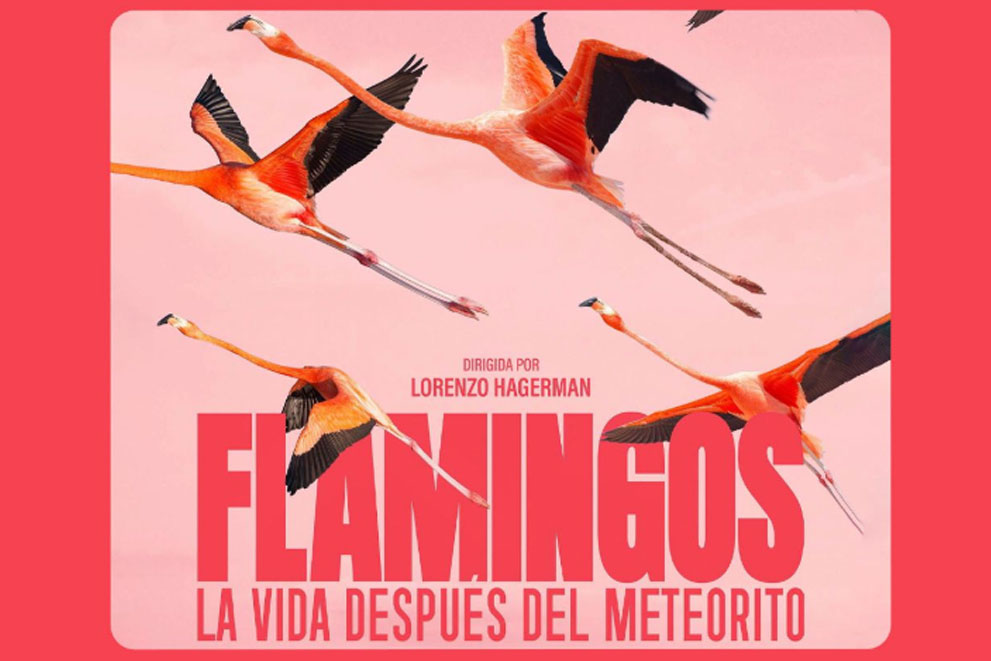
A new Mexican documentary offers a decade-long look at the life cycle of the flamingo in the Yucatán Peninsula. Directed by Lorenzo Hagerman and narrated by Mexican singer, composer, and multi-instrumentalist Julieta Venegas, “Flamingos: La vida después del meteorito” combines scientific observation with visual storytelling to examine how these majestic birds survive in a challenging environment.
The production spanned 10 years and required 700 days of filming in the northern Yucatán, where the flamingo population inhabits areas near the Chicxulub crater site—the impact zone linked to the dinosaur extinction event that gives the documentary its title. Director Hagerman spent up to 14 hours per day observing the birds and working closely with the Cornell Lab of Ornithology, a leading institution for avian research.
Hagerman described the experience as watching “a story of survival.” The documentary captures harsh realities: predators such as dogs and crocodiles hunting chicks, droughts affecting breeding grounds, and high nest mortality rates. According to the director, during his filming period, fewer than half of approximately 18,000 nests successfully produced surviving offspring.
The film departs from traditional nature documentary conventions. Instead of voiceover narration explaining animal behavior, “Flamingos” relies on a poetic script by Spanish poet Ajo (María José Martín), narrated by Venegas in her first documentary voice-over role. The musical score comes from Bryce Dessner, a member of the band The National and a 2026 Oscar nominee.
Critical reception has been mixed. Some reviewers praise the cinematography and immersive quality, noting that the camera acts as a silent observer, capturing the “cruelty of wildlife” alongside moments of beauty. However, some critics have pointed to pacing issues, describing sections of the film as monotonous, and noted that Venegas’ narration occasionally lacks energy.
The project originated when John Bowman from Cornell University approached Hagerman about creating a conservation-focused film to raise awareness not just for flamingos but also for less charismatic species sharing their habitat. Box office proceeds will support conservation efforts through the Fundación Pedro y Elena Hernández A.C. and Transformación, Arte y Educación A.C.
“Flamingos: La vida después del meteorito” is produced by La Vaca Independiente and Cactus Film & Video in partnership with the Cornell Lab of Ornithology.
Julieta Venegas and Environmental Activism
Venegas’ environmental advocacy dates back to at least 2012, when she served as the official spokesperson for the third annual EcoFest in Mexico City. The festival, one of the largest ecological events in Latin America, brought together 170 sustainable businesses and organizations and attracted an estimated 40,000 attendees.
At the time, Venegas spoke about the importance of individual action in addressing environmental challenges. “We all complain about our environment, about global warming, and about the planet changing, and we ask ourselves what we can do… We see this issue as something very distant, but we can get involved in many ways,” she said during a press conference. She emphasized that ecology should be understood not as an abstract concept but as something people can engage with in daily life.
Venegas describes herself as “a normal person who consumes products every day and tries to ensure that my way of consuming does not impact my environment, which is everyone’s environment.” Her role as EcoFest spokesperson came during a break from recording her sixth studio album, demonstrating her willingness to prioritize environmental causes alongside her musical career.