

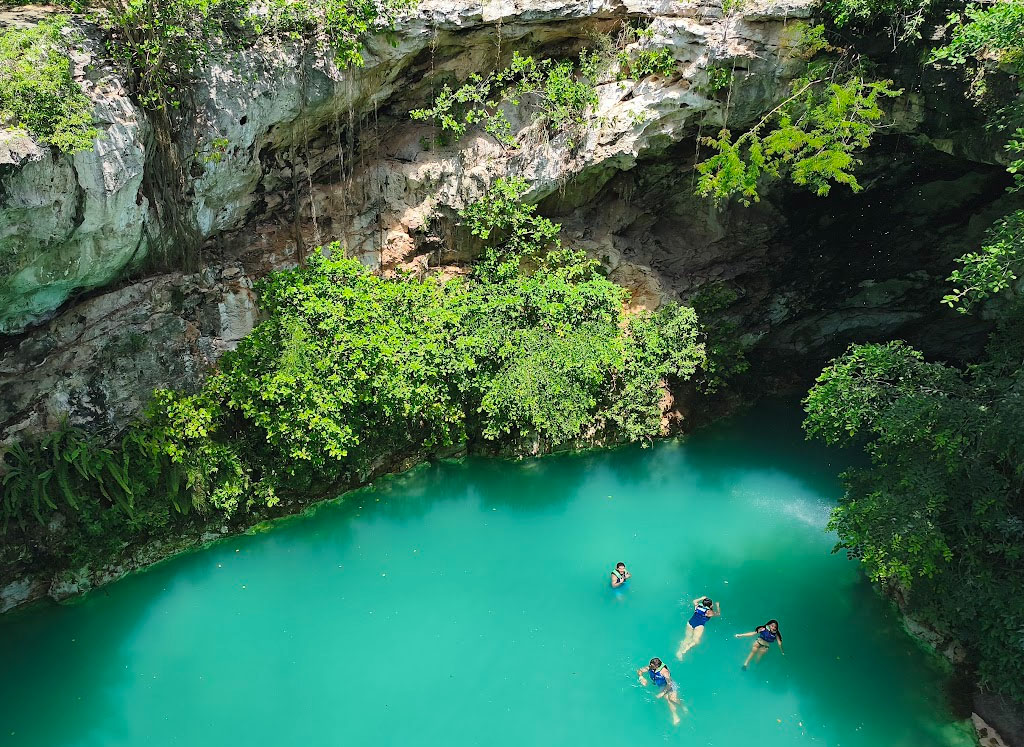
Authorities have ordered a stop to construction at a property in Abalá where developers were cutting through limestone to create artificial cenotes and provide access to existing ones, marking the latest crackdown on unauthorized tourism infrastructure in Mexico’s Yucatan Peninsula.
The suspension, confirmed by environmental authorities, aims to halt ongoing construction and prevent further damage to the protected area. Officials have not ruled out additional safety measures, environmental restoration actions, or legal complaints before competent authorities.
The case highlights a recurring pattern in the region: while some projects without proper permits face shutdowns, others — particularly large-scale government infrastructure — appear to receive exemptions or continue with minimal consequences.
A Pattern of Unauthorized Intervention
The practice of drilling into the Yucatan’s fragile limestone bedrock to create or access cenotes is not new. For decades, developers have sought to capitalize on the region’s natural sinkholes, which draw millions of tourists annually. However, these interventions carry significant environmental risks.
The Yucatan Peninsula sits atop a vast network of limestone caves and underground rivers. The porous rock functions “like Gruyere cheese, full of caves and cavities of different sizes and at different depths,” according to Northwestern University geologist Emiliano Monroy-Ríos . The aquifer beneath the peninsula spans approximately 64,000 square miles and supplies the only source of fresh water to millions of residents .
Construction in these areas without proper authorization “generates direct alterations in natural systems,” as authorities noted in the Abalá case. When limestone caves are breached, even before pillars or structures are installed, the ecosystem transforms entirely. Light enters previously dark chambers, gas compositions change, and sensitive species adapted to total darkness die off .
Xibalbá and Other Shutdowns
The Abalá closure follows similar actions against other tourism projects. Grupo Xcaret’s Xibalbá project which also involved modifying cave systems, was previously shut down by authorities.
Environmental enforcement has targeted various unauthorized developments across the peninsula. In 2023, following pressure from activists and cave divers, Mexico’s Federal Attorney for Environmental Protection issued temporary orders to suspend construction on multiple projects affecting cenotes .
These enforcement actions demonstrate that authorities can and do intervene when projects lack proper permits. “Carrying out infrastructure work on forest land without the necessary environmental authorizations represents a violation of federal provisions,” the official statement on Abalá noted.
Yet a clear double standard exists. While smaller commercial projects face shutdowns, the Mexican government’s own $30-35 billion Tren Maya project has proceeded despite documented destruction of cave systems and cenotes .
Engineer Guillermo D. Christy, a water quality consultant who has worked in the region for over 25 years, has documented steel pillars driven directly through cave roofs. At one cave complex known as Aktun Túyul, near Playa del Carmen, rows of pillars approximately three feet wide were sunk through cavern ceilings .
“The promise from the president and the director of the INAH was that they (the caves) would be protected,” D. Christy told the Associated Press. “López Obrador lied. They aren’t protecting the caves and sinkhole lakes. The damage is irreversible” .
According to cave explorer Roberto Rojo, more than 15,000 pillars have been driven into the Yucatan soil as part of the train project, with 40 pillars in a single cenote alone . The National Geographic reported that construction of Tren Maya resulted in 125 caves and cenotes punctured as pillars were installed .
The train was exempted from normal permitting, public reporting, and environmental impact statements, with the government claiming it is vital to national security .
Environmental Consequences
The damage from unauthorized construction — whether small tourism projects or large infrastructure — follows similar patterns. Broken stalactites litter cave floors. Concrete spills coat limestone surfaces. Water turns murky brown from corroded metal pillars leaching iron oxide .
“Pouring concrete into a cavern, directly into the aquifer, without any concern or care,” D. Christy said. “That’s total ecocide” .
Scientists warn that the interconnected nature of the aquifer means contamination spreads. Pollution entering one cenote can travel through underground channels to others, eventually reaching the sea and affecting the Mesoamerican Reef .