

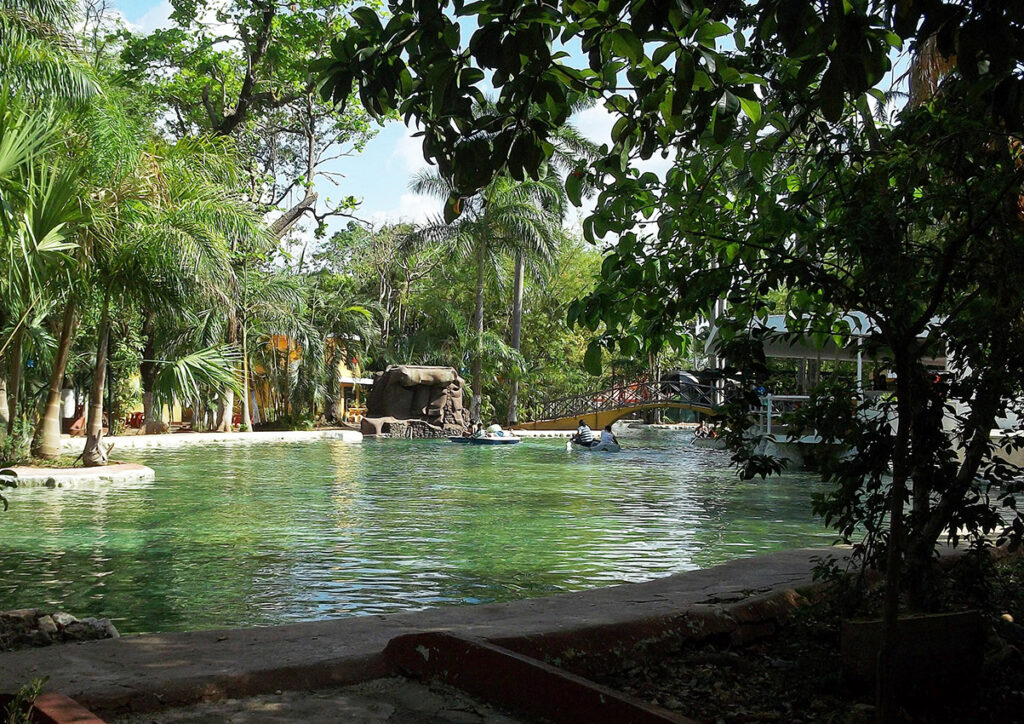
The artificial lake at Mérida’s Parque Zoológico del Centenario has been empty for several weeks as city crews carry out one of the more extensive maintenance projects the feature has seen in years — patching cracks, waterproofing surfaces, improving drainage, and expanding its fish population.
Felipe Pacheco Sansores, deputy director of General Services at the city’s public works department, said the lake is drained periodically for upkeep, but this round of work went deeper than usual.
“Each set amount of time, we have to empty the lake for maintenance,” he said. “This time, more complete work is being done — filling and repairing cracks, plus applying a waterproof coating.”
New hardware, more fish
The upgrades also include new intake filters for the water supply, drainage wells, and a wider variety of fish species once the lake is refilled. Previously, pumps were needed to drain the lake. The new infrastructure makes that process faster and less labor-intensive.
Running parallel to the lake work, the park’s environmental education area — where programming on local flora and fauna takes place — is undergoing its own renovation. That section is roughly 80% complete. City officials plan to reopen both areas together once all the work wraps up.
Pacheco Sansores noted that the age of the structures has been the biggest challenge. Some parts of the lake infrastructure are more than 40 to 50 years old, requiring careful handling to avoid causing new damage while fixing old problems.
The Centenario, as locals call it, is one of Mérida’s most beloved public spaces. Founded in 1910 to mark the centennial of Mexico’s independence, it began as a botanical garden before being converted into a zoo in 1962. The 9.7-hectare park on Avenida Itzáes sits just west of downtown and draws an estimated 1.5 million visitors a year. Admission is free.
The lake is one of the park’s signature attractions. A cable car crosses above it, and rowboats can normally be rented for paddling across. The park also runs a miniature train, a small aquarium, and wildlife exhibits ranging from big cats and primates to reptiles and tropical birds. A recent renovation of the zoo, completed in 2018, was described at the time as the most significant upgrade since the park first opened.
While the temporary closure of the lake has been an inconvenience for visitors, the city says the improvements will extend the feature’s lifespan and make it easier to maintain going forward. No reopening date has been announced, but officials say they are waiting on the environmental education area to finish before staging a joint reveal.
Mérida’s public park system has seen steady investment in recent years, with the city also developing the larger Animaya Zoo on the western edge of the city and the now-open La Plancha park near the downtown train station. More on Mérida’s urban green-space projects can be found at AP’s coverage of Mexican infrastructure initiatives.
Fast Facts: Parque Zoológico del Centenario
- Founded in 1910 to commemorate the centennial of Mexico’s independence
- Converted from a botanical garden to a zoo in 1962
- Located on Avenida Itzáes between Calles 59 and 65, west of Mérida’s historic center
- Covers approximately 9.7 hectares
- Home to more than 600 animals across roughly 92 species
- Admission is free; open Tuesday through Sunday
- Estimated 1.5 million visitors per year
- Attractions include a lake with rowboats, cable car, miniature train, aquarium, and environmental education center
With reporting from Diario de Yucatán