

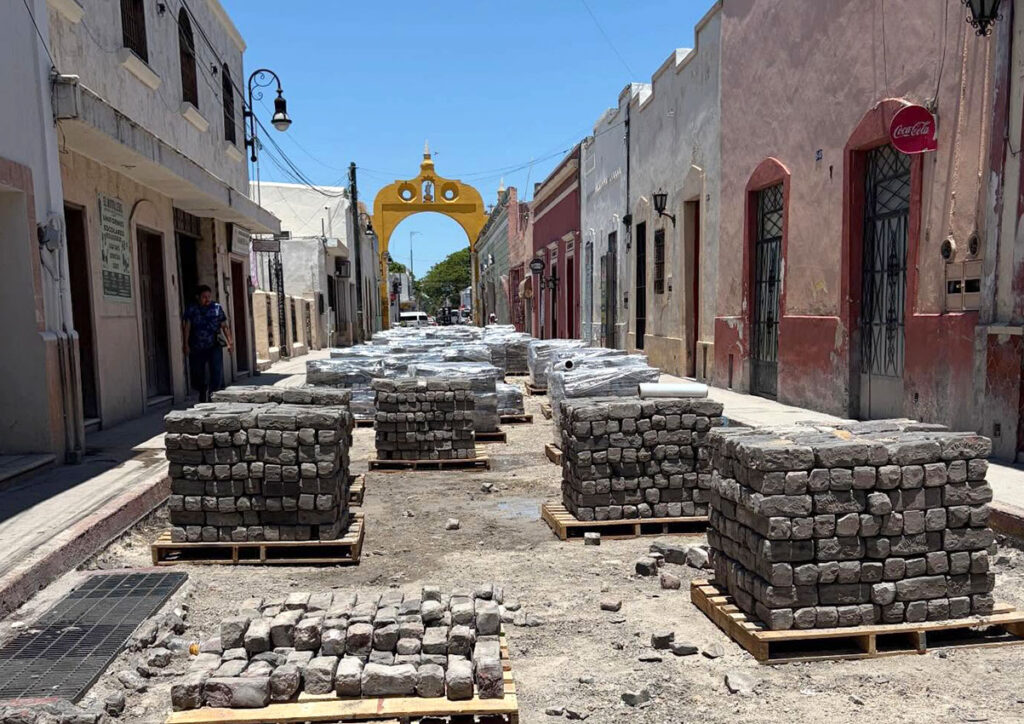
The cobblestone streets along one of Mérida’s most beloved colonial corridors are coming up — all of them, brick by brick — as the city moves into the second phase of a multi-year restoration project running from the Arco de San Juan south to Calle 73.
Workers began lifting the adoquines from Calle 64 on April 27 and will continue toward Calle 73, closing that stretch entirely to vehicle traffic. The crossing at Calle 73 from Calle 62 will also be closed. City officials say the work is expected to run through the end of August.
The scale of what residents are seeing is not an illusion. According to Mérida’s Public Works Department, the current phase covers 642 linear meters of street — roughly 4,061 square meters in total — across Calle 64 and Calle 64-A, stretching from the Arco de San Juan to the intersection near La Ermita.
This is the second of four planned phases. The first, completed last October, tackled about 2,894 square meters of cobblestone around Parque de la Ermita — the streets surrounding the Ermita de Santa Isabel park — including sections of Calle 66, Calle 77-A, and adjacent corners.
The approach is painstaking by design. Each adoquín is removed by hand, cataloged, and stacked in pallets of 320 pieces before being transported for cleaning and storage. The goal is to return every stone to its original position when the street is reconstructed. City officials say the process preserves the historical integrity of the zone, which falls within Mérida’s Centro Histórico — one of the largest historic districts in Latin America, a corridor shaped in part by the French cobblestone paving that gives streets like Calle 64 their distinctive character.
Drainage improvements
Beyond aesthetics, the project includes upgrades to the storm drainage system beneath the street. With the surface opened up and the base exposed, crews are seizing the opportunity to improve drainage infrastructure that has largely gone untouched beneath the cobblestones.
The Va y Ven bus stop for the Maxcanú route has been relocated to Parque San Juan for the duration of the work, along with the nearby taxi stand.
Residents in the neighborhood have had mixed feelings — though perhaps mostly one feeling. Social media reaction has ranged from relief (“Finally!”) to frustration that no advance notice was posted before work began. Many locals say the lack of signage or public communication left them confused about what was happening and how long it would last.
Mérida’s historic center has been the focus of stepped-up infrastructure investment in recent years. A major renovation of Calle 60 improved pedestrian access and street-level amenities between Plaza Grande and Parque Santa Ana. That project drew praise and scrutiny in equal measure, with some critics noting that follow-up repairs elsewhere in the Centro have relied on asphalt patches rather than matching materials.
The current cobblestone project represents a more methodical and preservation-focused effort. Federal rules require that any modifications to public spaces within the historic zone receive approval from INAH, Mexico’s National Institute of Anthropology and History, which oversees protection of monuments and colonial-era infrastructure nationwide.
Drivers and pedestrians who rely on this stretch of Calle 64 — a key artery between San Juan and La Ermita — should plan for detours through at least late August.
Fast Facts
- Calle 64 from Arco de San Juan to Calle 73 is fully closed to vehicles
- Work started April 27; expected to continue through late August
- 4,061 square meters of cobblestone being removed and restored
- Each stone is catalogued by hand and palletized in groups of 320
- Storm drainage upgrades are also being done while the street is open
- Va y Ven Maxcanú bus stop and taxi stand relocated to Parque San Juan
- This is Phase 2 of a 4-phase project covering the Santa Lucía and Mejorada areas
- Phase 1 was completed in October around Parque de la Ermita (2,894 square meters)
Sources: Yucatán a la Mano, Yucatán Magazine