

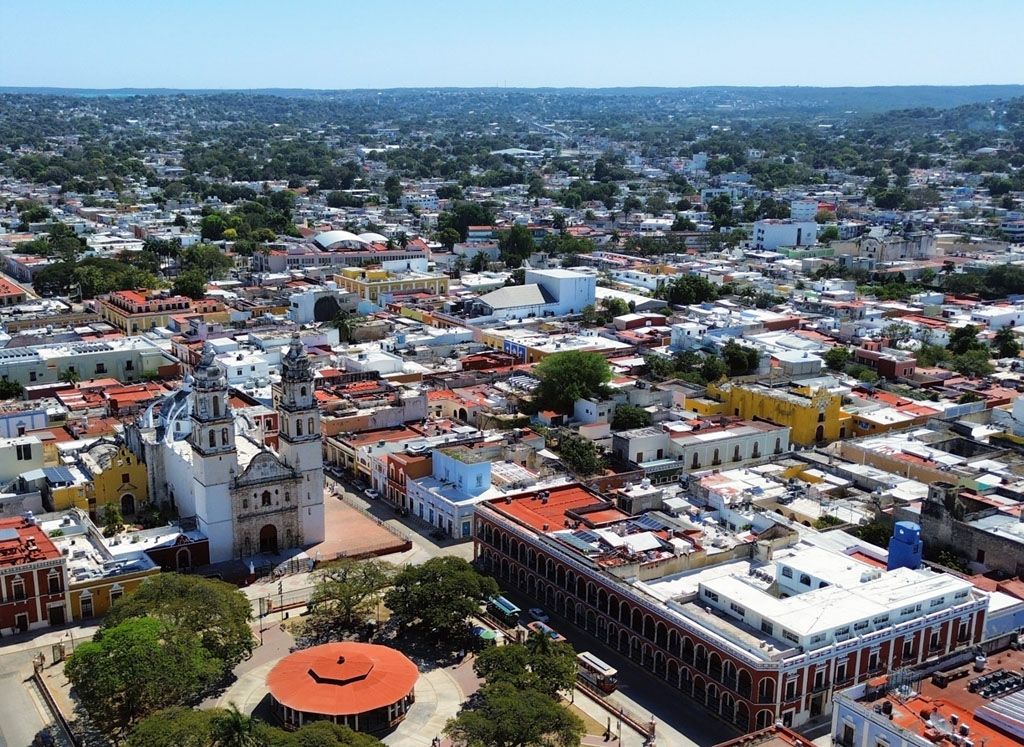
Campeche’s Governor Layda Sansores has declared that the state is essentially bankrupt, unable to pay even its electricity bills. In a stunning admission, she warned she would rather shut down government offices than beg for more loans, sparking a political crisis over a $4 billion peso deficit and a bitter dispute with the federal government over oil revenue.
“We don’t have a single peso of liquidity here in Campeche,” Sansores declared during a broadcast, revealing a deficit she estimates at 4 billion pesos. The governor stated that she was forced to ask for a payment extension on the last electricity bill and has now drawn a line in the sand. “There is no money for electricity, so we don’t work,” she warned, threatening to paralyze state offices entirely if the cash flow does not improve.
Governor Sansores has explicitly ruled out that Campeche would take out new loans to cover the operational shortfall. “I will not ask for a loan or an extension; I will turn off all the offices,” she said, framing the move as a form of protest against the federal funding formula.
The Federal Rift
The crisis has opened a significant political fracture between the state government and the federal administration of President Claudia Sheinbaum, despite both leaders belonging to the same MORENA party.
The Governor blames the crisis squarely on the Ley de Coordinación Fiscal (Fiscal Coordination Law), claiming that Campeche—historically a major oil producer—is being starved of its rightful dues. She alleges that of the 6 billion pesos the state manages, 4.8 billion have been cut, with an additional 700 million at risk.
While Sansores has publicly thanked President Sheinbaum for “solidarity” and road repair funds, her rhetoric remains confrontational. The federal government, through the disbursement of funds and the congressional approval process, has signaled that it will not simply write a blank check.
Congress recently authorized the state to take on a debt of 1 billion pesos, but strictly for “productive investment projects,” not to pay the light bills or cover current spending—a restriction that has left the governor frustrated.

The Vanishing Oil Bonanza
For decades, Campeche was the engine of Mexico’s oil industry. However, the depletion of the offshore Cantarell field and shifting federal energy policies have drastically reduced the revenue sent back to the state. Sansores lamented what she calls the “damned formula” that expects Campeche to endure the sacrifices of oil production without the financial rewards.
Tourism in Free Fall in Campeche
The “complete paradise” image sold to tourists is clashing with reality on the ground. In Ciudad del Carmen, a major business hub, the hotel sector is facing a catastrophe. By the end of 2025, 13 hotels were forced to close due to a collapse in occupancy, which hovered between 15% and 20%.
Furthermore, the much-touted Tren Maya (Mayan Train) has failed to deliver the promised economic boom for the state. Reports from the Calakmul region indicate low passenger turnout and a disconnect between the train stations and local communities. Rather than driving mass tourism, the project has been criticized for causing a spike in the cost of living and gentrification without providing corresponding economic benefits to local merchants and those in the hotel sector.
Questionable Priorities and Corruption Allegations
The current financial emergency is compounded by allegations of mismanagement and a lack of transparency. Critics—including former Governor Alejandro Moreno—have accused the Sansores administration of using public funds for political persecution and propaganda rather than solvency.
Reports of “vanity projects” have plagued the state. Notably, the construction of a luxury hotel by the Ministry of Defense (SEDENA) within the protected Calakmul Biosphere Reserve has drawn sharp criticism. UNESCO expressed concern over the lack of notification regarding the project, while audits have revealed a shortfall of $6.3 million requiring clarification. Additionally, the administration has faced scrutiny for excessive spending on communications and propaganda—estimated between 400 and 650 million pesos annually—which many argue should have been redirected to cover the operational shortfall.
A Political Gamble
As the state teeters on the edge of a bureaucratic shutdown, residents face the prospect of paralyzed public services. Whether the governor’s threat to “turn off the lights” is a genuine last resort or a high-stakes political maneuver to force the federal government to release more funds remains to be seen. For now, the future of Campeche remains in the dark.