

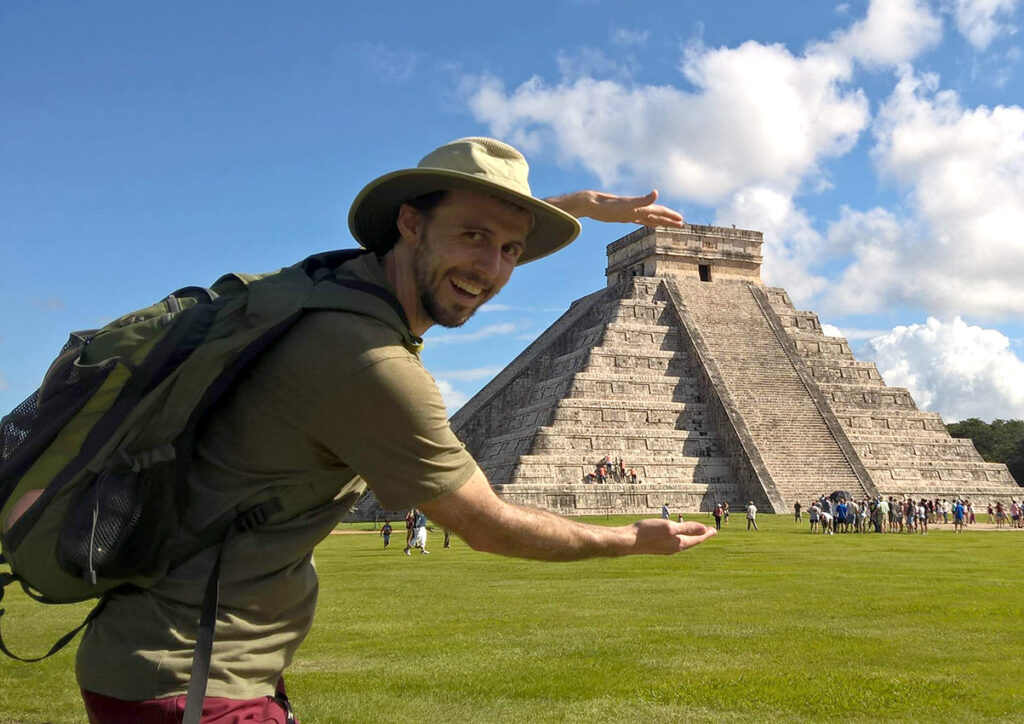
A gunman opened fire on tourists atop the Pyramid of the Moon at Teotihuacan on Monday, April 20, killing a Canadian woman and wounding at least 13 others before taking his own life. The attack sent shockwaves through Mexico’s tourism sector and triggered an immediate security response nearly 1,200 miles away, at Chichén Itzá in Yucatán.
By Tuesday morning, officials at Chichén Itzá had implemented a temporary ban on backpacks at the ancient Maya site — one of the most visited archaeological zones in the Americas. Guadalupe Espinosa Rodríguez, director of the Chichén Itzá archaeological zone, confirmed the measure would run at least through April 22, with a possible extension through the end of the week.
The Teotihuacan attack was carried out by Julio César Jasso Ramírez, a 27-year-old Mexican national from Mexico City, according to the State of Mexico attorney general’s office. Authorities say he arrived at the site by rideshare the previous day and checked into a nearby hotel. Shortly before noon Monday, he climbed to the summit of the Pyramid of the Moon and began shooting at visitors below with a .38-caliber revolver, holding a bag containing 52 cartridges. When National Guard personnel arrived and confronted him, he exchanged fire with them and was wounded in the leg. At 11:45 a.m., he took his own life.
Seven people suffered gunshot wounds; six others were injured falling while trying to flee. The dead tourist, whose name has not been released, was 32 years old. Among the wounded were six Americans, three Colombians, two Brazilians, a Dutch national, a Russian, and a second Canadian. A child of six was among those hurt.
Investigators later found in the attacker’s backpack handwritten notes and printed materials referencing mass shootings carried out in the United States in April 1999 — the month of the Columbine High School massacre, whose 27th anniversary fell on the day of the attack.
At Chichén Itzá, Espinosa Rodríguez said the backpack restriction was a precautionary measure directly tied to the tragedy. Visitors arriving with backpacks must leave them in their vehicles or place them in the custody of security personnel or National Guard troops stationed at the entrance. Only small handbags are permitted inside the site, subject to inspection.
The director noted that bag checks are already a daily routine at Chichén Itzá, conducted by the National Guard under established protocols. She said those inspections have already resulted in the confiscation of unauthorized items. David Escalante, director of the Patronato Cultur de Yucatán, which administers the site in partnership with INAH, said Chichén Itzá has always maintained strict entry controls. He added that both Cultur and INAH personnel are being reinforced to prevent any armed individual from gaining access.
Officials from both agencies also announced plans to install airport-style metal detectors and X-ray scanners as a longer-term upgrade to site security. Tourists at Chichén Itzá responded to the tighter protocols with cooperation, according to site officials.
The attack at Teotihuacan has landed at a particularly sensitive moment. Mexico, the United States, and Canada are co-hosting the 2026 FIFA World Cup this summer, and security at major tourist destinations is drawing heightened scrutiny. Mexico’s security secretary, Omar García Harfuch, said in the wake of the shooting that prominent tourist sites would see increased deployment of both ground forces and digital surveillance.
Chichén Itzá drew more than four million visitors in 2025, making it the most visited archaeological site in Mexico that year. For tips on what to expect at the site, including rules around prohibited items, see our Chichén Itzá guide.
Fast Facts
- A gunman killed a Canadian tourist and wounded 13 others at Teotihuacan on April 20, 2026
- The attacker, identified as Julio César Jasso Ramírez, 27, fired from the top of the Pyramid of the Moon before killing himself
- Six Americans were among the wounded
- Chichén Itzá banned backpacks effective April 21, at minimum through April 22, possibly through the weekend
- Only small handbags, subject to inspection, are permitted inside the site during the restriction
- Visitors with backpacks must leave them in their vehicles or with National Guard custody
- INAH and Cultur plan to install airport-style scanners as a longer-term security measure
- Chichén Itzá received more than four million visitors in 2025
Sources: La Jornada, NPR, CNN, CBC News