

The death of Nemesio Rubén Oseguera Cervantes — the notorious cartel boss known as “El Mencho” — sent shockwaves across Mexico on Sunday, and the Yucatán Peninsula was not spared. While Quintana Roo saw real violence in the form of arson attacks on vehicles and businesses, Yucatán’s public institutions spent much of the day beating back a flood of misinformation spread through social media.
Mexican army forces killed Oseguera Cervantes, 59, during a military operation in the town of Tapalpa, in the western state of Jalisco, on Sunday, February 22. He was wounded in a firefight and died while being flown to Mexico City. The operation — described by a former DEA official as one of the most significant actions in the history of drug enforcement — also left four cartel members dead at the scene, with two others dying during transport. Three members of Mexico’s armed forces were wounded. Armored vehicles, rocket launchers, and other heavy weapons were seized.
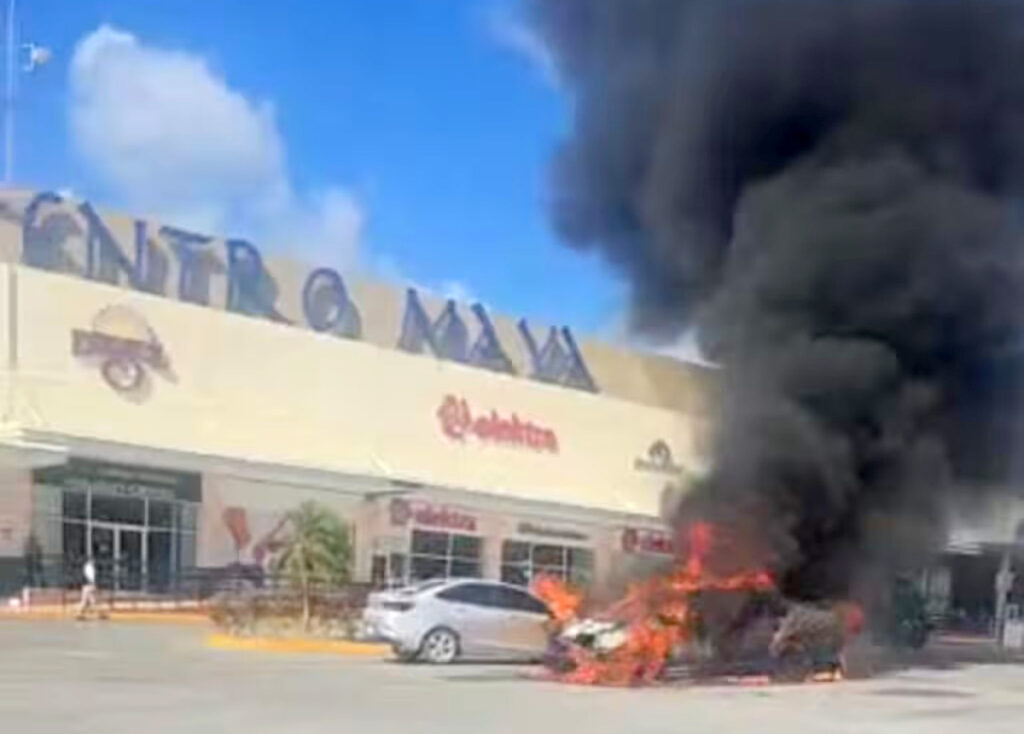
The retaliation was swift and nationwide. Cartel operatives torched cars and blocked highways in nearly a dozen states, from Jalisco to Tamaulipas. On the Yucatán Peninsula, the violence is concentrated primarily in Quintana Roo.
In Playa del Carmen, 2 cars were set ablaze in the parking lot of the Centro Maya shopping mall around 10:30 a.m. Another vehicle was torched near Plaza Las Americas, with witnesses describing men on a motorcycle as the suspects. At least 3 more vehicles were set on fire on Highway 180 between Cancún and Puerto Morelos, briefly shutting down one of the state’s main arteries. The National Guard helped reopen the road after firefighters extinguished the blaze.
In Tulum, arsonists doused the front of an OXXO convenience store in La Veleta neighborhood with gasoline before setting it alight. A second OXXO in the Ejido neighborhood was also targeted. Two employees were injured. At least 3 vehicles were set on fire on highways outside the town. A person was arrested in Cozumel in connection with a fire at a convenience store there, and a vehicle linked to the incident was seized.
Quintana Roo Governor Mara Lezama held an emergency security roundtable and deployed more than 10,000 security personnel across the state to protect tourist and residential zones. She also pushed back against false reports, including one claiming the hotel zone in Cancún had been shut down. Isla Mujeres, Cozumel, and other municipalities reported heightened patrols but said activities were proceeding normally. The Secretariat of Citizen Security of Quintana Roo (SSC) urged residents to report emergencies to 911 and to avoid spreading unverified information.
In neighboring Yucatán, the government had no real violence to report — but plenty of fiction to correct. The Secretaría de Seguridad Pública (SSP) confirmed that a video circulating on WhatsApp, purportedly showing a shootout near Cabo Norte close to Plaza La Isla in Mérida, was actually footage from another state. Fake audio files with supposed threats were also debunked. Two official agencies issued denials about entirely fabricated announcements: the Secretaría de Educación de Yucatán (Segey) denied rumors that schools had been suspended, and the Agencia de Transporte de Yucatán (ATY) confirmed that public transit was running normally. Governor Joaquín Díaz Mena expressed support for President Claudia Sheinbaum’s actions and urged residents to rely only on official channels.
The U.S. State Department directed government employees in Quintana Roo to shelter in place and issued broader travel warnings for Americans in several Mexican states. Multiple airlines, including Delta Air Lines and Air Canada, canceled or suspended flights to Puerto Vallarta and Guadalajara.
The Jalisco New Generation Cartel, known by its Spanish initials CJNG, co-founded by Oseguera Cervantes around 2007, became one of the most powerful drug trafficking organizations in Mexico. The U.S. Drug Enforcement Administration considered it a rival to the Sinaloa Cartel, with a presence in all 50 U.S. states. The cartel is a primary supplier of fentanyl, cocaine, and methamphetamine to the U.S. market. In February 2025, the Trump administration designated CJNG as a foreign terrorist organization. The U.S. had offered a $15 million reward for information leading to Oseguera’s arrest.
For more on the national picture, see Mexico Tribune’s coverage of the cartel raid and shelter-in-place warnings issued across Mexico.
President Sheinbaum, who has previously expressed skepticism about strategies that target individual cartel leaders — warning that they can fracture organizations and spark new cycles of violence — acknowledged the roadblocks and fires but called for calm. “There is absolute coordination with the governments of all states,” she wrote on X. “In the vast majority of the national territory, activities are proceeding with complete normality.”
Fast Facts: El Mencho and CJNG
- Nemesio Rubén Oseguera Cervantes (“El Mencho”), 59, co-founded the Jalisco New Generation Cartel (Cártel de Jalisco Nueva Generación, or CJNG) around 2007
- He was killed on February 22, 2026, during a Mexican military operation in Tapalpa, Jalisco; he died while being airlifted to Mexico City
- The U.S. State Department had offered a $15 million reward for information leading to his arrest
- The Trump administration designated CJNG a foreign terrorist organization in February 2025
- The DEA estimates CJNG has a presence in all 50 U.S. states and is responsible for a large share of fentanyl entering the country
- El Mencho’s son, Rubén Oseguera (“El Menchito”), was sentenced to life in prison in the U.S. in March 2025
- In Quintana Roo, more than a dozen vehicles and at least 2 businesses were set on fire in retaliation on Sunday
- Quintana Roo Governor Mara Lezama deployed more than 10,000 security personnel across the state
- Yucatán’s SSP debunked multiple pieces of false information circulating on WhatsApp, including fake video of a shootout and fabricated announcements about school closures and transit shutdowns
- U.S. government staff in Quintana Roo were directed to shelter in place; multiple airlines suspended flights to Guadalajara and Puerto Vallarta