

Mexico’s grid operator has signed a three-year deal with Turkish energy company Karpowership to deploy a floating power plant off the coast of Quintana Roo — a direct response to the chronic blackouts that have hammered the Peninsula in recent years.
The agreement was finalized with federal and state energy authorities, including CENACE, SENER, CFE, and the government of Quintana Roo. The 250 MW plant is described as a critical emergency intervention to mitigate seasonal blackouts and extreme grid stress. The deal runs through 2028.
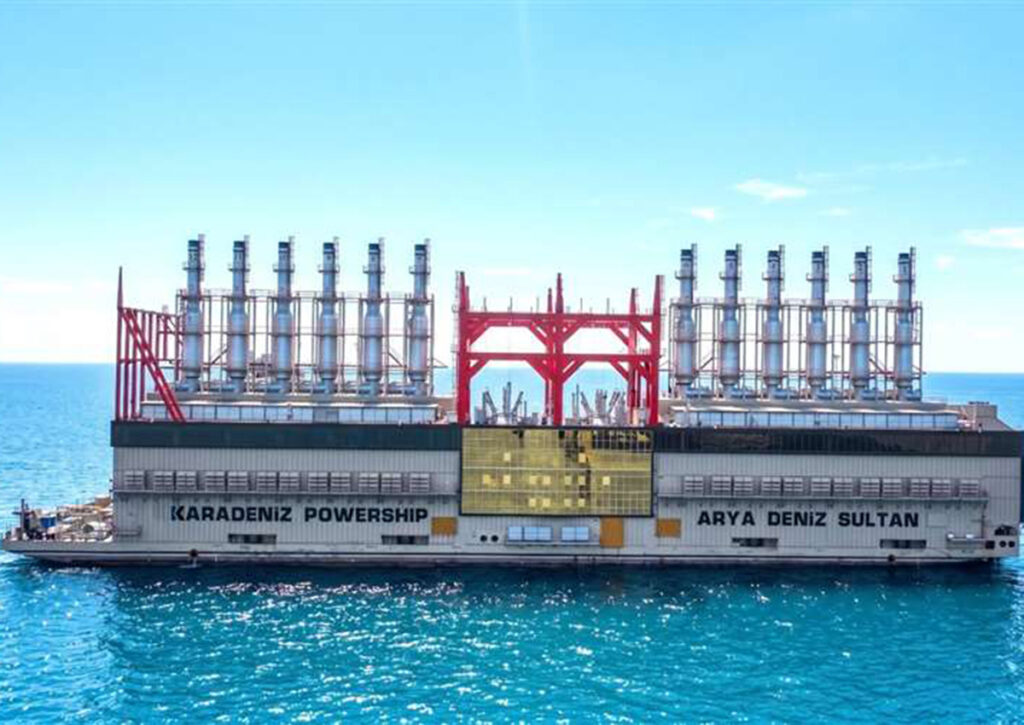
Under the agreement, Karpowership will deploy its powership Arya Deniz Sultan alongside an LNG Terminal Ship to provide dispatchable electricity to the peninsular subsystem.
How a Powership Works
The concept is unusual: the floating power plant is a ship fueled by another vessel outfitted as a liquefied natural gas terminal. That pairing means the operation can import its own fuel and generate electricity independently of existing pipeline infrastructure — a significant advantage in a region long plagued by gas supply problems.
The project will operate under environmental safeguards aligned with Mexican regulatory requirements, including oversight from SEMARNAT and ASEA, along with international maritime standards.
Both vessels are expected to arrive in Mexico in the coming weeks, with commercial operations set to begin in coordination with state and federal authorities. The company currently operates 45 powerships in 14 countries, with more than 8,500 MW of installed capacity.
A Grid Under Pressure
The deal comes as the Yucatán Peninsula faces what experts describe as a structural energy crisis. The region is projected to record the country’s highest growth in electricity demand at 3.8% annually through 2038, according to PRODESEN 2024–2038.
By the end of 2024, Yucatán, Campeche, and Quintana Roo together consumed roughly 2,416 megawatts of electricity per day but had only 1,818 megawatts of installed generation capacity. That gap has been widening for years, and the consequences have become hard to ignore.
During extreme heatwaves in May and June of 2024 and 2025, when temperatures soared above 45°C (113°F), demand from air conditioning and refrigeration spiked. Mérida alone suffered over 50 outages in a single month. A peninsula-wide blackout last September knocked out power to more than 2.2 million users across Campeche, Yucatán, and Quintana Roo.
The region’s vulnerability is partly structural. Limited high-voltage transmission lines have kept the peninsula physically isolated from Mexico’s National Interconnected System — a condition amplified by decades of underinvestment. The Yucatán grid has long depended on a single gas pipeline, the Mayakán, which has proven unreliable. A massive blackout in March 2025 was attributed in part to moisture in that pipeline affecting generation at the Nuevo Pemex cogeneration plant.
A Bridge, Not a Fix
Karpowership’s deployment is explicitly a short-term measure designed to provide operational resilience during peak demand — not a substitute for the longer-term grid investments that engineers and economists say the region urgently needs.
Other projects are in the pipeline. Yucatán state officials have pointed to the Mérida IV combined-cycle plant and a new Valladolid facility as longer-term solutions. Yucatán Magazine has covered the deeper structural challenges in a detailed analysis of the peninsula’s grid problems.
Karpowership’s expansion into Mexico builds on its broader growth strategy in the Americas. The company recently acquired a shipyard in Brownsville, Texas, and already operates projects in Brazil, Ecuador, Guyana, and the Dominican Republic.
For the Yucatán Peninsula — where summer heat, population growth, and tourism demand all converge on an already-strained grid — the floating plant represents an unusual but fast solution to a problem that has resisted easy answers for years.
Fast Facts
- Karpowership is deploying a 250 MW powership and a separate LNG terminal vessel to Quintana Roo’s coast
- The three-year agreement runs through 2028 and was signed with CENACE, SENER, CFE, and the Quintana Roo state government
- The powership is named Arya Deniz Sultan
- Both vessels are expected to arrive within weeks; commercial operations will begin in coordination with authorities
- The Yucatán Peninsula is projected to have Mexico’s fastest-growing electricity demand: 3.8% annually through 2038
- The deployment is described as an emergency measure to address seasonal blackouts, not a permanent infrastructure solution
- Karpowership operates 45 powerships in 14 countries with over 8,500 MW of installed capacity
Sources: Bloomberg, Offshore Energy, LNG Prime, Mexico Business News, Karpowership press release, Inspenet