

A Mérida-based human rights organization says it will deploy a team of trained observers at Sunday’s International Women’s Day march to document police conduct and ensure authorities don’t impede protesters’ right to demonstrate.
The Centro por la Justicia, Democracia e Igualdad (Center for Justice, Democracy, and Equality), known as Cejudi, announced the monitoring operation ahead of the annual march, set for Sunday, March 8, in Mérida. The contingent will depart from Parque de La Mejorada (La Mejorada Park) at 5 p.m. and proceed to the Monumento a la Patria (Monument to the Fatherland) on the Paseo de Montejo.
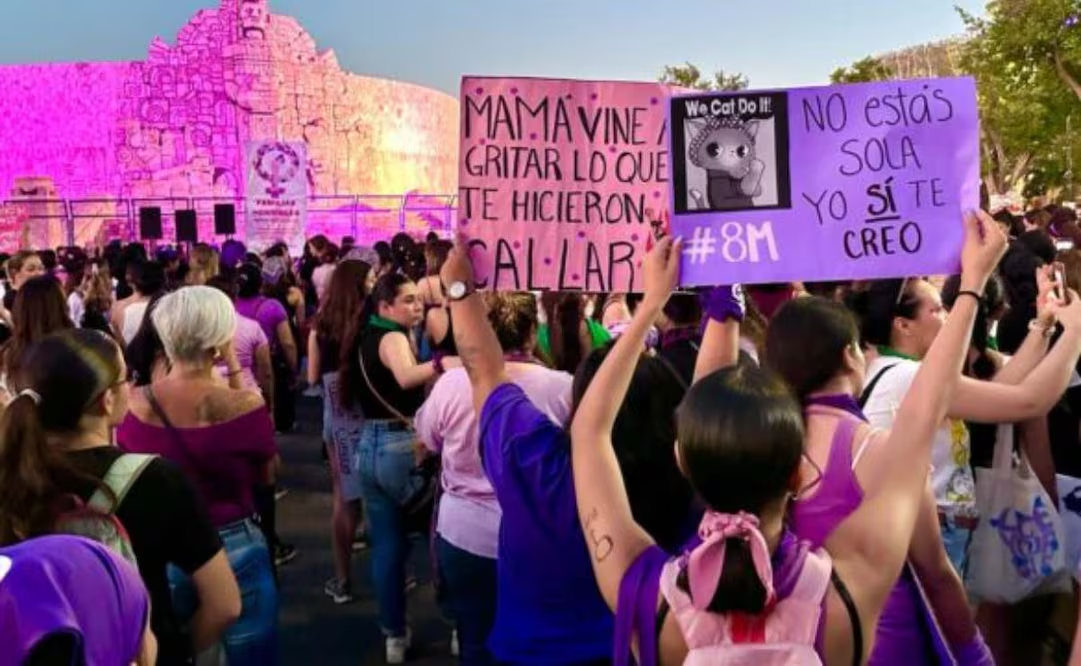
“The obligation of the authorities is to ensure the circulation and safety of all persons, not to prevent the progress of a demonstration,” said María Paula Balam Aguilar, Cejudi’s executive director.
Balam Aguilar said the observer team will track the full march route, paying particular attention to any actions that might violate participants’ human rights. She noted that last year, observers documented authorities using pressurized water against demonstrators — a practice Cejudi considers a form of repression that violates the right to protest.
Under established guidelines for feminist marches, Cejudi recommends that police escorts consist primarily of women officers, who should not carry firearms, must keep their faces uncovered, and must display visible identification. Cejudi has participated in feminist mobilizations for several years, verifying that freedoms of expression and assembly are protected and documenting how security operations are carried out.
A Different Tone This Year
This year’s lead-up to the march has a notably different feel than in years past. Both Mérida Mayor Cecilia Patrón Laviada and Yucatán Governor Joaquín Díaz Mena announced that neither the Palacio Municipal (City Hall) nor the Palacio de Gobierno (Government Palace) will be fenced off during the march. Patrón Laviada framed the decision in terms of her administration’s commitment to women, saying the building would remain open as “a space for women.” As of Saturday morning, none of the monuments along the Paseo de Montejo had been fenced in, either — a visible departure from the metal barriers that lined the boulevard in previous years.
The contrast with previous marches is stark. In 2025, authorities surrounded historic buildings and government offices with metal barriers, and clashes erupted when protesters pushed back against those barricades. Police deployed water against demonstrators, and at least seven historic monuments and buildings sustained damage. In 2024, feminist organizers alleged that an outside political group infiltrated the march and steered participants toward the city center, where vandalism occurred.
Mérida’s Catedral de San Ildefonso (Cathedral of Saint Ildefonso) is taking its own precautions regardless of what state and city authorities decide. The cathedral’s rector, Juan Pablo Moo Garrido, asked the state government to arrange protection for the building’s façades after extensive restoration work was completed in early March following a full year of repairs. The cathedral plans to modify Mass schedules on Sunday, closing around 2 p.m. to allow protection measures to be installed.
Historic structures in the vicinity of the route are also seeing some precautionary barriers. Wooden fencing has already been placed around the Ateneo Peninsular — home to the Museo del Tren Maya (Maya Train Museum) — to shield the heritage building.
This Year’s Message
The march’s organizing collectives have framed this year’s action around a slogan that links women’s rights with land rights: “Neither the land nor women are territory for conquest.” The statement draws a connection between gender-based violence and what organizers call the displacement of local communities by real estate development and other megaprojects. Groups taking part include We Are Women On Fire, Comando Trans Interseccional, Rueda de Mujeres, Red de Acompañamiento Yucatán, and Violetas Rebeldes, among others.
The march comes just weeks after Yucatán stiffened its penalties for femicide, raising the maximum sentence to 70 years under a decree signed by Governor Díaz Mena in February. The broader context for this year’s 8M march in Mexico reflects persistent concerns about gender violence across the country, with feminist collectives calling out what they describe as a worsening situation despite legislative gains.
M8 Mérida facts
- The International Women’s Day march in Mérida begins Sunday, March 8, at 5 p.m.
- Starting point: Parque de La Mejorada; ending point: Monumento a la Patria on the Paseo de Montejo
- Cejudi (Centro por la Justicia, Democracia e Igualdad) will deploy human rights observers along the route
- Neither the Palacio Municipal nor the Palacio de Gobierno will be fenced off
- As of Saturday morning, no monuments on the Paseo de Montejo had been fenced in
- The Catedral de San Ildefonso is expected to close around 2 p.m. and may be shielded by protective barriers
- The march’s central slogan: “Neither the land nor women are territory for conquest”
- Yucatán raised its maximum femicide sentence to 70 years in February 2026
Sources: El Universal, Diario de Yucatán, Quadratin Yucatán, Riviera Maya News