

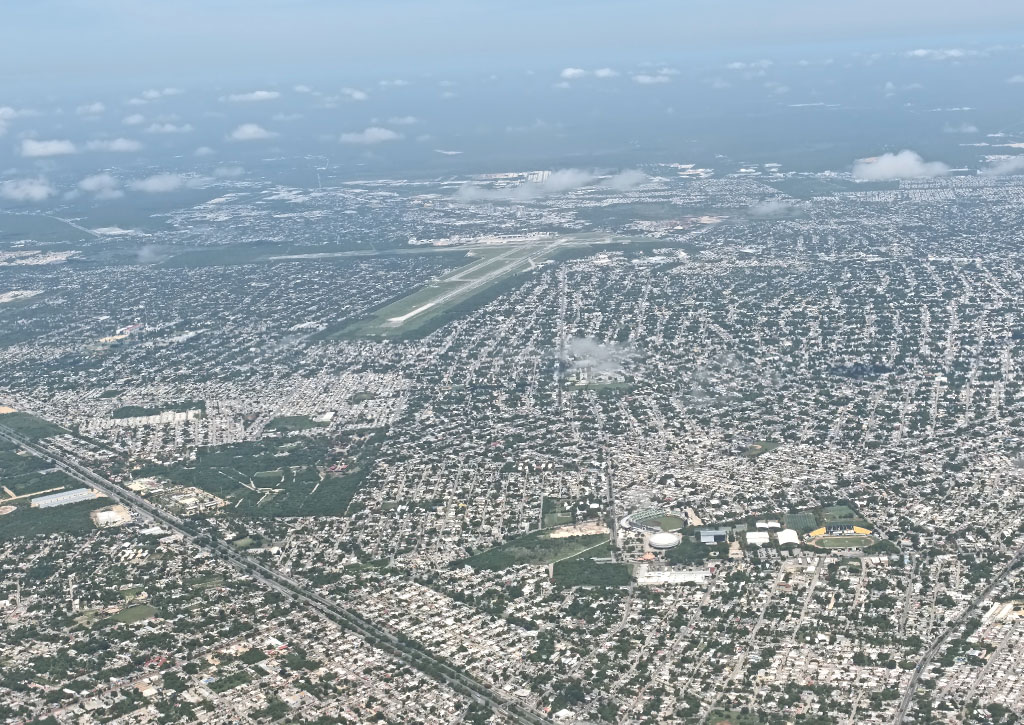
A report from Oxford University, published in the journal Sustainable Cities and Society, has reframed the debate with a stark warning for Mexico: Mérida, the capital of Yucatán, now ranks 47th among 205 cities worldwide in heat vulnerability.
The city sits ahead of metropolises in Mozambique, India, and Bangladesh, and close to Guayaquil, Ecuador. What makes this ranking particularly alarming is that Mérida has also landed among the ten most vulnerable tourist destinations and international business centers globally.
The Oxford researchers, led by Nethmi Jayaratne Kariyawasam of the Smith School of Enterprise and the Environment, found that Mérida faces what they describe as a “dangerous cocktail”: extreme heat combined with a rapidly aging population, a troubling lack of urban vegetation, and severe economic barriers to cooling.
The Concrete Sprawl
Mérida’s growth over the past two decades has been nothing short of explosive. Between 2000 and 2020, the city’s population surged from approximately 800,000 to 1.3 million people. But population growth tells only half the tale.
The built-up area of the metropolitan zone nearly doubled during the same period, expanding from 21,103 hectares to 42,186 hectares. More than 300 real estate developments have been planted across the landscape, concentrated especially in the city’s northern reaches. By 2020, more than a quarter of Mérida’s residents already lived beyond the traditional city limits.
This is not growth in the traditional sense of densification; it is sprawl, a low-density, car-dependent expansion that eats up the surrounding countryside and replaces it with concrete, asphalt, and tile roofs.
The urban footprint has expanded so dramatically that urban density actually declined during this period, from 46 inhabitants per hectare in 2000 to 43.9 in 2020. More people, spread more thinly across a vastly larger territory..
The Urban Heat Island Effect
The physics of this transformation are unforgiving. Concrete, asphalt, and metal absorb and store solar radiation during the day, releasing it slowly through the night. This phenomenon, known as the urban heat island effect, can raise city temperatures by 3 to 5 degrees Celsius above those in surrounding rural areas.
In Mérida’s tropical climate, already characterized by high humidity and punishing solar radiation, this effect is amplified to dangerous extremes.
A 2024 study published in the journal Sensors used satellite imagery and machine learning to analyze land surface temperature patterns across the Mérida metropolitan area from 2001 to 2021.
The findings were stark: land surface temperatures rose steadily over the study period as the urban footprint expanded, with a correlation coefficient exceeding 0.8 between temperature increases and land-cover changes due to urbanization and deforestation.
If current trends continue, the study projects that the temperature differential between Mérida and its rural surroundings will reach 3.12 degrees Celsius ±1.111 degrees) by 2030.
Vanishing Canopy
Perhaps the most consequential aspect of Mérida’s urban sprawl is what has been lost in the process. The city’s traditional architecture and urban form once incorporated abundant vegetation, shaded patios, tree-lined streets, and low-thermal-mass construction.
The recent building boom has systematically erased these adaptations. New developments are often constructed on land stripped entirely of trees with vast expanses of pavement and concrete, and minimal shade.
According to Dr. José Luis Hernández Estefanoni of the Center for Scientific Research of Yucatán (CICY), areas of new urban development on the city’s periphery register temperatures up to 10 degrees Celsius higher than neighborhoods that retain vegetation and trees. “In areas where they removed all the trees, and there is no shade,” he explains, “the ground reaches much higher temperatures than in neighborhoods with backyards and trees”.
The disparity is not random; it is a pattern of environmental segregation. Wealthier neighborhoods often retain more tree cover and green space, while lower-income areas on the expanding periphery are left exposed to the full force of the sun. The Oxford study explicitly noted that Mérida’s “lack of uniform tree cover unfortunately favors urban segregation.”