

A Mérida journalist was physically blocked and pushed by state police officers while covering a multi-vehicle accident last Friday, drawing condemnation from press freedom advocates and raising fresh questions about how authorities handle media access in Mexico.
Gabriel Jesús Chan Uicab, a crime and public safety reporter for Diario de Yucatán, arrived April 10 to cover a chain-reaction crash at the kilometer 6 overpass of Mérida’s peripheral road. An SSP patrol vehicle — unit 8115, assigned to highway surveillance, had been involved in the collision, which injured at least one person, a 26-year-old woman who was taken for medical treatment and later reported out of danger.
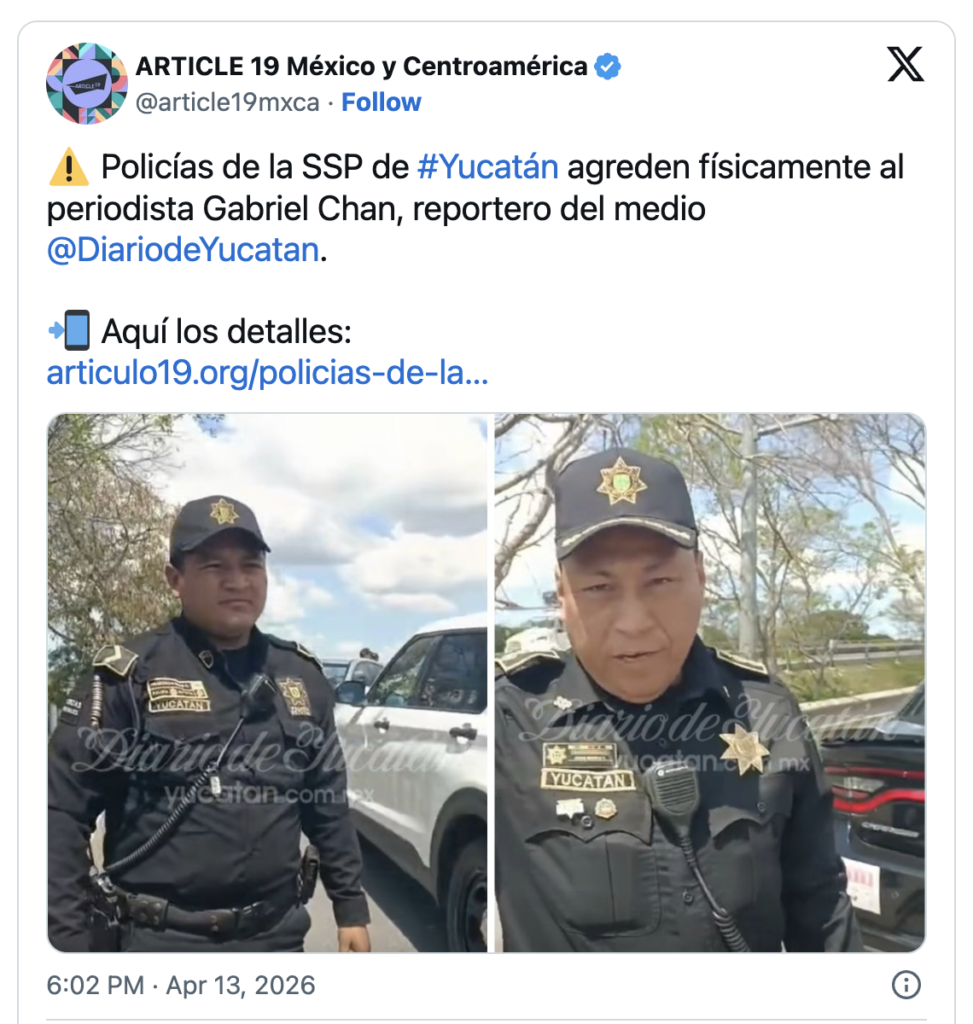
When Chan Uicab approached the scene to begin recording, officers had placed traffic cones around the site. One officer told him he was not allowed to take photos and ordered him to leave, citing the cones as a perimeter. When he tried to continue working, a second officer attempted to grab his cellphone and shoved him. The deputy traffic secretary, Jesús Novelo Chan, stepped in to stop the attack. Even so, a commander then put an arm around the reporter’s torso and forcibly moved him away from the scene.
The incident added another layer of controversy: some media outlets initially reported that Luis Felipe Saidén Ojeda, head of Yucatán’s Public Security Secretariat, had been involved in the crash. The SSP flatly denied that claim in an official statement, saying Saidén Ojeda was inside the Secretariat building when the accident occurred, and criticized those reports as “irresponsible and sensationalist.” The officer involved in the confrontation with Chan Uicab has been referred to the department’s Internal Affairs unit.
Press freedom organization Artículo 19 condemned the assault and called on Yucatán authorities to guarantee that journalists can report freely. The group stressed that blocking the press through physical force undermines the public’s right to information.
The incident was not Chan Uicab’s first run-in with police while working. It is at least the third time in his more than a decade covering public safety and crime that officers have detained or physically interfered with his reporting.
The broader picture for journalists in Mexico is grim. The country consistently ranks among the most dangerous in the world for reporters, driven by organized crime and, as this episode illustrates, at times by the authorities themselves. Reporters Without Borders recorded eight journalist murders in Mexico alone in the first seven months of 2025. While Yucatán has generally been spared the cartel-driven violence that makes other Mexican states deadly for reporters, interference by police — including physical altercations during news coverage — is not unheard of even here.
Mexico’s federal government established a protection mechanism for journalists in 2012, but press freedom groups have long criticized it as understaffed and slow to respond. Attacks against reporters at the state and local level frequently go unpunished.
Local journalists who cover crime, accidents, and government accountability often work in precarious conditions, and incidents like this one make clear that even a routine traffic call can carry professional risk.
Read more: Yucatán Magazine has covered the challenges of journalism and local media in recent reporting.
Related: Reporters Without Borders tracks press freedom conditions in Mexico in detail.
Fast Facts
- Reporter Gabriel Jesús Chan Uicab covers crime and public safety for Diario de Yucatán and has worked in Mérida journalism since 2011.
- The incident occurred April 10 at the kilometer 6 overpass on Mérida’s peripheral road in the Dzununcán area.
- SSP patrol vehicle No. 8115 was involved in the chain-reaction crash; one person was injured and treated.
- The SSP denied that Secretariat head Luis Felipe Saidén Ojeda was present or involved in the accident.
- The officer who physically confronted Chan Uicab has been referred to the Internal Affairs department.
- Press freedom group Artículo 19 condemned the assault and called on authorities to protect media access.
- Mexico ranked among the world’s most dangerous countries for journalists in 2025, with eight murders recorded in just the first half of the year.
Sources: LatAm Journalism Review, Diario de Yucatán, Haz Ruido, Reporters Without Borders