

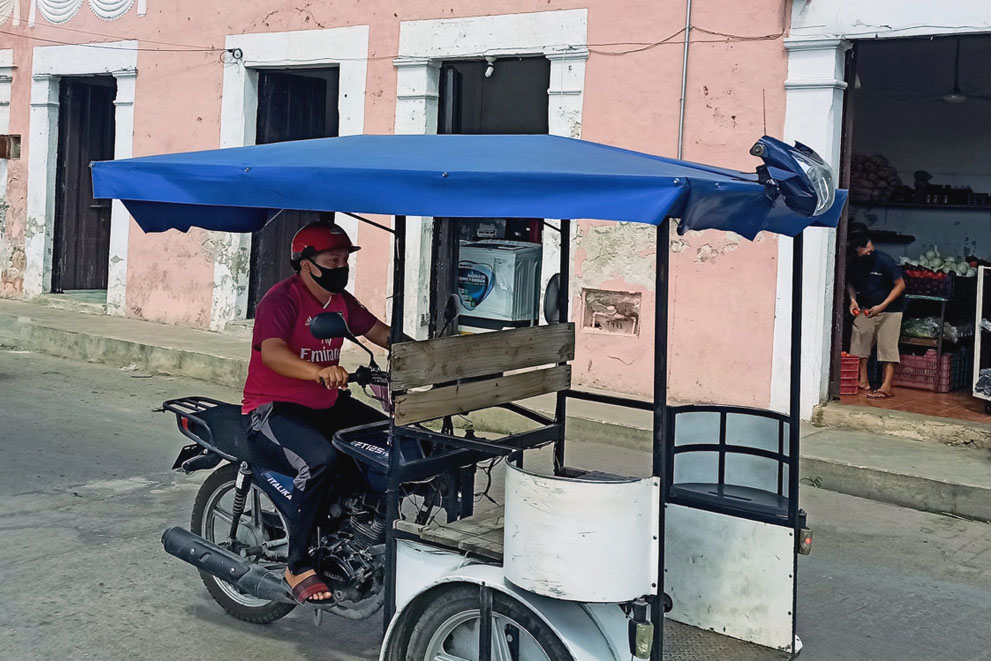
Facing what it describes as “exponential, disorderly, anarchic” growth in the number of moto-taxis operating throughout the city, the Yucatán state government has established a new commission to regulate, order, and modernize the popular but largely informal transportation service.
The agreement, published Monday in the state’s official gazette, creates the Commission for the Regulation, Ordering, and Modernization of the Moto-Taxi in the Municipality of Mérida. The move comes as the three-wheeled vehicles have proliferated far beyond the last official count of 1,320 units in 2021—a figure that experts and union leaders now say represents a fraction of the actual number in circulation.
The commission will function as an intergovernmental advisory body within the Yucatán Transportation Agency (ATY). While its recommendations are non-binding, it brings together officials from multiple state agencies—including public security, sustainable development, health, and urban mobility—to develop technical proposals for delineating operating zones, establishing safety standards, and potentially integrating motorized taxis into the broader public transit system.
Economic Pressures Fuel Unregulated Growth
The explosion in moto-taxi numbers reflects deeper economic and social transformations reshaping the Mérida metropolitan area. Union representatives now estimate that between 15,000 and 18,000 moto-taxis operate in the municipalities of Umán and Kanasín alone—working-class suburbs that have experienced rapid population growth as Mérida’s urban footprint expands.
According to José Manuel Peniche Marenco, leader of the Autonomous Confederation of Workers and Employees of Mexico (CATEM) in Yucatán, which represents some 650 moto-taxi operators, the sector’s expansion has been fueled by economic precarity. Many operators lack access to formal employment and turn to moto-taxis as a survival strategy.
“There is a mafia that has up to 300 moto-taxis and offers them to workers for 300 pesos a day,” Peniche Marenco said, describing a system where drivers rent vehicles under exploitative conditions rather than owning them. The lack of official recognition means operators have no access to credit or financing to purchase their own vehicles, trapping many in a cycle of debt and informal labor.
The broader context of platform-based work adds another layer of complexity. An estimated 60,000 people in Mérida now work through digital platforms, with some 19,000 using motorcycles for ride-hailing and delivery services. While moto-taxis operate independently of app-based platforms, they compete in the same niche of affordable, nimble urban transport—a space where regulation has lagged far behind growth.
Safety, Environmental, and Labor Challenges
The proliferation of motor-taxis raises significant safety concerns. Research published in the journal Energy for Sustainable Development notes that moto-taxis have been widely adopted across Mexico, particularly in peri-urban areas where conventional public transit is insufficient, but their expansion has occurred “without official regularization” in many states.
Safety advocates have long warned that motorcycle-based transport carries inherent risks. In 2022, when Uber Moto launched in Mérida, the Sustainable Mobility Observatory noted that motorcyclists represented up to 33 percent of traffic fatalities in the municipality, warning that two-wheeled vehicles are “more prone to invade lanes and commit other abusive and risky behaviors”.
The new commission’s mandate explicitly includes developing safety protocols for both users and operators, as well as identifying “areas of opportunity and specific problems” within the service.
Environmental considerations are also driving the push for modernization. A comprehensive life-cycle assessment comparing gasoline and electric moto-taxis in Yucatán found that electric models—particularly those using lithium-ion batteries—have significantly lower environmental impacts than their gasoline counterparts. The study, published in late 2024, noted that electric moto-taxis could reduce ecosystem damage by more than two-thirds compared to gasoline-powered units, though it cautioned that the benefits depend heavily on transitioning the region’s electricity grid toward renewable sources.
Toward Formal Recognition
The commission’s creation follows years of advocacy by moto-taxi operators seeking legal recognition. CATEM’s Peniche Marenco said authorities have long “kicked the can down the road” by refusing to formally acknowledge the sector. He called for a three-step process: defining the appropriate vehicle type, establishing insurance requirements, and amending state law to incorporate moto-taxis as a recognized transport mode.
The commission is scheduled to begin operations within 15 business days. Its formation coincides with broader debates over transportation equity in Yucatán. Traditional taxi drivers have also mobilized recently against what they call “unfair competition” from digital platforms, forming a united front across the Yucatán Peninsula to demand equal tax treatment and regulation.
For moto-taxi operators, the stakes are immediate. The ATY has indicated that certificates issued through the regularization process will be one-year operating permits rather than permanent concessions, allowing for ongoing supervision as the sector modernizes.
Whether the commission’s recommendations will translate into concrete policy—and whether operators facing daily economic pressures can afford the transition to safer, cleaner vehicles—remains to be seen. But after years of operating in a legal gray zone, both drivers and city officials acknowledge that the era of unchecked growth is ending.