

Mexico’s war on drugs has intensified, and a checkpoint in Mérida has already yielded a sizable seizure.
A multi-agency operation at a security checkpoint at the Teya overpass netted approximately 120 kilograms of marijuana and one arrest on Monday — a routine-looking bust that comes as Mexico navigates the turbulent aftermath of the death of one of its most powerful cartel bosses.
Federal and state forces stopped a rented truck on the northern edge of the city after the driver refused to cooperate with a routine inspection. K-9 units were called in and quickly detected the drugs, described by El Universal as dried plant material consistent with marijuana. The vehicle belonged to a private company. A man identified only as Marco G.O. was detained.
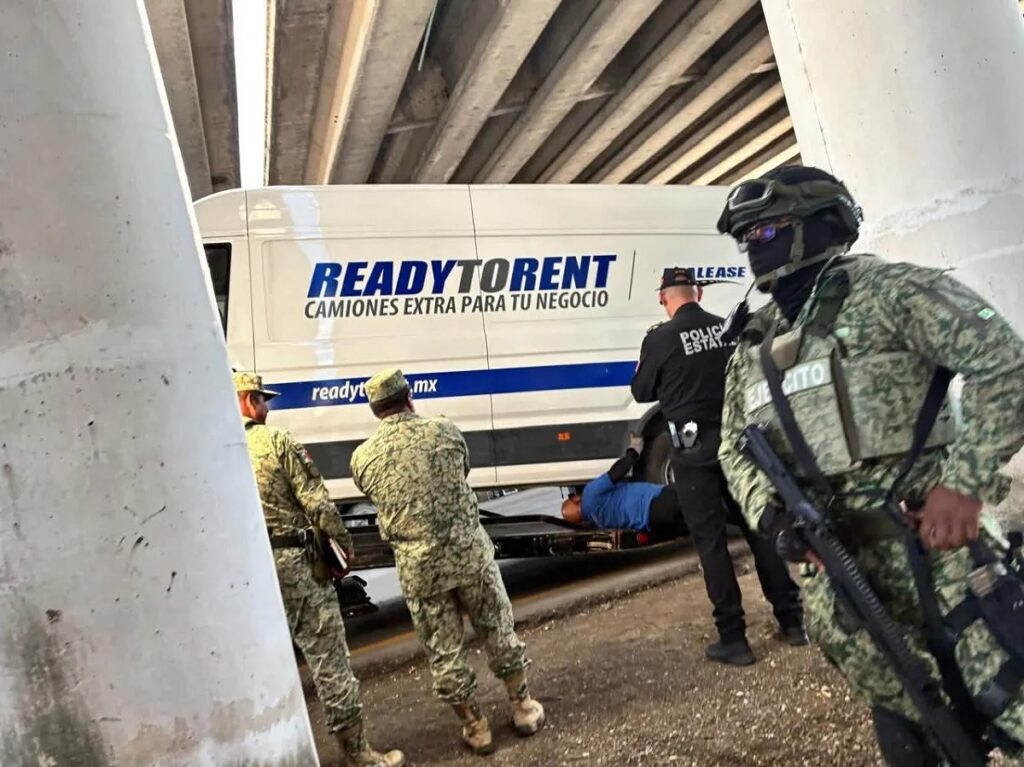
The Mexican Army, the Guardia Nacional (National Guard), and the Secretaría de Seguridad Pública (Secretariat of Public Security), or SSP, are handling the case. The drugs are to be turned over to the Fiscalía General de la República (FGR), the federal attorney general’s office, for formal processing.
During the same operation, agents from the Instituto Nacional de Migración (National Migration Institute) inspected buses arriving from Quintana Roo. One person was detained for failing to prove legal residency and was transferred to immigration offices in Mérida.
A Broader Moment for Mexican Security
The seizure comes two days after the Mexican Army killed Nemesio “El Mencho” Oseguera Cervantes, the founder and leader of the Cártel de Jalisco Nueva Generación (Jalisco New Generation Cartel), or CJNG, during an operation in the western state of Jalisco on Feb. 22. His death set off a wave of roadblocks, arson, and armed clashes in several Mexican states, raising questions about what comes next for the cartel’s fractured leadership.
The CJNG had been designated a foreign terrorist organization by the U.S. State Department in February 2025. Intelligence reports and DEA assessments have noted the cartel’s presence across much of Mexico, including the Yucatán Peninsula, where it has competed for influence against the Sinaloa Cartel and Gulf Cartel factions in areas including Mérida, Progreso, and Tizimín.
Yucatán is not a major trafficking hub compared to border states or the Caribbean coast, but it sits along routes used to move drugs and migrants from Central and South America northward. Security analysts note that the peninsula’s main illicit attractions for organized crime are extortion of the tourism industry and human trafficking, rather than the open territorial warfare seen in states like Colima or Zacatecas.
Despite that, Yucatán has long maintained one of the lowest violent crime rates in Mexico, and Mérida regularly ranks among the safest large cities in the Americas. The U.S. State Department maintains a Level 1 travel advisory for Yucatán — the safest tier — a distinction shared only with Campeche among Mexican states.
The Teya checkpoint, located where several major highways converge on the approach to Mérida, has been the site of previous significant seizures. In November 2025, a similar joint operation on the Mérida-Campeche highway resulted in the confiscation of roughly 500 kilograms of marijuana, crystal meth, and crack cocaine from a cargo truck traveling from Jalisco toward Quintana Roo.
With El Mencho gone and no clear successor established, security experts warn of possible fragmentation within the CJNG and competition for control of trafficking routes — a dynamic that historically drives violence up before it comes back down. For now, Yucatán’s security forces appear focused on maintaining the checkpoints and joint operations that have made the state a harder target than most.
Fast Facts
- Approximately 120 kilograms (about 265 pounds) of marijuana-like substance seized
- One suspect, identified as Marco G.O., arrested at the scene
- Checkpoint location: beneath the Teya bridge, northern Mérida
- Agencies involved: Mexican Army, National Guard, SSP Yucatán, FGR, INM
- A second person was detained separately for immigration violations
- CJNG leader “El Mencho” was killed by the Mexican Army on Feb. 22, 2026
- The U.S. State Department designated CJNG a foreign terrorist organization in February 2025
- Yucatán holds a U.S. State Department Level 1 travel advisory — the safest rating