

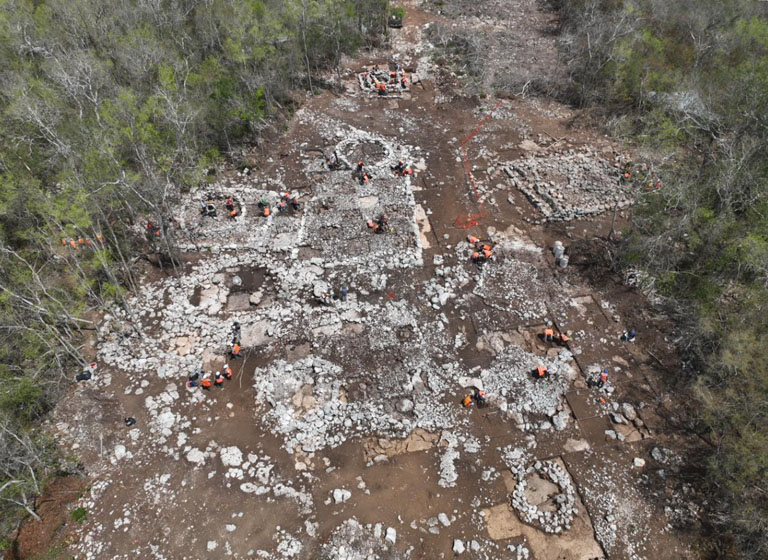
Archaeological salvage work tied to the Maya Train’s new cargo route has uncovered significant Maya remains near Poxilá, Yucatán. The discoveries include a ritual-residential structure from the Classic period (400-750 AD) and a Preclassic ballcourt. The work is conducted by Mexico’s National Institute of Anthropology and History (INAH).
One of the most significant structures uncovered is a structure measuring 6 by 6 meters. An offering comprising a vessel and a string of shell and green stone beads found in a nearby domestic structure dates the occupation to the Classic period (400-750 A.D).
A Household with a Special Purpose
The site, nicknamed “panadero,” is not dominated by a massive pyramid complex or large civic center. Instead, it was a domestic unit—essentially a residential group—where a small community lived. The layout follows a typical pattern for the era: several structures built around central patios or courtyards.
The builders constructed their homes using roughly shaped local limestone. Today, only the foundations, low wall alignments, and doorways remain as evidence of the dwellings.
However, one specific building stood out to the researchers. While most of the excavated rooms were strictly residential, one particular structure has a design that suggests it served a different purpose.
Near the site, researchers also recently uncovered a Maya ballcourt dated somewhere between 800 and 900 B.C.E. It is unclear if this ballcourt was part of the previously mentioned settlement or another nearby, and much more ancient site within the walls of Hacienda Poxilá.
Evidence of Maya Ritual Use
The structure in question is a square building measuring 6 by 6 meters. Unlike the simple living spaces, this one has three distinct levels, or tiers, stacked on top of each other. On the south side, a low stone bench (a “banqueta”) was built against the wall, providing a view over the rest of the residential group.
On the second level of this platform, the team found evidence of a small room that was likely built using wooden poles and other perishable materials, which have since decayed.
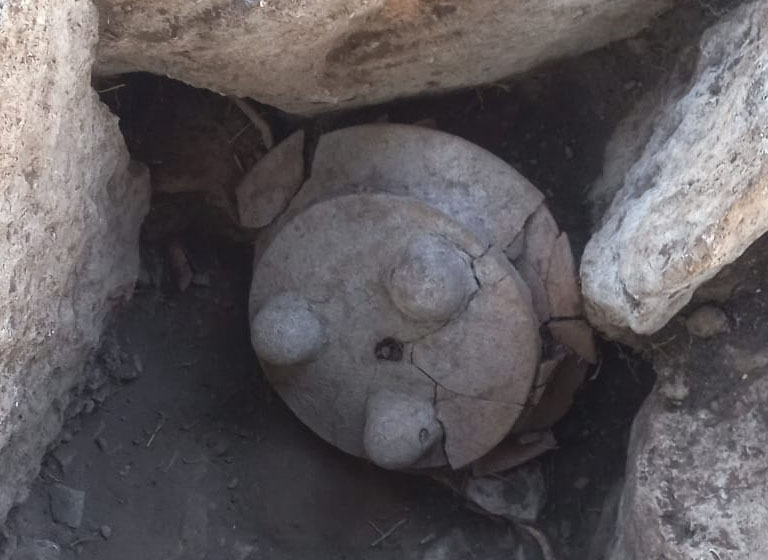
Near the center of this structure, archaeologists discovered a small limestone disk known as a “panucho,” which served as a lid for a “jobón” (a hollowed-out log used as a beehive). To the south of the same area, they found an arrangement of three flat stones.
According to José Luis Díaz Cruz, the archaeologist who led the excavation of this specific building, these features do not match typical domestic architecture. Susana Echeverría Castillo notes that given the shape, size, and location of this building within the residential area, “it must have been intended for functions related to the ideology and beliefs of the group that lived there.”
Dating the Discovery
The researchers found an offering inside one of the domestic structures that helps establish a timeline. This offering consisted of a ceramic vessel and a string of beads made from shell and green stone.
Based on this evidence, archaeologists estimate that the settlement was inhabited during the Maya Classic period, specifically between 400 and 750 A.D.
Maya Ancient Trade Networks
Researchers do not believe this household existed in isolation. Echeverría Castillo contextualizes the find by linking it to other contemporary settlements discovered in the region, such as those found on the grounds of the Yucatán Scientific and Technological Park.
The theory is that these smaller sites, including the newly discovered one, were likely connected to the ancient commercial city of Chunchucmil. During the Classic period, Chunchucmil was a sprawling city that functioned as a major trade hub. It was strategically located to connect the Gulf Coast, where communities harvested salt and fish, with smaller inland farming communities and larger regional centers, such as Oxkintok.
Preservation Efforts
Because the construction of the service road for the train cannot be moved, the INAH has proposed a plan to preserve the unique ritual structure in place. Rather than moving the stones, the team intends to cover the structure with a protective layer of geotextile fabric. This technique will safeguard the ancient altar from damage while allowing the railway construction to proceed above it.