

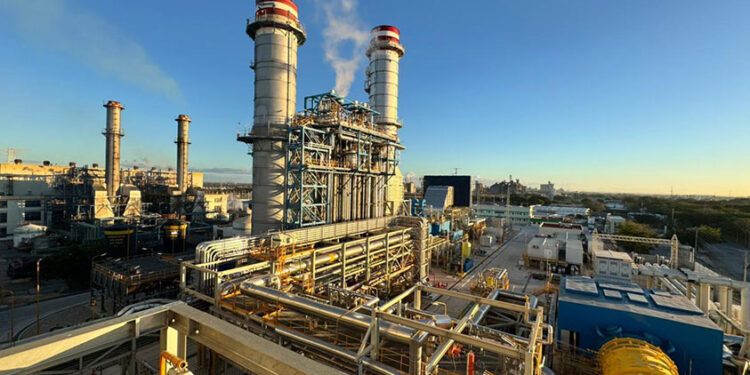
After four years of construction and a string of missed deadlines, a new natural-gas power plant has finally come online in Mérida — and for the hundreds of thousands of Yucatán residents who have endured years of blackouts, brownouts, and rolling outages, it can’t come soon enough.
Mexico’s state power company, CFE, reported that the Central de Ciclo Combinado “Elvia Carrillo Puerto” began operating at midnight on May 12. The facility has a net installed capacity of 499 MW and sits within the existing Mérida thermoelectric complex on the city’s outskirts. CFE says the plant will serve more than 1.53 million residents across the region.
The announcement came five days after CFE Director General Emilia Esther Calleja Alor revealed the plant’s opening date — and its new name — during President Claudia Sheinbaum’s morning press briefing.
Why have customers been waiting
The Yucatán Peninsula has long operated as what energy experts call an “energy island” — largely cut off from Mexico’s national power grid and dependent on its own strained generation capacity. By the end of 2024, the three Peninsula states consumed roughly 2,416 MW of electricity daily but had only about 1,818 MW of installed capacity, according to CFE data. That shortfall has meant years of outages that damaged appliances, disrupted businesses, and left neighborhoods without power for hours at a stretch during the hottest months.
Demand on the Peninsula grows at roughly 10% per year — the highest rate in the country — driven by population growth, heavy air conditioning use during increasingly brutal summers, and large infrastructure projects including the Mayan Train. In March 2025, a massive blackout knocked out power across the Peninsula and Tabasco after moisture compromised the quality of natural gas flowing through the Mayakán pipeline. Residents of some Mérida neighborhoods have reported outages lasting more than 12 hours, and protests against the CFE have flared repeatedly in recent years.
Small businesses have borne a significant share of the pain. Losses of up to MX$45,000 (roughly US$2,600) per blackout incident have been reported, with industrial operations in Progreso and Valladolid also suffering damaged equipment and interrupted production. For investors and businesses considering the Peninsula, unreliable power has been among their top concerns.
The new 499 MW plant represents the largest single addition to the Peninsula’s generating capacity in years — enough to meaningfully shift the balance between supply and demand, though experts have cautioned that aging distribution infrastructure and gas supply vulnerabilities remain separate problems that the new plant alone won’t solve.
The plant itself
Construction began in 2022 under the previous administration of Andrés Manuel López Obrador. The project missed multiple deadlines — originally expected to open in November 2024, then pushed to October 2025 — before finally going live this month. The infrastructure includes a combined-cycle generating unit and two electrical substations operating at 115 and 230 kilovolt tension levels. CFE says it completed a full design review and equipment testing process overseen by Cenace, the national energy control authority, before connecting the facility to the national grid.
The plant runs on natural gas and, by CFE’s own projections, will prevent the emission of 1.49 million metric tons of CO₂ per year — the equivalent of removing roughly 319,000 cars from circulation. Officials say its design includes measures to protect the local aquifer.
More capacity on the way — eventually
Officials say the Mérida plant, combined with a second facility under construction near Valladolid, is also intended to provide the power needed to electrify the Mayan Train, which currently runs on diesel. The Valladolid plant, called “Riviera Maya,” will have a capacity of 1,020 MW. Its completion date remains uncertain — originally expected in January 2025, then pushed to late 2027, with no firm timeline currently on record.
The plant’s formal name honors Elvia Carrillo Puerto, a Yucatecan activist born in 1878 who became one of Mexico’s most prominent early feminists. She founded the country’s first feminist leagues, fought for women’s suffrage, and in 1923 became the first woman elected to the Yucatán state legislature. Her work is widely credited as instrumental in the eventual passage of national women’s suffrage in 1953. She is buried in Mérida and was officially recognized as a Veteran of the Revolution.
Fast Facts
- The plant’s official name is Central de Ciclo Combinado “Elvia Carrillo Puerto”
- Capacity: 499 MW net
- Fuel source: natural gas
- Operations began: midnight, May 12, 2026
- Estimated beneficiaries: more than 1.53 million Peninsula residents
- Projected CO₂ reduction: 1.49 million metric tons per year
- Construction started: 2022; original opening target: November 2024
- A second plant, “Riviera Maya,” is under construction near Valladolid with a planned capacity of 1,020 MW; no firm completion date has been set
Sources: Diario de Yucatán, Yucatán Magazine