

A resident stood up at a community meeting in May 2022 and said what many in the room were feeling. Someone had just announced plans to build a 28-apartment, five-story building on a quiet street in their comisaría. “Do you have any idea of the aggression that feels like to the neighbors?” he asked.That meeting, held in the small municipal office of Santa Gertrudis Copó — a Maya community in Mérida’s northeast — became the starting point for a two-year academic study of how rapid, high-end real estate development is reshaping the lives of the people who were there first.
Copó, as it’s known locally, sits about 10 km (6 miles) from Mérida’s centro. Its name comes from kopo’, the Maya word for the white álamo tree (Ficus cotinifolia) that grows at the community’s heart. By 1995, it had been officially absorbed into Mérida’s urban footprint. But residents still think of it as a pueblo — a place with roots going back more than 2,300 years, first as a Maya settlement near the Prehispanic city of Ichcaanzihó, and later as a henequen hacienda whose laborers are still remembered by elders who worked the fields as children.
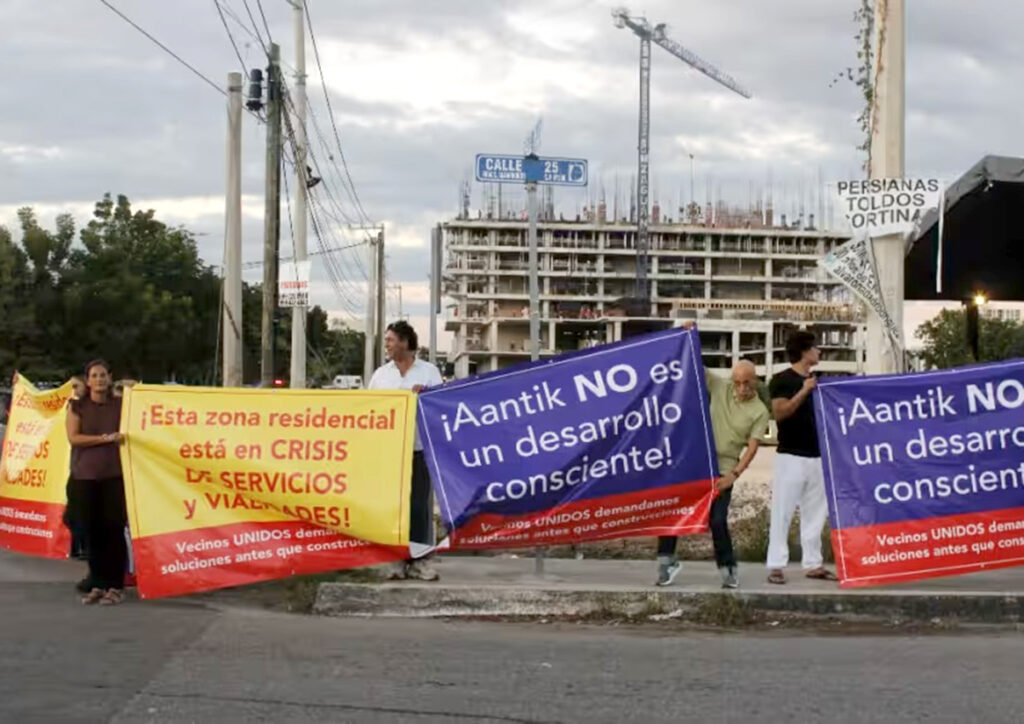
Today, Copó is surrounded by money it can’t access. A study by researchers from UADY and the Centro de Investigación y Estudios Avanzados (Cinvestav) found that real estate in the area ranges from MX$3.7 million (roughly US$185,000) for pre-sale apartments to MX$4–20 million (US$200,000–$1 million) for units in a planned mega-development, which would bring six 13-story towers to land straddling Copó and two neighboring communities. A community-led protest campaign managed to halt that project in late 2023 over missing land-use permits and environmental impact assessments — though promotional material for the units was still circulating after the work stoppage, possibly in violation of Yucatán real estate law.
Researcher Emily Robinson Talbot spent eight months doing fieldwork in Copó, conducting in-depth interviews with 17 long-term residents, attending ejido meetings, community assemblies, and the community’s Hanal Pixán celebration. What she and her co-authors found was not simple opposition to development, but a more complicated mix of feelings. Stress and sadness were the most frequently cited emotions in interviews. But residents also expressed pride, peace, and a sense of belonging that they described as rare. “Here people still come out to the front of their houses to gossip, to chat, to get some air,” said one participant, the community’s commissioner from 2018 to 2024. “In the city, people don’t even know each other anymore.”
More than half the impacts residents described were both positive and negative — a practical acknowledgment that some economic opportunity has arrived alongside the disruption. The issue isn’t development itself, but development that bypasses local input and pricing that excludes local buyers. Property taxes have doubled in some cases. Older infrastructure isn’t designed to handle the water and waste loads that come with multi-family towers.
About 42% of families in Copó in 2018 earned between MX$2,700 and MX$6,799 a month (roughly US$135–$340) — well below the state average. The same families watched 22 new condominium and apartment projects rise in their community between 2011 and 2023, with only one receiving formal authorization from Mérida’s urban development office.
Copó is not unique. The researchers name several other communities in Mérida’s metropolitan zone — Caucel, Dzityá, Cholul, Sitpach, Tamanché, and others — where vacancy rates in new developments exceed 11%. Across the wider metro zone, more than 61,000 housing units stood empty in the 2020 census, the bulk of them on the periphery. Developers keep building; the market keeps floating on speculation.
For the people of Copó, the question is whether they can hold enough of their community together to remain a community at all.
“Sometimes it bothers me,” one resident said, “because that land that those people are taking could have been given to people from here.”
For more on Mérida’s growth pressures, see our coverage of Greater Mérida’s metropolitan expansion.
Santa Gertrudis Copó: Key Facts
- Located in the northeast of Mérida, incorporated into the urban zone in 1995
- Name derives from kopo’, Maya for the white álamo tree (Ficus cotinifolia)
- Settlement history dates back more than 2,300 years
- In 2018: roughly 677 residents in 150 homes; median income well below the state average
- 22 condominium and apartment projects documented between 2011 and 2023; only one had formal city authorization
- 11%+ vacancy rate in new developments across the most affected comisarías
- One mega-project — six towers, 13 floors each — was halted in November 2023 over missing permits
Source: Cuadernos de Arquitectura de Yucatán, No. 38 (2025), UADY Faculty of Architecture; “Hay veces me molesta porque esa tierra que ocupan las personas se le podían dar a los de acá”: Impactos socioemocionales de la expansión urbana de alta plusvalía en Santa Gertrudis Copó” by Emily Robinson Talbot, María Teresa Castillo Burguete, Yolanda Fernández Martínez, and Almira Hoogesteyn Reul