

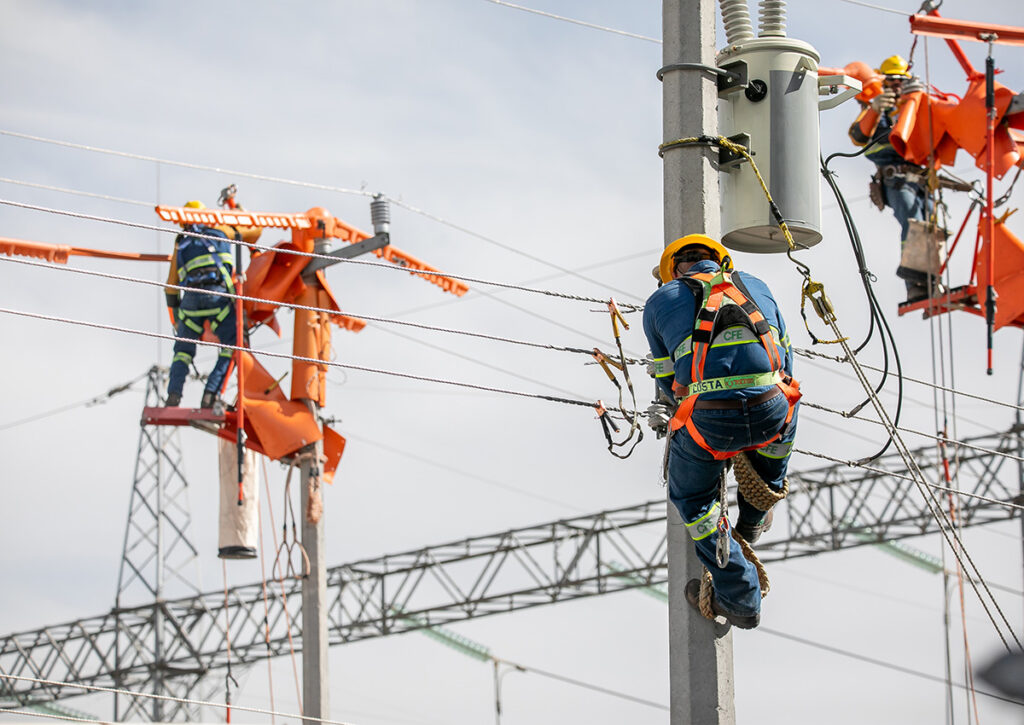
For years, the Yucatán Peninsula has operated as Mexico’s “energy island” — a fast-growing economic powerhouse tethered to the rest of the country by a single, fraying electrical umbilical cord. I have previously argued that this isolation has brought us to a breaking point, where the dream of a “Smart Grid” is constantly deferred by the reality of rolling blackouts and aging transformers.
Now, a new report from S&P Global Ratings suggests the Mexican government has finally looked at the bill for fixing this mess and realized it can’t pay it alone. The solution: a strategic pivot that invites private investors back into the fold — but only if they are willing to play by a very specific, and very restrictive, set of rules.
The Admission of Necessity
The math is staggering. To keep pace with national demand, Mexico needs to inject over $30 billion into power generation and another $12 billion into the transmission and distribution grid. For the CFE, an entity currently carrying roughly $85 billion in debt, these figures aren’t just a challenge — they are a mathematical impossibility.
In response, the Sheinbaum administration has unveiled a “54/46” joint-venture framework. The state retains the majority stake and the steering wheel, while private entities are invited to provide the capital, the technology, and the construction muscle for the remaining 46%.
For Yucatán, this isn’t just a policy shift; it’s a white flag. The government has essentially admitted that the “energy island” cannot be modernized through state decree alone.
Investing in the “Isolated Node”
The S&P report pulls no punches in its assessment of our region, explicitly labeling Yucatán an “isolated node.” While the rest of the country debates market share, our conversation is about survival. The report highlights that infrastructure constraints here currently limit the integration of new generation capacity.
This creates a paradoxical tension for the potential investor. The opportunity is clear: the peninsula is desperate for the solar and wind energy that private firms excel at building. But even if a private firm builds a state-of-the-art solar farm in Tizimín, the power has nowhere to go if the CFE-controlled transmission lines remain a bottleneck.
S&P’s cautious view reflects a hard truth: investor confidence, eroded by years of legal battles and canceled auctions, won’t be restored by a press release. Investors are looking for more than an invitation; they are looking for a guarantee that their 46% stake won’t be held hostage by a 54% majority that prioritizes political ideology over grid efficiency.
The Price of Control
The success of this new model hinges on the CFE’s creditworthiness. Because the CFE will be the primary buyer for at least 70% of the power generated by these new projects, the entire system’s stability is tied to the state’s ability to pay its bills.
In Yucatán, we have seen what happens when the grid fails. In September 2025, a high-voltage line failure left more than 2.2 million users across Yucatán, Campeche, and Quintana Roo without power for hours. We have felt the economic sting when that single 400 kV line from the north falters. If this new partnership model fails to attract the necessary billions, the peninsula will remain in a state of arrested development — growing at the speed of the 21st century but powered by a 20th-century mindset.
Looking Ahead
The question is no longer whether private capital is welcome in Yucatán — it’s whether it will be effective. A “Smart Grid” requires more than just new hardware; it requires a transparent market where electrons flow based on demand and efficiency, not just state-mandated quotas.
The government is finally inviting the world to help build the bridge to our energy future. But as long as the CFE holds the only key to the gate, Yucatán remains a peninsula waiting for a spark that the state alone can no longer provide.
Read more from David W, Keelan at Yucatán Magazine.
Breaking Down the Details
- Under Mexico’s 2024 energy reform, at least 54% of electricity on the national grid must come from CFE or state-affiliated sources; private producers are limited to 46%
- The Yucatán Peninsula relies on a single 400 kV transmission line connecting it to the rest of Mexico’s national grid
- By late 2024, the three peninsula states consumed roughly 2,416 MW daily but had only 1,818 MW of installed generation capacity — a shortfall of nearly 600 MW
- In September 2025, a transmission line failure left more than 2.2 million users across Yucatán, Campeche, and Quintana Roo without power
- Mexico’s Plan to Strengthen and Expand the National Electric System 2025–2038 targets 29,000 MW of new capacity, with private investment contributing an estimated 6,400 MW
- CFE’s Mixed Development Structures program offers 25-year power purchase agreements and targets 7.5 GW of renewable capacity by 2030
- Private partners in the joint-venture model provide 100% of equity capital; CFE contributes land, permits, grid integration, and operations
About the author: David W. Keelan is a writer and community advocate based in Yucatán, Mexico. He is a member of the Mérida English Rotary Club and author of “Isla Energética Bajo Presión: La Red Eléctrica de Yucatán al Límite.” His work explores the intersection of energy policy, economic resilience, and community development across the Yucatán Peninsula. A Pennsylvania native who also lived in Maryland. David retired in 2020 and is living his best life in Mérida, Yucatán.