

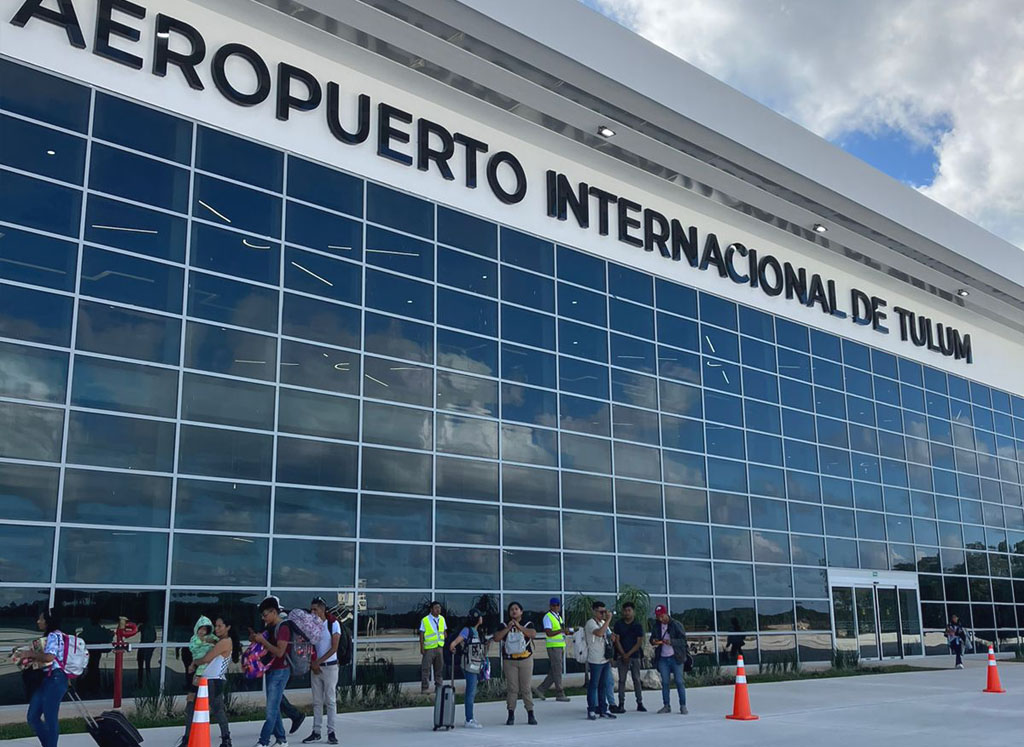
Mexico’s federal government says it will offer airlines 100% incentives for three years to fly into Tulum, as the Riviera Maya’s newest airport struggles to hold onto routes.
Federal Tourism Secretary Josefina Rodríguez Zamora announced the plan Thursday, Oct. 22, during a visit to Cancún. She said Tulum’s Felipe Carrillo Puerto International Airport will be treated as a priority, because unlike Cancún it serves mainly one destination.
Several outlets reported that the incentives would run from 2027 to 2030. The goal is to attract permanent routes rather than seasonal flights.
Key details are still missing. Rodríguez Zamora said Grupo Mundo Maya, the state company that runs the airport, would explain the program at one of President Claudia Sheinbaum’s morning press conferences. As of Monday, officials had not said which fees the incentives would cover or how airlines could qualify.
She also did not confirm whether a similar plan could apply to Cancún International Airport.
An airport losing airlines
The Tulum airport opened Dec. 1, 2023, built by military engineers in about 18 months. It was meant to ease crowding at Cancún and give travelers a shorter trip to Tulum and the southern Caribbean coast.
Traffic has fallen sharply this year. Between January and June, the airport handled about 471,500 passengers.
Aeroméxico suspended its Tulum flights Sept. 30. Volaris will stop flying there Jan. 7, 2027, citing low occupancy and rising costs. American Airlines has also cut service, including its route from Miami.
Over the past three years, Avianca, Copa Airlines, Discover Airlines, JetBlue, and Volaris Costa Rica have also left. Once Volaris goes, domestic flights will be in the hands of Viva Aerobus and the state-owned Mexicana de Aviación.
Airlines have pointed to market conditions. Industry analysts have also cited airport fees, a visitor tax on non-residents, fuel costs, and the long drive between the airport and Tulum’s hotel zone.
When flights could return
Citing projections from Canaero, Mexico’s national air transport chamber, Rodríguez Zamora said global airlines should reach a break-even point in the first quarter of 2027. She expects routes and frequencies to start recovering in the second half of next year.
She said Tulum’s problems are not about a lack of promotion or interest from airlines, but about global challenges facing aviation and tourism.
Some local business leaders and outlets have raised questions about the plan, including how much the public sector would pay and whether routes would stay once the incentives end.
Hotels, restaurants, tour operators, and taxi drivers in Tulum are among those most affected by the loss of direct flights. For now, many travelers to Tulum still fly into Cancún and drive south about two hours.
Read more about the Volaris exit and the airport’s recent losses. Bloomberg has also reported on the airline pullback.
Fast Facts
- Airport: Felipe Carrillo Puerto International Airport, Tulum (TQO)
- Opened: Dec. 1, 2023
- Plan: 100% incentives for 3 years, reported as 2027 to 2030
- Announced by: Federal Tourism Secretary Josefina Rodríguez Zamora
- Still unknown: Which fees are covered and how airlines qualify
- Recent exits: Aeroméxico (Sept. 30), Volaris (ends Jan. 7, 2027)
- Passengers, January to June 2026: About 471,500
Sources: Diario de Yucatán, Reportur, Quinta Fuerza, Luces del Siglo, El Quintanarroense, Diario Cambio 22, Sol Quintana Roo, El Heraldo de México, Bloomberg, Yucatán Magazine