

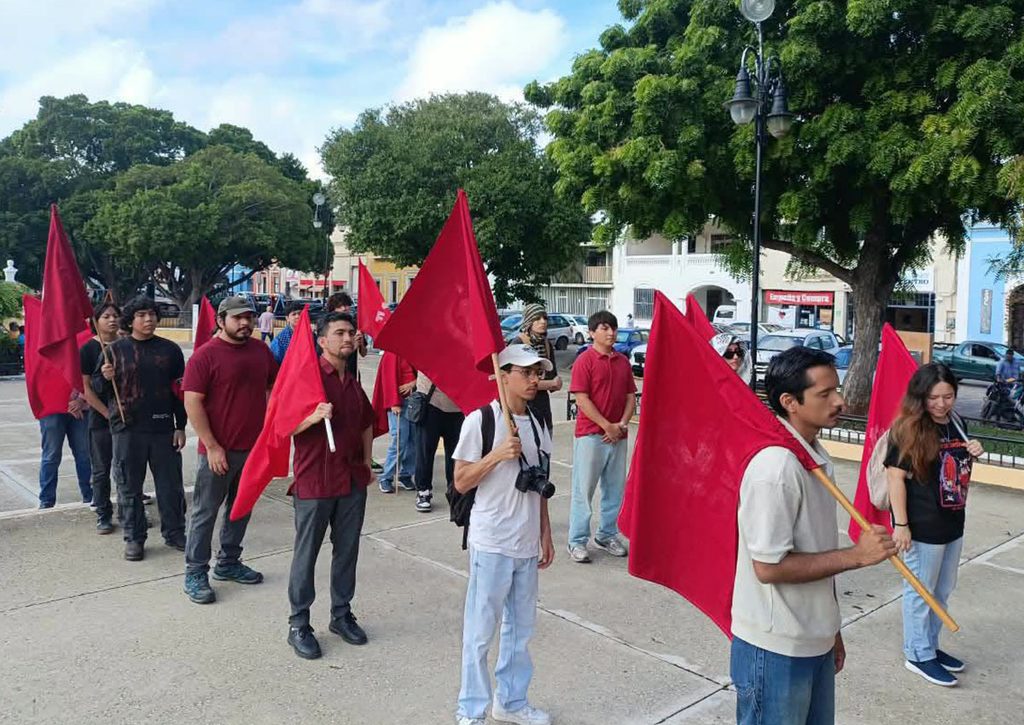
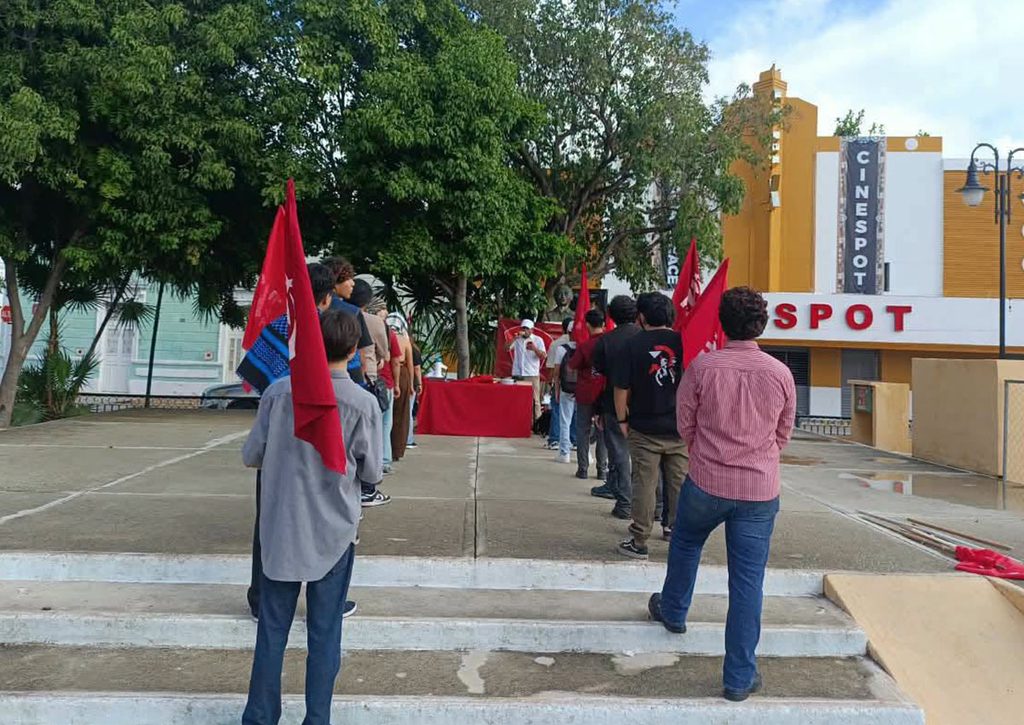
A couple dozen young people carrying red flags gathered Sunday morning in Parque de Santiago, one of Mérida’s oldest neighborhood squares. They lined up in front of a bronze bust of a martyred labor activist while a speaker with a microphone addressed the group. Behind him hung a banner reading Frente de la Juventud Comunista, or Communist Youth Front. Some flags bore the hammer and sickle. A folding table held books and pamphlets.
The scene stood out in a park better known for Tuesday night dances and weekend collectors’ swap meets. It isn’t isolated, though. Posters promoting Marxist ideas have been turning up around the Centro.
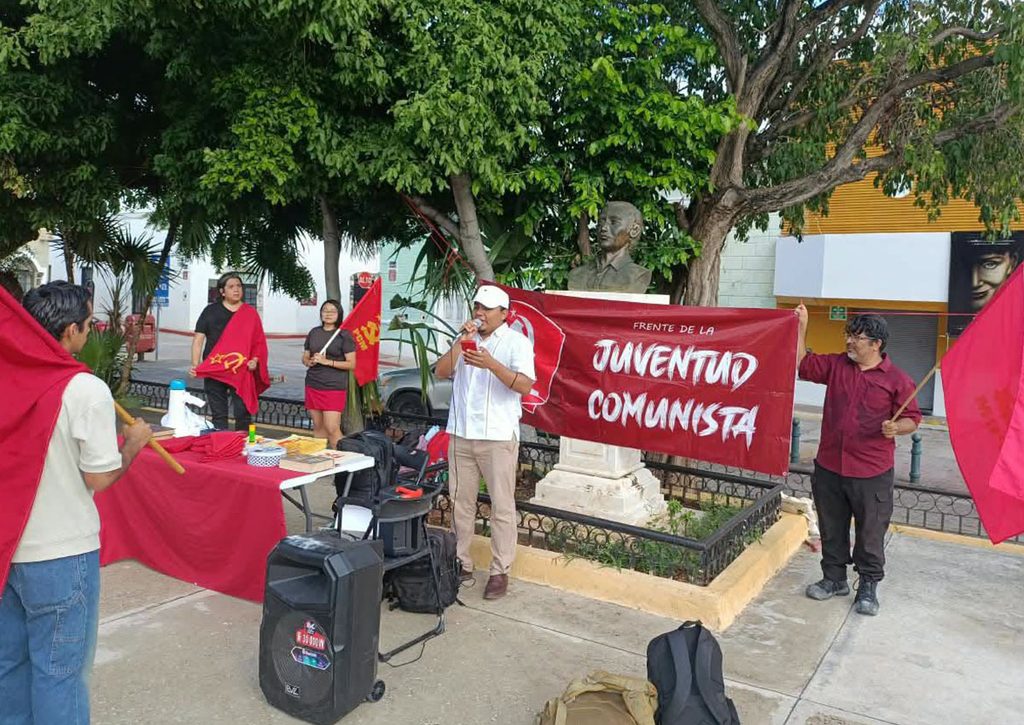
The Frente de la Juventud Comunista, known as the FJC, is the youth wing of the Partido Comunista de México. It calls Marxism-Leninism its guide and says it is fighting capitalism in favor of a socialist revolution. The group focuses on working, unemployed and student youth. It describes itself as the party’s main school for training future leaders.
The group says it is growing. At its fourth national congress in July, the FJC reported delegates from the Yucatán Peninsula and the Southeast, as well as Mexico City, Michoacán, Nuevo León and Baja California. The party’s own newspaper described a recovery of the youth group in several regions. Independent membership figures are not available.
Earlier this month, FJC and party members in Yucatán joined the annual Oct. 2 march marking the 1968 Tlatelolco student massacre in Mexico City. That same day, as La Jornada reported, the party said Mexico City police detained eight of its members on their way to the march. They were released hours later. City officials reported no arrests at the close of the march.
Communist symbols remain a flashpoint in Mexico. In July 2025, Cuauhtémoc borough Mayor Alessandra Rojo de la Vega removed statues of Fidel Castro and Ernesto “Che” Guevara from a Mexico City park. She cited missing permits and neighbor complaints, and called the pair dictators. President Claudia Sheinbaum suggested moving the statues elsewhere. The Communist Party demanded their return.
In Yucatán, socialism has deep roots. Felipe Carrillo Puerto led the Socialist Party of the Southeast and governed the state from 1922 until his execution in January 1924. He proclaimed what he called the first socialist government in the Americas. He pushed land reform, gave his first speech as governor in Maya and expanded women’s political rights. In the 1930s, Yucatán had one of the Communist Party’s largest and most active regional branches.
Carrillo Puerto is still honored across the political spectrum. Gov. Joaquín Díaz Mena of Morena leads a ceremony at his tomb each January. Today’s Communist Party, however, sees Morena as a social democratic party and frequently criticizes it.
At the ballot box, the party remains on the fringe. The original Partido Comunista Mexicano merged into a broader left coalition in 1981. Today’s party has no official registration, so in 2024 it ran Marco Vinicio Dávila Juárez as an unregistered write-in candidate for president. National polls don’t track it.
Whether a wider trend exists among Mexico’s young is hard to measure. Recent youth protests have pulled in many directions. The Gen Z marches of November 2025 were fueled by anger at the federal government and promoted heavily by opposition figures on the right.
North of the border, the numbers are clearer. An NBC News poll in September found that 42% of U.S. voters ages 18 to 29 view socialism positively, up from 28% in 2018. It was the first time in nearly a decade of NBC polling that young voters rated socialism more favorably than capitalism. Most U.S. voters overall still view socialism negatively.
About the bronze bust
The bust at Parque Santiago depicts the likeness of Efraín Calderón Lara, a student leader, social activist, and labor lawyer who fiercely advocated for the rights of the Yucatecan working class. During the 1970s, he helped organize the first independent trade unions in Yucatán, stepping outside official government-sanctioned labor institutions to empower local workers. Because of his influential leftist political activism, he was abducted and assassinated in February 1974. The murder is largely thought to have been state-sanctioned and carried out by police.
Fast Facts: Communist Youth Front
- Spanish name: Frente de la Juventud Comunista (FJC)
- Parent party: Partido Comunista de México (PCM)
- Ideology: Marxism-Leninism
- Electoral status: The PCM has no official party registration
- Yucatán’s socialist governor: Felipe Carrillo Puerto, 1922–1924
- Oct. 2 marks the 1968 Tlatelolco massacre of students in Mexico City
- Website: juventudcomunista.org
With reporting from La Jornada, Por Esto!, Expansión and El Machete, and polling data from NBC News