

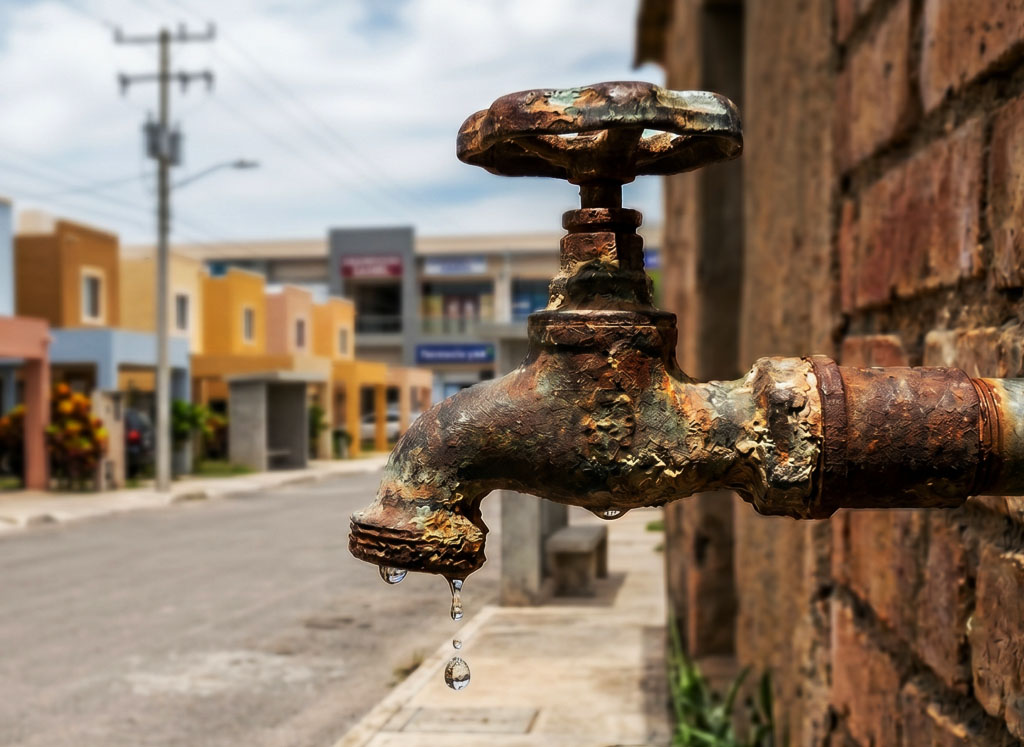
With temperatures touching 42°C (108°F) and heat indices surpassing 50°C (122°F), turning on the tap in large swaths of this colonial capital has become an exercise in frustration—or futility. Isolated reports of low water pressure have ballooned into a generalized crisis, particularly in the sprawling western suburb of Ciudad Caucel, where residents have taken to the streets to demand action.
“We’ve become very normalized about it,” said Larissa Acosta Escalante, a local congresswoman from the Citizens’ Movement party, referring to the supply failures affecting thousands of families. But for the more than 100,000 people living in Ciudad Caucel alone, normalization has given way to outright fury.
The issue has been exacerbated by the intermittent power outages the city has experienced over the past few weeks.
‘We Pay, but There is No Water’
On April 26, dozens of residents from Caucel, Los Héroes, Dolores Otero, and other affected colonies gathered in front of the Palacio de Gobierno in Mérida’s historic center. Armed with megaphones, garden hoses, and hand-painted banners—one read simply “SOS”—they denounced a situation that has persisted for months, and in some cases years.
“The problem we have is not recent. It goes back years,” said Carlos, a resident of Ciudad Caucel, at the protest. He added that despite paying bills exceeding 1,000 pesos per month, his household often goes without water for days. Another protester, Rowan Madrid, questioned the state water utility’s billing practices: “How is it possible that you are charging me this amount for water if I don’t even have continuous service? There are people who go up to a week and a half without a single drop”.
The protests, which included the blocking of major avenues in April, have escalated as the region enters its hottest months. According to local legislators, the problem affects at least 26 separate sections of Ciudad Caucel, one of the largest housing complexes in western Mérida.
A City That Outgrew Its Pipes
The core of the problem is not difficult to diagnose: Mérida has grown explosively, but its water infrastructure has barely changed.
Between 2000 and 2020, the metropolitan area nearly doubled its surface area, from 21,103 to 42,186 hectares, according to research from the National Autonomous University of Mexico (UNAM). In that same period, the population swelled from 800,000 to over 1.3 million inhabitants. Critically, the built area grew faster (2.3% annually) than the population (2%), meaning the city is sprawling outward in a low-density, horizontal pattern that is exceptionally costly to service.
The urban footprint now reaches approximately 340.94 square kilometers (about 131.6 square miles) as of 2023, expanding primarily toward the north and west—directly into areas such as Caucel, Dzityá, and Cholul. Daniel Antonio Magaña Lozano, president of the College of Habitat Designers and Urban Planners of Yucatán, noted that the growth is “dispersed, distant, and disconnected from social welfare,” driven largely by private developers building on former ejido lands where infrastructure is expensive to extend.
The water system, meanwhile, has been left behind. The College of Civil Engineers of Yucatán stated that the drinking water infrastructure is more than half a century old and has never undergone a comprehensive overhaul. More than 30% of the distribution network is over 40 years old, and leaks waste nearly half the water before it ever reaches a home.
Francisco Torres Rivas, director of the state water utility Japay (Junta de Agua Potable y Alcantarillado de Yucatán), has acknowledged that the shortages stem directly from Mérida’s uncontrolled growth and the inevitable deterioration of the existing network. But residents have little patience for acknowledgments. Eight families have filed a federal lawsuit alleging that the city granted construction permits without conducting the required water feasibility studies, thereby violating the constitutional human right to water protected under Article 4 of the Mexican Constitution.
The Hidden Threat: Poisoned Aquifers
If aging pipes and sprawling suburbs explain why the water does not flow, another crisis explains why, when it does arrive, it may not be safe to drink.
The Yucatán Peninsula sits atop one of the world’s largest karst aquifer systems, a vast network of porous limestone and underwater caves that serves as the region’s sole source of fresh water. But the same porous geology that makes the aquifer so abundant also makes it catastrophically vulnerable to contamination. Pollutants do not filter slowly through soil; they pour directly through cracks and sinkholes (cenotes) into the groundwater below.
Independent testing has revealed that contamination from pig farms into groundwater and springs contains dangerously high levels of nitrogen, phosphorus, fecal coliform, and animal medications. In March 2026, a UN special rapporteur called on Mexican authorities to declare an environmental alert in Yucatán after documenting farms with 50,000 pigs located in communities of just 1,500 people, discharging massive quantities of manure, hormones, and antibiotics into the aquifer.