

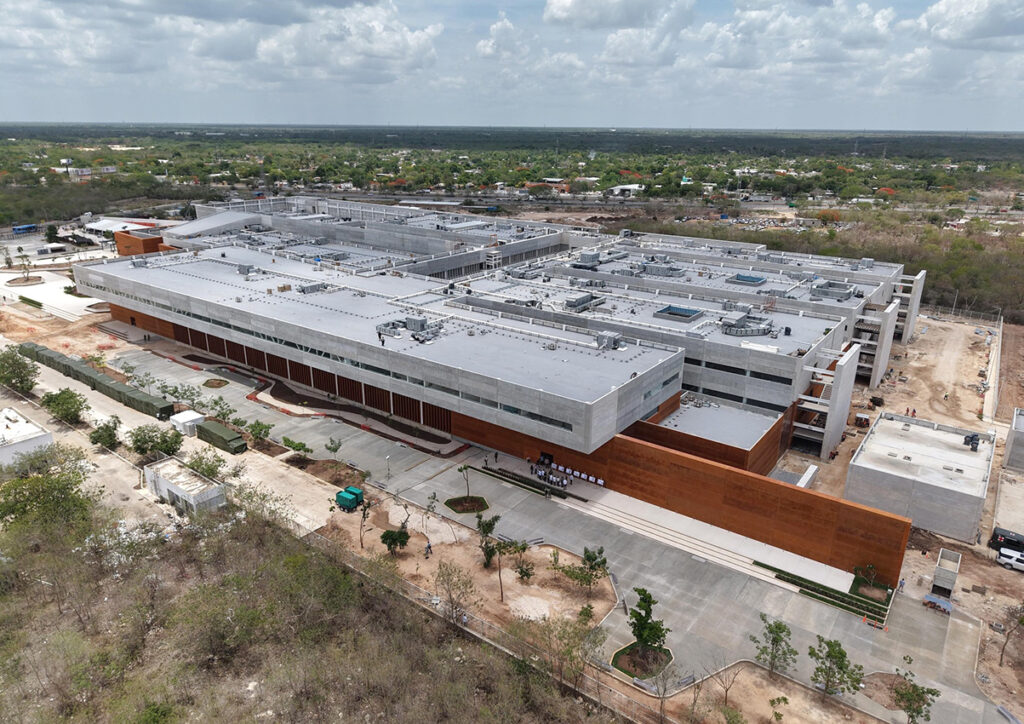
A gleaming new hospital has opened on the south side of Mérida, and social media is buzzing. Some foreign residents seem to believe that the new Hospital General “Dr. Agustín O’Horán” — inaugurated by President Claudia Sheinbaum in May as part of the IMSS-Bienestar rollout — means free, world-class health care for everyone living in Yucatán, expats included. It’s an understandable confusion. But it’s also wrong, and the misunderstanding could lead people to make costly decisions about their coverage.
The short version: IMSS-Bienestar and regular IMSS are not the same thing, even though both carry the IMSS name. Regular IMSS — the system many expats already use through a program called Seguro para la Familia — is a contributory social security program. You pay an annual premium, you get coverage. For 2025, those premiums ranged from roughly MX$8,900 to MX$20,650 per year (about US$114 to US$313), depending on age.
IMSS-Bienestar is something different. It’s a federally managed public health program designed to provide free care to people who have no other coverage at all — people living in poverty who have never had access to IMSS, ISSSTE, or any other formal system. It replaced the earlier INSABI program, which itself replaced Seguro Popular. The target population is Mexico’s most economically vulnerable residents, not foreign retirees.
Patricia Sales, who runs Health Itinerary, a Mérida-based insurance and medical concierge company, posted a detailed breakdown on Facebook this week, trying to clear things up. Her explanation is worth reading for foreign residents who’ve been relying on regular IMSS or private insurance and are wondering whether they still need it.
As Sales put it plainly: “This system was mainly created for some of the most vulnerable populations in Mexico — people living in extreme poverty who may never have had access to formal employment, retirement benefits, or traditional social healthcare systems.”
What the New Hospital Is For
The new O’Horán, inaugurated by Sheinbaum alongside Gov. Joaquín Díaz Mena, is designed to provide free specialized care to an estimated 1.2 million people in the region who lack social security coverage. The facility, located on Mérida’s Periférico Sur, has more than 650 beds, 43 specialties, and 16 operating rooms. With its opening, Yucatán became the 24th state to formally join the IMSS-Bienestar system. The transition means that public hospitals and clinics previously managed by the state health department are now federally administered under the IMSS-Bienestar umbrella.
None of that changes the picture for most foreign residents.
What This Means for Expats
If you already have regular IMSS through Seguro para la Familia, nothing changes. You still need to keep paying. You still access care through your assigned family clinic. IMSS-Bienestar does not replace that coverage, and the two systems cannot be used interchangeably.
Of course, people on tourist visas cannot enroll in any Mexican public health system at all. But foreign residents with temporary or permanent residency can access regular IMSS voluntarily — and that remains the recommended path for those who qualify and can afford it.
Technically, a foreign resident without any coverage and not enrolled in regular IMSS could potentially access IMSS-Bienestar services at participating public hospitals. But the program is intended for people in financial need, the facilities are more basic than at private alternatives, and the wait times are long. Middle- and upper-income residents are actively discouraged from using it.
If you can afford traditional coverage, maintain it. Dropping regular IMSS to take advantage of IMSS-Bienestar would be a poor trade for most foreign residents, and using a safety-net program designed for the poor when alternatives exist raises an ethical question worth sitting with.
Related: For a broader look at what Mérida’s hospital landscape actually offers, see Yucatán Magazine’s hospital guide.
The Bottom Line
Mexico’s health system is fragmented by design — different institutions serve different populations based on employment, income, and immigration status. IMSS-Bienestar fills a critical gap for millions of Mexicans who previously had nothing. It is not a universal service that foreign residents can simply walk into, and the new O’Horán hospital was not built with expats in mind.
Health Care Facts
- The new Hospital General “Dr. Agustín O’Horán” opened in May 2026 on Mérida’s Periférico Sur
- It has more than 650 beds, 43 specialties, and 16 operating rooms, with capacity for 1,400 surgeries and 1,000+ consultations per day
- It is the largest IMSS-Bienestar hospital in southeastern Mexico and Central America
- Yucatán is the 24th state to join the IMSS-Bienestar system
- IMSS-Bienestar serves people without any formal social security coverage; it is not a replacement for regular IMSS
- Expats on tourist visas (FMM) cannot enroll in any Mexican public health system
- Foreign residents with temporary or permanent residency can enroll in regular IMSS (Seguro para la Familia) for roughly US$114–US$313 per year, depending on age
- IMSS-Bienestar and regular IMSS are separate systems and are not being merged
Sources: La Jornada Maya, La Jornada, Milenio, Consultor Salud, Expat Focus, Migaku, Mexperience, Health Itinerary