

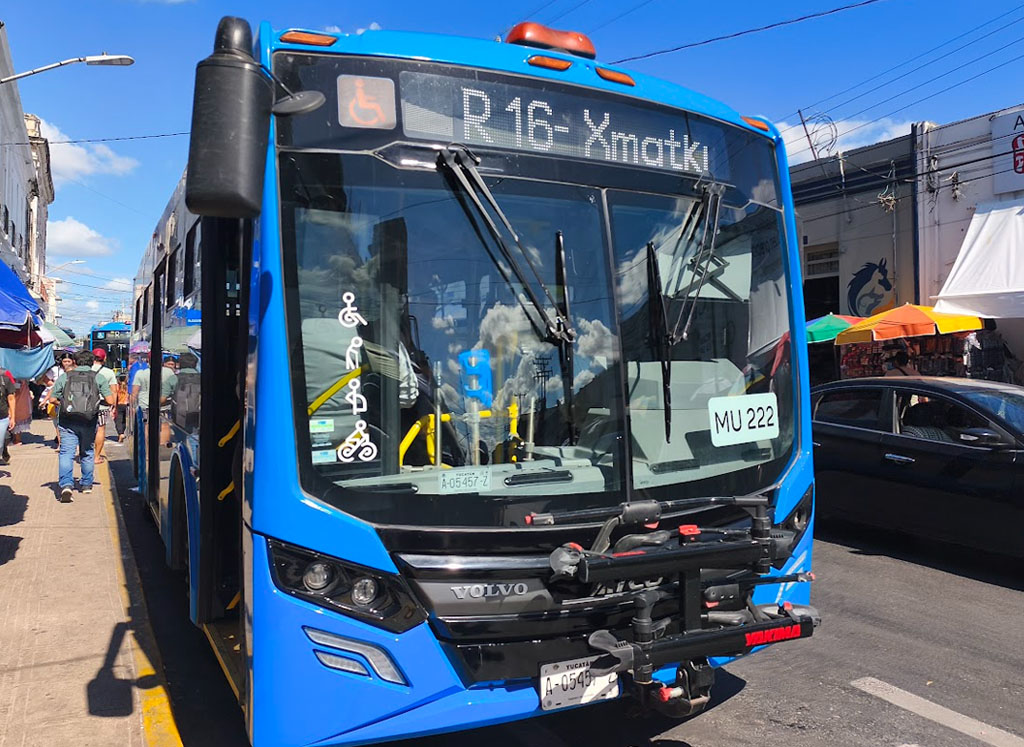
For weeks, representatives from over a dozen concessionaire companies have issued increasingly dire warnings, culminating in a recent march on the Government Palace.
There, they publicly declared themselves on the Va y Ven verge of bankruptcy, stating that without an urgent injection of funds, the service could be suspended within days.
This crisis puts the daily commutes of hundreds of thousands of residents at risk, but it also raises the question of what a viable alternative would look like.
The answer lies in a web of politically disputed debts, a broken payment model, and a growing chasm between operators and the authorities, some of whom seem content to see the entire model fail.
The Va y Ven Political’s Dimension
Even before he was elected Governor, Diaz Mena, and serval official within MORENA, expressed their disapproval of the Va y Ven transit system, some even saying that once in power they would dismantle it.
These statements did not go over well with the public, and although these positions were quietly abandoned, there remains a widespread sentiment that the failures of the Va y Ven have been politically managed.
A Debt That’s Strangling the System
At the center of the storm is an unpaid debt from the Yucatán Transport Agency (ATY) to the private companies that operate the Va y Ven. On June 4, 2026, representatives of at least 14 bus concessionaires representing over 80 routes went to the Government Palace to request the governor’s urgent intervention, warning that the agency owes them more than 180 million pesos—an amount they report has been pending since mid-April.
David Quintal, a representative of the “Circuito Metropolitano” line, stressed that the operators need about 45 million pesos immediately just to keep the buses on the road while a long-term solution is hashed out.
Raymundo Vargas León, a counselor for the Yucatán Bus Drivers Union, underscored the immediacy of the peril, telling media outlets that the companies are so strangled financially that they have no more than a week’s worth of solvency left. “We are in a chaotic situation, and in a matter of days, this could explode,” he warned. “We will do what we can with whatever resources we have, but the service could be interrupted”.
The ATY’s Own Financial Black Hole
While the concessionaires point the finger at the ATY for late payments, the ATY’s own financial situation appears to be the root cause of the gridlock.
The agency, it seems, is simply running out of money. David Quintal has stated unequivocally that his diagnosis shows the ATY to be financially insolvent.
He noted that the state government has contributed what it can, but the agency’s own collection systems are failing. In the first four months of 2026 alone, he claimed that between 350 and 400 million pesos in potential revenue were lost or unaccounted for due to inefficient fare collection systems, for which the ATY is responsible. This has created a cascading crisis: the state isn’t collecting enough fare revenue to pay the bus companies, and the bus companies, in turn, cannot afford to operate.
The Core of the Problem
The tension has been brewing for months, and it is much more than a simple late payment. The conflict has exposed a deep flaw in the financial architecture of the Va y Ven—the payment-per-kilometer scheme.
Originally, the ATY paid concessionaires for a “minimum guaranteed kilometer.” This meant that even if a bus didn’t travel a certain number of kilometers on a given day, the company would still be compensated for a base amount.
However, the state has argued that this incentivized inefficiency and led to overcharging. In response, the ATY recently passed a reform to transition to a new “payment-per-kilometer-traveled” model, where the government only pays for the actual miles logged.
The concessionaires are enraged by this change, which they claim is financially devastating. They argue that the current rate, which they say is set at 31 pesos per kilometer, is already outdated, as the costs of fuel and maintenance have skyrocketed.