

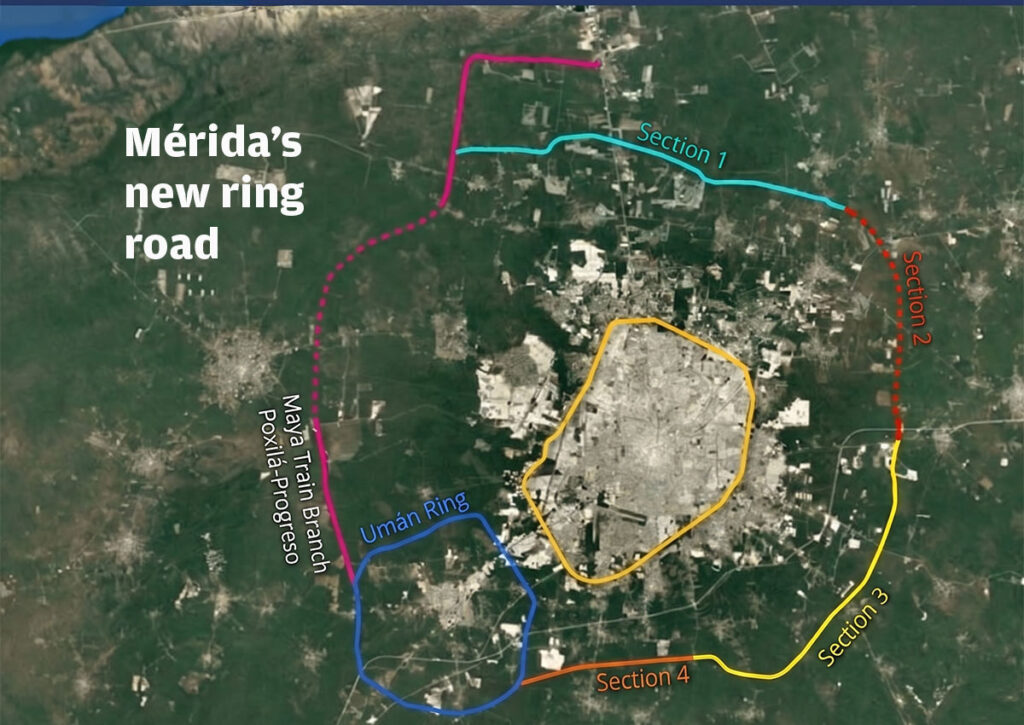
Yucatán’s state infrastructure agency published its annual public works plan Wednesday, revealing that more than three-quarters of a MX$1.5 billion credit line will go toward a new metropolitan ring road around Mérida — not the city’s ailing water system that Gov. Joaquín Díaz Mena had cited as the loan’s main purpose.
The document, released by the Yucatán Infrastructure Agency (Incay) in the state official gazette, shows MX$1,141,115,709 — nearly 98% of the financed portion and about 76% of the overall MX$1.5 billion — earmarked for three ring road contracts. Less than 22% of the credit is directed at water and public safety needs. The plan covers 13 projects totaling MX$1,473,263,613, and every contract will be awarded by direct assignment with no competitive bidding.
That breakdown is raising eyebrows. In late May, Díaz Mena publicly framed the credit line as a response to Japay’s infrastructure failures — the water utility’s chronic shortages have left residents in nearly 100 Mérida neighborhoods without reliable service. The state finance secretary, Juan Sánchez Álvarez, later clarified that the MX$1.5 billion was not new debt but rather an unused portion of a 2023 authorization for the Progreso deep-water port.
A Loan With a Complicated History
The money traces back to June 2023, when the state Congress authorized then-Gov. Mauricio Vila Dosal to borrow up to MX$3,063 million for the Progreso port expansion. The current administration drew MX$1,633 million of that for port work; what remained is now being redirected — with officials arguing it is a legally permissible reallocation of pre-approved credit. Critics are not convinced. The original decree authorized borrowing only in 2023 and 2024, which some legislators say means the current administration needs fresh congressional approval to use it at all.
The Congress rejected a separate MX$1,530 million loan request in December 2025 after opposition members argued the projects lacked technical studies or confirmed route plans. The ring road remains without a final engineering design or right-of-way agreement.
The largest single line item in the Incay plan is MX$809 million for the purchase of 269 hectares of land in six municipalities — Umán, Samahil, Hunucmá, Ucú, Mérida, and Progreso — for the Anillo Vial Metropolitano. A further MX$300 million covers Phase 1 construction, budgeted for 86,800 square meters to be built between January and late September. And MX$32 million goes to four pre-investment studies for the same phase.
That last item draws particular attention: the studies are scheduled to run June through September, while construction is already supposed to be underway from January. The Incay plan does not explain the overlap.
Water Keeps Waiting
Japay director Francisco Torres Rivas has described the water system as deteriorating, with constant leaks, aging pipes, and treatment plants in need of upgrading. Of 37 facilities, only seven have been rehabilitated; 30 remain on a to-do list. The challenges are well documented: Yucatán Magazine has reported on aquifer contamination and infrastructure concerns tied to rapid population growth, with Mérida’s population now at 1,087,930 according to national population council figures.
Business groups have been cautious about the loan’s allocation. The head of Canaco, the local chamber of commerce, said publicly that it remained unclear how funds would be divided. Some urban planning critics have suggested the ring road’s primary beneficiaries could be real estate developers and landowners along the proposed corridor rather than the general public.
The Ring Road’s Bigger Picture
The Anillo Vial Metropolitano is one of the Díaz Mena administration’s signature projects, designed to redirect freight traffic around Mérida and link the region’s industrial zones to the Mayan Train freight route and the expanded Progreso port. The Mérida Metropolitan Area, formally recognized by the state Congress in late 2025, encompasses 13 municipalities — six of which, the Incay noted, have PAN-affiliated mayors, including Mérida itself under Mayor Cecilia Patrón Laviada.
With elections set for June 2027 to renew municipal governments and legislative seats, the concentration of spending around Mérida and the opaque origins of the credit are likely to keep this debate active through the campaign season.
Fast Facts
- The Incay 2026 public works plan was published Wednesday, June 25, in the Diario Oficial del Gobierno del Estado de Yucatán
- Total 2026 program: MX$1,473,263,613 across 13 projects; all contracts awarded by direct assignment
- Ring road allocation from the credit: MX$1,141,115,709 — land acquisition (MX$809M), Phase 1 construction (MX$300M), and pre-investment studies (MX$32M)
- That represents approximately 76% of the MX$1.5B credit and nearly 98% of the financed portion of the 2026 plan
- Water-related and public safety works: less than 22% of the credit
- The credit originates from a 2023 authorization for the Progreso port; the original borrowing window closed at the end of 2024
- Pre-investment studies for the ring road’s first phase are scheduled June–September, while construction is budgeted to begin in January — the plan does not explain the discrepancy
- Mérida’s population: 1,087,930 (2025 Conapo)
- State and municipal elections scheduled for June 2027
Sources: Diario de Yucatán, PorEsto, Diario Oficial del Gobierno del Estado de Yucatán