

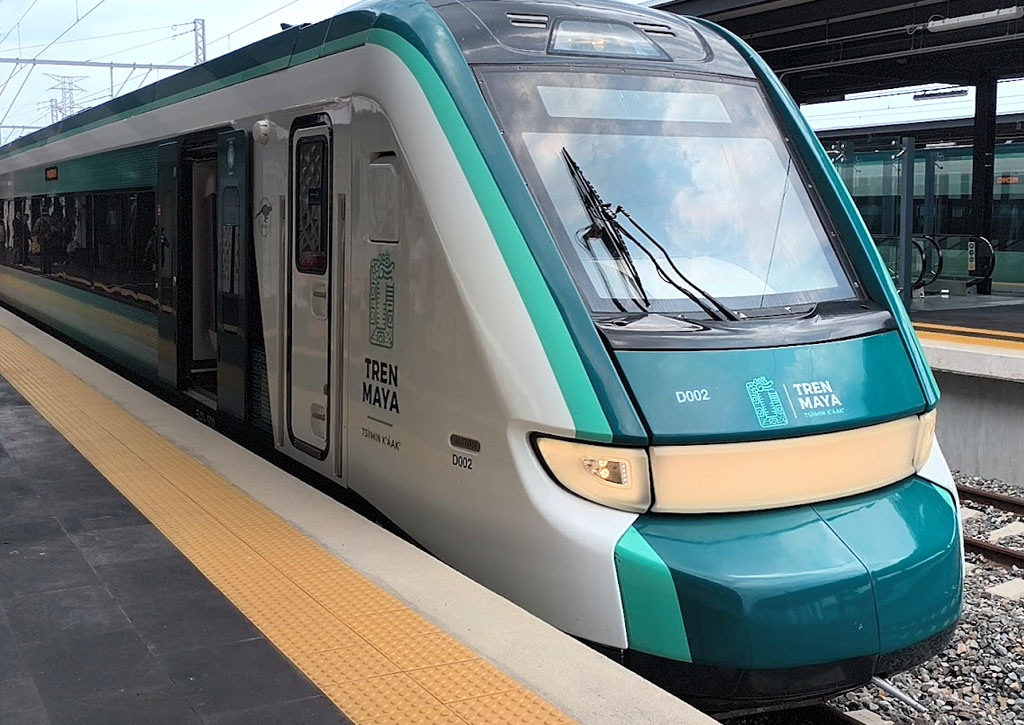
On Monday, a man with a hearing disability was injured after being struck by a Tren Maya unit traveling toward the Hacienda Teya terminal on the Umán–Teya railway section.
According to initial reports, the man, reportedly around 60, was walking on the tracks at the time of the impact. He sustained blows to various parts of his body, abrasions on his left side, and cuts on the toes of both feet. He was transported while conscious to a hospital,
The National Guard and Tren Maya security personnel were immediately dispatched to determine the circumstances of the incident. The section where the man crossed includes fencing and patrols by the National Guard and the Mexican Army. However, authorities have not fully clarified how unauthorized individuals have gained access to the track area in previous incidents.
Similar reports from the same day describe a man walking on the tracks in the opposite direction of the convoy near X’Matkuil. The driver reduced speed and attempted to stop the train, but could not avoid the impact, projecting the pedestrian several meters and causing various injuries. That incident caused an approximately 1.5-hour delay at the Teya station, where passengers had to disembark until the tracks were cleared.
Tren Maya Past Accidents
The Tren Maya has been under constant public observation since its inauguration, and its safety has been questioned following reported accidents. While most incidents have not resulted in injuries, they have caused delays, material damage, and concerns about the reliability of the railway system.
Since the Tren Maya entered service, there have been at least four known accidents:
- March 25, 2024 – Tixkokob, Yucatán: The fourth car of convoy D006 derailed while entering the station at low speed. There were no injuries, and passengers continued their journey on another train. The investigation pointed to inadequate mechanical fastening in the track switch.
- April 16, 2024 – Izamal, Yucatán: A derailment was reported at the station upon entry. No injuries were recorded, but the incident caused delays and forced passengers to be transported by bus.
- August 2024 – Izamal, Yucatán: Another minor derailment affected train 304 at this station. Damage was moderate, with no injuries reported, and immediate attention protocols were activated.
- August 13, 2025 – Izamal, Yucatán: Car 304 left the track upon arriving at the station. The incident caused material damage and required passenger compensation, but there were no injuries.
The construction phase of the project also saw a significant loss of life. According to the organization Cohesión, between December 1, 2018, and September 27, 2024, 64 workers died, and another 46 were injured during the construction of the Tren Maya. The most frequent causes of death and injury included being run over and crushed by heavy machinery.
Safety Measures and Their Limitations
The Umán–Teya section, where the latest accident occurred, features cyclone fencing and patrols by the National Guard and the Mexican Army. Despite these measures, people have continued to access the track area in previous incidents, and the circumstances of how they do so have not been fully clarified.
The Tren Maya is administered by Sedena, placing it under military control. This has raised questions about transparency, particularly regarding incident reporting. When a citizen requested information about the number of accidents in 2025 through transparency channels, Tren Maya directed them to the Regulatory Agency of Railway Transport’s official page. Still, the link returned a “404-Page not found” error. Data on incidents after the first half of 2024 has remained hidden from public view.
Why People Cross the Tracks: A Generational Reality
The reasons people cross the Tren Maya tracks, despite barriers in some places, are rooted in the region’s geography and history. The tracks have split areas where people have moved around for generations.
For residents of these areas, the tracks represent a division of their lived environment. The railway cuts through land that families have traversed for decades, if not longer. Fences and patrols are recent impositions on a landscape that has always been open.
When a barrier goes up across a path that has been used for generations, it is not always seen as a legitimate obstacle. For many, the tracks are just another part of the terrain, not a boundary that should fundamentally alter how they move through their own communities.
The economic reality of the region compounds this issue. Many of those who cross the tracks do so out of necessity rather than choice. Without resources to take longer, safer routes, the risk often seems worth it. A detour around a fenced section might add significant time to an already difficult journey. For someone walking to work, to market, or to visit family, the extra distance can be prohibitive. The calculation is simple: the train may come, but the risk of waiting or walking around is weighed against the certainty of lost time and lost opportunity.
In the case of the man struck on Monday, his hearing disability meant he could not hear the train’s audible signals. But even for those without such disabilities, the decision to cross is often made with the knowledge that the train schedule is not always predictable, that the barriers are not always continuous, and that the consequences of not crossing can be more immediate than the risk of an accident.