

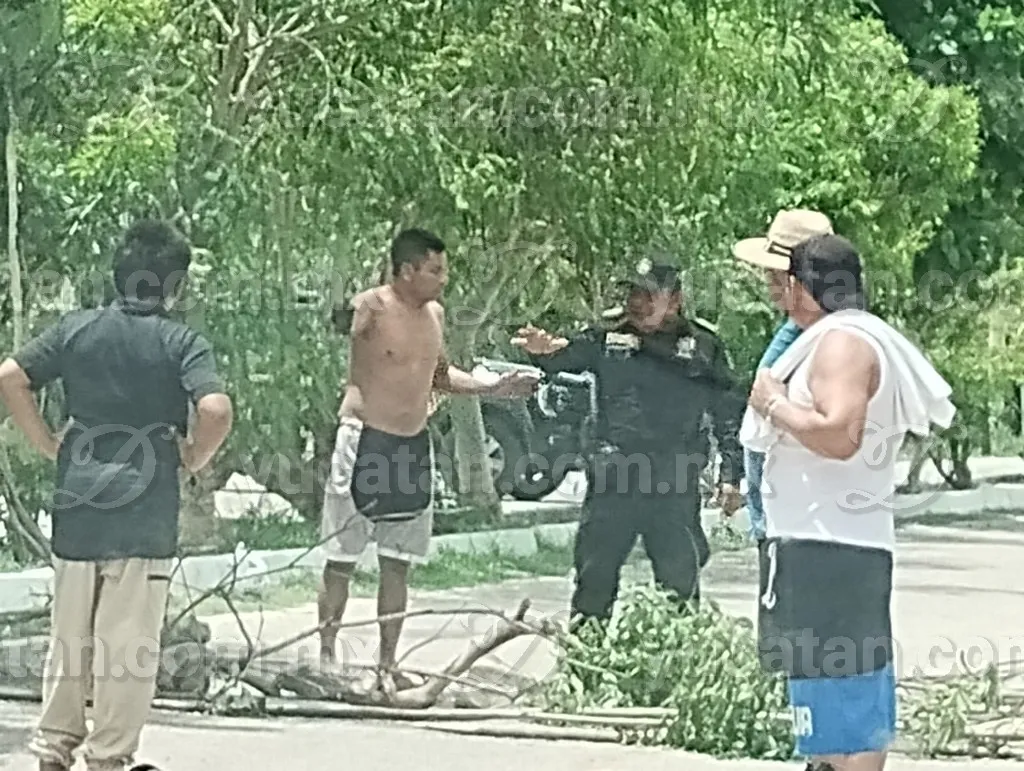
Residents in a neighborhood of Xmatkuil, on Mérida’s southern edge, blocked a major road Sunday to protest four straight days without electricity, snarling traffic in and out of the area for hours.
The blockade closed both directions of Calle 50 at its intersection with Calle 221 starting around midday. The road, known locally as Avenida 50, is one of the main routes linking downtown Mérida with several outlying communities to the south.
Traffic diverted for hours
The closure led to tense exchanges between drivers and the protesters. Motorists argued that blocking the road wouldn’t solve the underlying problem with the Comisión Federal de Electricidad, Mexico’s state power utility known as CFE. Drivers were forced to find alternate routes to reach Xmatkuil or get back into the city.
Officers with Mérida’s public security department were sent to the scene to try to mediate. The timing was awkward: the city’s fairgrounds nearby had a set of drag races, or arrancones, planned that same afternoon as part of an organized event. As of Sunday evening, the protest was still underway and no timeline for restoring power had been announced.
Part of a broader pattern
Sunday’s blockade echoes a similar protest last year, when residents of another Mérida neighborhood shut down a stretch of road after enduring weeks without reliable service. Blackouts across the Yucatán Peninsula have become a near-constant feature of the summer months, driven by aging infrastructure, rising demand and extreme heat that strains transformers and power lines.
CFE has poured billions of pesos into fixes, including two new combined-cycle plants — one in Mérida, one in Valladolid — meant to add hundreds of megawatts of capacity to the regional grid. State officials have pointed to progress at the Mérida IV facility as a sign the worst may be ending, though outages like the one in Xmatkuil suggest distribution problems persist even as generation capacity grows.
Political pressure builds
The outage also landed in the middle of a political fight over the state’s handling of the crisis. On the same day as the Xmatkuil blockade, PAN Yucatán party leader and state legislator Álvaro Cetina Puerto publicly criticized the state government, saying deadlines for fixing the blackouts have shifted repeatedly over the past year — from an initial promise of a 2027 fix to a newer 2030 horizon.
Cetina pointed to a US$300 million emergency energy plan he said has fallen short of its promised results, along with unresolved questions about the Mérida IV plant’s actual output. He said his party will formally request information from the Yucatán Energy Agency on the state of the grid and the emergency plan’s progress. He also noted that state lawmakers from the ruling Morena party have twice rejected PAN proposals to lower electricity rates and offer bill credits for outage hours.
Neither CFE nor Yucatán state officials had issued a public response to Sunday’s protest by the time of this report.
Fast facts
- Residents blocked Calle 50 at Calle 221 in Xmatkuil, Mérida, on Sunday, July 12.
- The protest followed four consecutive days without electricity.
- The closed road, Avenida 50, links downtown Mérida with comisarías to the south.
- Public security officers responded to mediate conflicts with drivers.
- A PAN Yucatán legislator separately criticized the state’s handling of the broader blackout crisis the same day.
- The Mérida IV power plant is among several projects meant to ease chronic outages across the peninsula.
Sources: Diario de Yucatán, Yucatán Magazine, Mexico Business News