

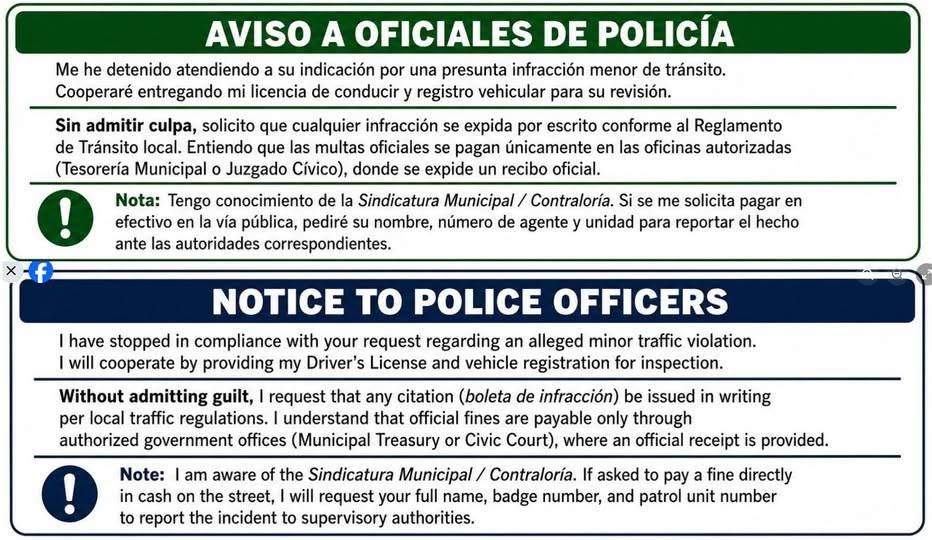
A simple Spanish phrase has been making the rounds on expat Facebook groups again: “Dame mi multa, por favor” — please give me my ticket. For drivers who spend time on Yucatán’s roads, especially in a rental car or a vehicle with foreign plates, it’s one of the more useful lines to know.
The advice isn’t new. Expat blogs like Surviving Yucatán have circulated versions of this tip for more than a decade, aimed at drivers pulled over for minor issues — a rolling stop, expired tags, a burned-out taillight — rather than accidents or anything involving alcohol. The idea is straightforward: asking politely for an official ticket signals that a driver knows the difference between a legitimate fine and a shakedown, and many officers back off once that’s clear.
Why the Phrase Works
Multa is the formal Spanish word for a fine. Requesting one in writing means an officer has to process paperwork rather than pocket cash on the spot, which discourages the more casual attempts at a bribe. If an officer keeps pressing, expat guides suggest calmly asking for a badge number and name, or requesting to speak with a supervisor, rather than getting out of the vehicle or arguing.
If a ticket does get written, drivers usually aren’t stuck with the full amount. Many Mexican cities offer discounts for paying quickly — sometimes cutting the fine by half — though the exact terms vary by state and municipality, so it’s worth asking exactly what the local rules allow.
The Legal Risk of Paying Up
Handing over cash instead carries more risk than most tourists realize. Offering a bribe to a public official in Mexico is a crime called cohecho, punishable under the federal penal code by two to 14 years in prison. That applies to the person offering the bribe as much as the officer taking it — meaning a driver who tries to pay their way out of a minor violation is technically committing a felony, not just haggling.
Yucatán has taken visible steps against corrupt officers in recent years. In one widely reported case, two motorcycle police in the Hunucmá area were fired and criminally charged after routinely stopping drivers between Hunucmá and Sisal and demanding roughly 4,000 pesos apiece — far above the more typical 200-peso “mordida” reported in most encounters. State officials have also acknowledged that corruption remains a costly problem; one federal study put the price tag for Yucatán at roughly 9.5 billion pesos a year, among the highest of any state.
A Changing Enforcement Landscape
Traffic enforcement across Mexico is also shifting at the federal level. As of late May, Mexico’s National Guard gained expanded authority over federal highways and bridges, including the power to issue citations, run vehicle inspections and set up checkpoints — a change that puts Guardia Nacional instructions ahead of ordinary traffic signals on those roads. The reform applies specifically to federal highways rather than city streets, so it doesn’t change how municipal police in Mérida or elsewhere handle routine stops, but it adds another layer drivers should be aware of on longer trips across the peninsula.
For most day-to-day driving in and around Mérida, the basics haven’t changed: stay calm, stay polite, and ask for the paperwork.
Fast Facts
- “Dame mi multa, por favor” means “Please give me my ticket” in Spanish
- Offering a bribe (cohecho) can carry two to 14 years in prison under federal law
- Typical roadside bribes reported in Yucatán run around 200 pesos, though cases as high as 4,000 pesos have led to firings
- Corruption costs Yucatán an estimated 9.5 billion pesos annually, per a federal study
- Mexico’s National Guard gained new authority over federal highway traffic enforcement in late May 2026
- Advice applies to minor stops only — not accidents, DUI suspicions or serious crimes, which should go through an insurer or attorney
Sources: Yucatán Magazine, El Financiero, La Silla Rota, Excélsior, yucalandia.com