

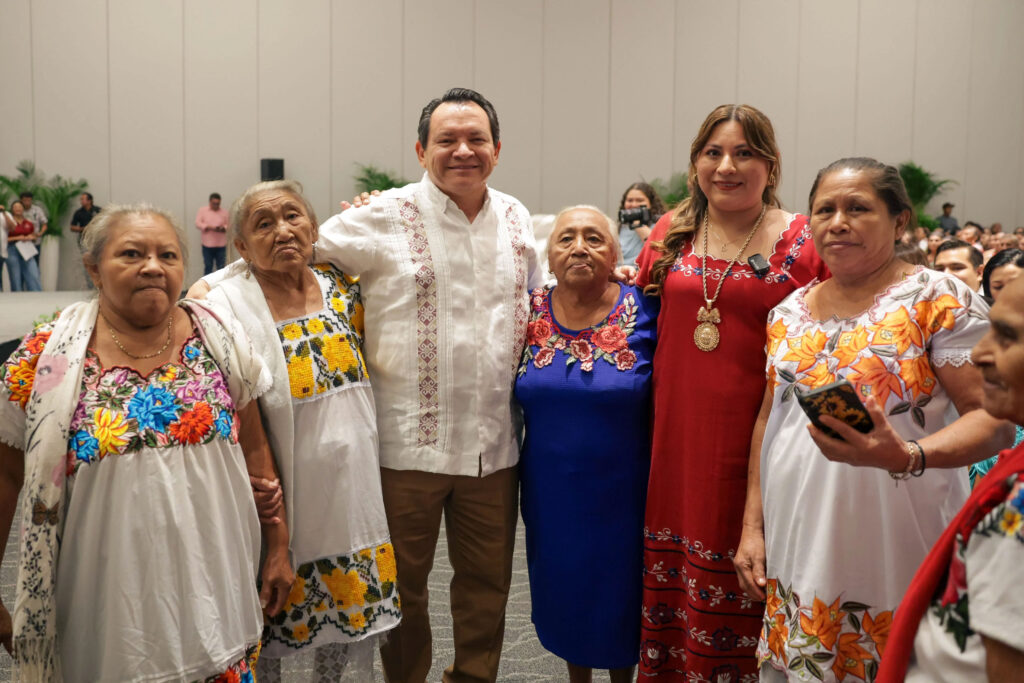
Photo: Gobierno de Yucatán
Miriam Esther Góngora Mul learned her trade from her mother and grandmother. For more than 10 years, she has helped women in Tzucacab through pregnancy and childbirth, usually with little notice from anyone outside her community.
That changed Thursday. Gov. Joaquín Díaz Mena handed Góngora a certificate honoring her career and a payment card from a new state program called Parteras del Bienestar.
She is one of 313 traditional midwives from 58 municipalities who will now receive MX$3,000, or about US$160, every two months.
“This is knowledge our mothers and grandmothers taught us, and we do it with all our hearts to help women when they need it most,” Góngora said. “For a long time we did this work in silence, and sometimes we felt no one saw our effort.”
Speaking for the group, she thanked the state and said the support makes their roots feel “more alive than ever.”
Díaz Mena called the payment card “an act of justice” and a recognition of the women’s knowledge after a lifetime of service. He also asked the midwives to pass on what they know to their daughters, granddaughters and young women in their towns so the tradition does not fade.
The program is open to traditional midwives 18 and older anywhere in the state. It is run by the state’s Secretaría de Bienestar, or welfare ministry, through its Mujeres Renacimiento office.
State welfare secretary Verónica Interián Argüello attended the event, along with Feliciano Moo y Can, director general of the Instituto para el Desarrollo de la Cultura Maya, and Susana Homá Dzib, a midwife from Chichimilá.
A tradition that has been shrinking
In Maya communities, the partera has long done far more than catch babies. She checks on expectant mothers, gives the traditional abdominal massage known as a sobada, and visits new mothers in the weeks after birth. Like the region’s Maya healers, she usually learns from an older relative rather than in a classroom.
That chain has been breaking. A Por Esto! report in May found that midwives now attend less than 1% of births in Yucatán, roughly 40 years after the practice peaked. Hospital births became the norm, and fewer young women took up the work.
The losses are personal in small towns. Last December, the community of Yaxhachén said goodbye to Bacila Tzec Uc, its last traditional midwife, who died at 97. Around the same time, state officials and lawmakers floated the idea of a formal school of midwifery to keep the knowledge alive.
Health experts have argued for years that midwives still have a role to play. The Pan American Health Organization estimates that a well-trained midwife working inside the health system can handle up to 90% of the essential care mothers and newborns need. Across Mexico, a growing number of women are seeking out midwives again, part of a wider midwifery comeback that has drawn support from foundations and public health groups.
It remains unclear how the state will verify new applicants or whether the 313 enrolled so far represent most of the midwives still working. Officials did not release a full list of participating towns.
For Góngora, the moment was about being seen. Women like her have kept a centuries-old practice going in rural Yucatán, often unpaid and out of public view.
Fast Facts
- Program: Parteras del Bienestar
- Payment: MX$3,000 (about US$160) every two months
- Enrolled: 313 midwives from 58 municipalities
- Eligibility: Traditional midwives age 18 and older, statewide
- Run by: Yucatán Secretaría de Bienestar, Dirección Mujeres Renacimiento
With reporting from La Jornada Maya and Por Esto!