

A vessel carrying roughly 30 tons of humanitarian aid departed the port of Yucalpetén, near Progreso, last week and arrived in Havana on Tuesday — a crossing of about 368 nautical miles (424 miles) that took roughly two days. The ship, dubbed “Granma 2.0” by its organizers, carried food, medicine, solar panels, and bicycles as Cuba faces a deepening energy and economic crisis.
The voyage was part of the Nuestra América Convoy, an initiative organized by the Progressive International and allied groups to deliver aid to Cuba in response to tightening U.S. energy sanctions. More than 650 participants from 33 countries converged on Havana over the weekend, and Cuban President Miguel Díaz-Canel was on hand to receive them.
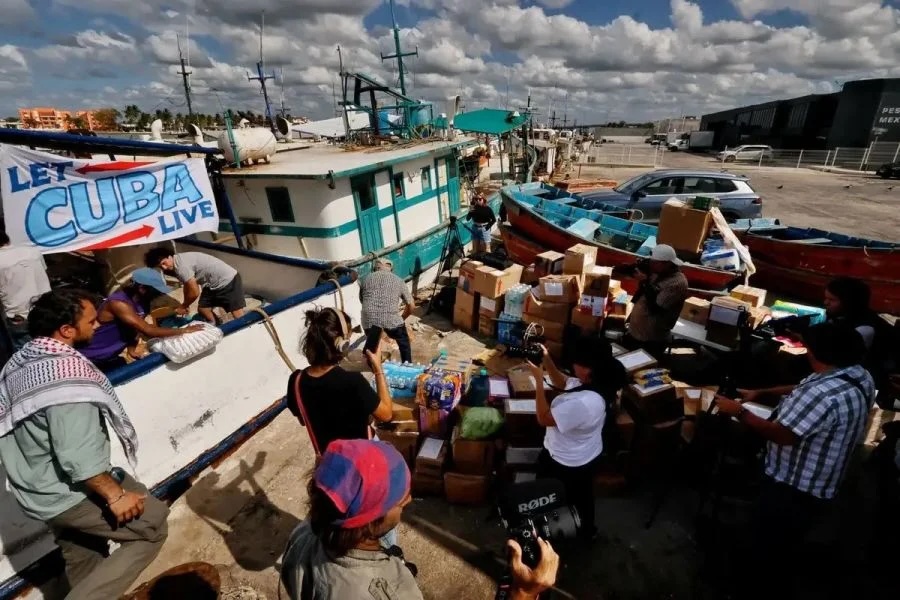
The boat carried 32 crew members representing 11 nationalities. Among the cargo were 73 solar panels earmarked for health clinics, along with rice, beans, cooking oil, hygiene products, diapers, and cereals donated by supporters in several countries. Some supplies had to be stored at a Mexican Navy facility before departure due to limited space aboard the vessel.
Brazilian activist Thiago Ávila, who also participated in the Global Sumud Flotilla’s Gaza mission in 2025, was among those on board. “This type of economic warfare shouldn’t exist,” he told reporters after docking in Havana, describing the U.S. blockade as the actions of “a pirate state that doesn’t respect international law.” He also acknowledged the limits of the delivery: the ships were “a drop in an ocean of need” but a meaningful gesture of solidarity.
Cuba is in the grip of a prolonged energy crisis. The island, which produces only about 40% of the fuel it needs, has gone three months without access to diesel, fuel oil, gasoline, jet fuel, or liquefied petroleum gas, according to Cuba’s Deputy Minister of Energy and Mines, Argelio Abad Vigo. Widespread blackouts — including two nationwide outages in a single weekend — have disrupted daily life, transportation, and food distribution. Airlines from Canada and Russia have suspended flights to the island due to the jet fuel shortage.
The crisis escalated in late January, when President Donald Trump signed an executive order designating Cuba a threat to national security and announced tariffs on countries supplying fuel to the island. That measure was later rolled back in February, but Cuba’s oil imports had already been severely disrupted following a separate crackdown on Venezuela, historically one of Havana’s main energy suppliers.
The convoy has drawn both admiration and controversy. Organizers frame it as a grassroots humanitarian effort. Critics, including the independent Cuban publication Havana Times, have raised questions about the political ties of key organizers to the Cuban government, and whether the aid will reach ordinary citizens. The convoy’s local distribution partner, the Cuban Institute of Friendship with the Peoples, has been described in declassified CIA documents as a potential front for Cuban intelligence — though organizers call it an independent nonprofit.
The initiative was inspired by the Global Sumud Flotilla, which in 2025 attempted to reach Gaza by sea but was intercepted before reaching its destination. This time, organizers had cooperation from both the Mexican and Cuban governments. The ship was named in tribute to the Granma, the vessel that carried Fidel Castro and fellow revolutionaries from Veracruz to Cuba in 1956 to launch their armed struggle.
Yucatán’s geographic proximity to Cuba — the two are separated by roughly 300 miles of open Gulf — has made the Peninsula a natural hub for cross-strait activity. Talks have been underway since at least 2023 to establish a maritime route between Progreso and the Cuban port of Mariel for tourism and cargo.
According to Al Jazeera, a YouGov poll taken in February found that 46% of Americans disapprove of the U.S. energy blockade against Cuba, while 28% support it.
Nuestra América Convoy — Key Facts
- Departed from Yucalpetén, near Progreso, Yucatán
- Vessel name: Granma 2.0
- Cargo: 30 tons, including food, medicine, 73 solar panels, bicycles, and hygiene products
- Crew: 32 people from 11 countries
- Distance: 368 nautical miles (about 424 miles)
- Arrived in Havana: Tuesday, March 24, 2026
- Organized by: Nuestra América Convoy / Progressive International
- Total convoy participants: 650+ from 33 countries