

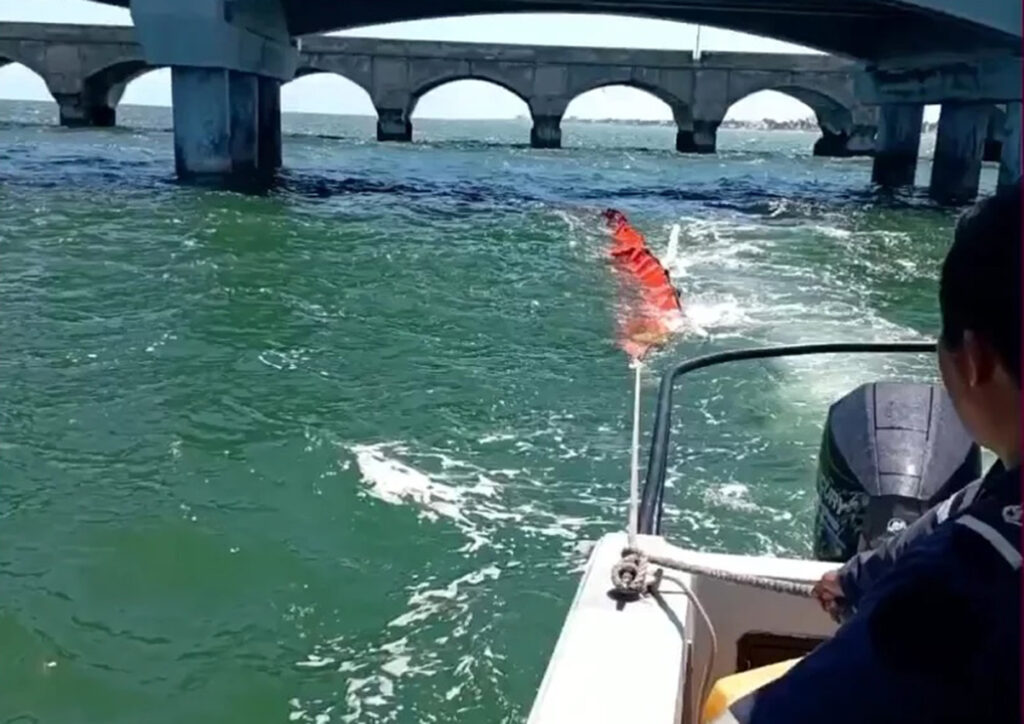
Diesel fuel from a pair of old, out-of-service Pemex submarine pipelines has been seeping into the Gulf of Mexico near the port of Progreso, with orange containment barriers now visible from the fishing dock — and fishermen saying the problem is anything but new.
Pemex workers arrived at the site Monday morning, borrowing small boats from local fishermen to reach the contaminated area near arch 25 of Progreso’s landmark pier. At least 2 fuel slicks were reported: one roughly 300 meters from shore, near the muelle fiscal, and a second about 100 to 150 meters from the beach. Both appear to originate from the same pair of aging pipelines.
The pipes in question were once used to move gasoline, diesel, and jet fuel from Pemex’s offshore terminal to a beach junction point, from which the fuel was pumped overland to a storage and distribution facility on the Mérida-Progreso highway. Those lines have long since been decommissioned — active fuel transfer now runs through newer pipelines installed above the pier’s adjacent viaduct. But the old pipes, badly deteriorated, are still physically present on the seafloor, and appear to be leaking residual hydrocarbons.
Yucatán Gov. Joaquín Díaz Mena confirmed Monday that the leak came from a disused underwater pipeline and said specialized divers had sealed it. He also took pains to clarify that the incident was separate from the much larger Pemex spill that has contaminated more than 900 kilometers of Gulf coastline across Veracruz, Tabasco, and Tamaulipas — a crisis now the subject of federal investigations and criticism from more than 40 civil society organizations. Read more about that Gulf spill and the broader threat to the Yucatán coast.
Despite the governor’s declaration that the pipeline had been sealed, the timing of the official response raised eyebrows. Fishermen in the area say they have been reporting the problem for months. According to multiple accounts, fuel slicks have been an on-again, off-again presence in the waters near the muelle Chocolate, the popular fishing pier. It was only in the past week or so, as the slicks became more visible, that containment barriers went up. Pemex had not issued any official statement as of Monday evening.
Local fishermen like José Vázquez have spoken publicly about what’s at stake. Fuel contamination fouls nets, coats hulls, and can drive fish away from the affected zone. Some fishermen have already been giving the area a wide berth, which means lost income. The longer-term concern is harder to quantify — hydrocarbons can disrupt marine ecosystems and compromise the quality of commercially valuable species, an issue with implications well beyond Progreso’s harbor.
Maritime and port sources confirmed that fuel from the leak had already been dispersing toward the western port area due to tidal movement and wave action, making it visible to anyone paying attention. In a port city, that means a lot of people knew before authorities acted.
It’s a pattern that resonates in the broader Pemex context. The larger Gulf spill — traced to a 36-inch pipeline connecting the AKAL-C offshore platform to the Dos Bocas Maritime Terminal — was reportedly detectable by satellite as early as February, weeks before the government acknowledged it publicly. Three Pemex employees were subsequently dismissed over the mishandling of that incident. Civil society groups have called the firings insufficient, arguing they address the cover-up but not the damage.
For Progreso, a beach destination and cruise port grappling with serious coastal erosion in recent years, a fuel-contamination incident — however contained — is an unwelcome addition to existing environmental pressures.
Fast Facts
- The leaking pipelines are decommissioned Pemex lines that formerly carried gasoline, diesel, and jet fuel from an offshore terminal to the Progreso beachhead
- Active fuel pipelines now run above the pier’s alternate viaduct; the old lines remain on the seafloor
- Fuel slicks were reported at 2 locations: roughly 300 meters and 100-150 meters from shore
- Orange containment barriers were installed near pier arch 25 over the weekend preceding the Monday response
- Gov. Díaz Mena said the pipeline has been definitively sealed; Pemex had not confirmed this officially as of Monday
- Fishermen say the problem predates the official response by months
- The incident is unrelated to the larger Pemex Gulf oil spill affecting Veracruz, Tabasco, and Tamaulipas
Sources: La Jornada Maya, ProgresoHoy, PorEsto, Diario de Yucatán, La Silla Rota, Mexico Business News