

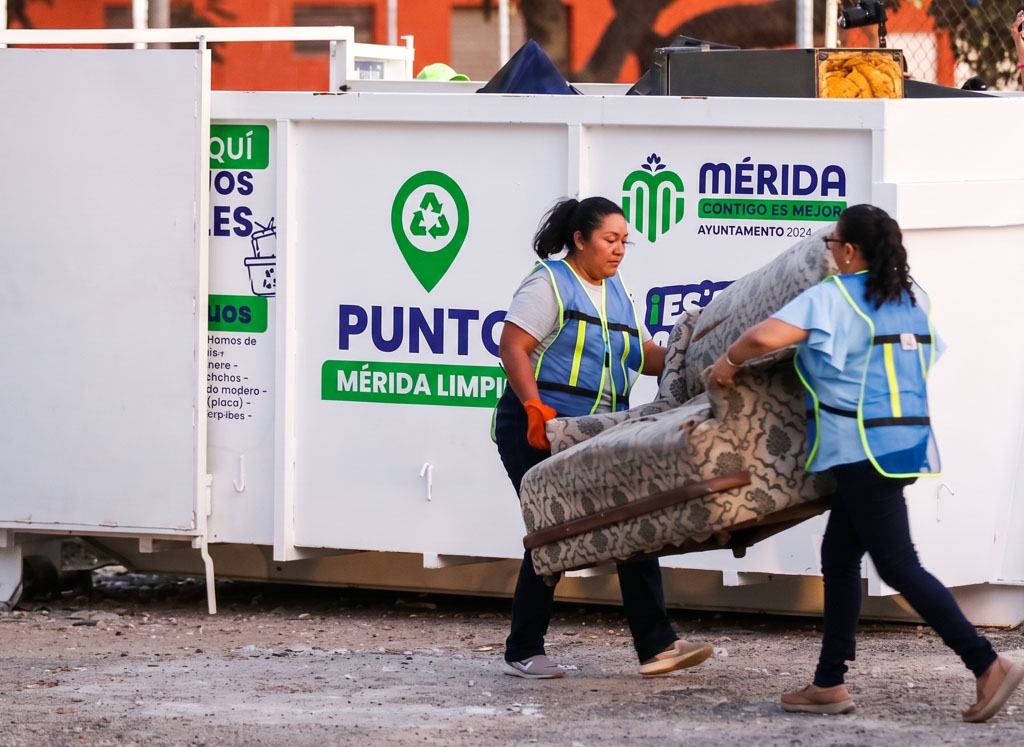
The municipal program Mérida Limpia (Clean Mérida) is about to take one of its most ambitious leaps since its creation. Already proven effective in managing bulky and special waste, the initiative will expand its presence across the city with the addition of 42 new containers in 2026. The goal is to eliminate the unsightly and unhealthy accumulation of junk on street corners and medians.
Currently, the program operates 23 mobile containers distributed among private waste concessionaires: Servilimpia coordinates 18 units, Sana operates four, and Pamplona manages one. That figure will soon be outdated.
The expansion will unfold in two phases. The first will begin this July with the deployment of 15 new containers, accompanied by two roll-off trucks specifically designed to load and transport bulky waste. The second phase calls for 27 additional containers, bringing the total number of collection points to 65 before the close of 2026.
To date, the program has collected more than 3,492 metric tons of special waste—10 times the 350 tons collected throughout all of 2024 under the previous community clean‑up system.
This year, Mérida Limpia received an international award from the Technical Association for Waste Management and the Environment (Ategrus) for best global practices in urban cleaning and waste management, with special emphasis on territorial impact and citizen participation.
What you can and cannot drop off
The program does not accept ordinary household trash. Instead, it targets special solid waste: large items that regular collection trucks cannot handle. The list includes mattresses, refrigerators, stoves, tires, glass, wood, furniture, and electronic equipment.
However, not every location accepts every type of waste. Batteries and electronic devices require special logistics. These materials are collected only at Mega Puntos Verdes, or fixed green points in strategic locations, and during specific campaigns such as Reciclatón, where a specialized electronics recycling company ensures proper treatment and recycling.
Busiest locations
Demand is especially intense in high‑density residential zones, where space to store bulky junk is limited and accumulation on public streets becomes a recurring problem.
Ciudad Caucel is a prime example. This vast subdivision, one of Mérida’s largest, has a Mega Punto Verde located at the Rodríguez Tamayo Educational Center (CERT), inaugurated in November 2024. Citizen participation there has been remarkable, thanks in part to collaboration with the local student community, which has become an ally in promoting a culture of recycling.
The Las Américas subdivision is another high‑traffic point. Its Mega Punto Verde, set up at the Fut7 soccer field, has become a neighborhood reference point. Other consistently busy locations include Parque de la Alemán, Los Héroes, Paseo Verde, Parque Tabennthá, Universidad Marista, and the Pensiones neighborhood, among others.
Each of these fixed modules can accept up to 18 types of waste, including used cooking oil, plastic bags and wrappers, PET bottles, empty aerosol cans, small and medium electronics, glass bottles and jars, paper, cardboard, ferrous or tin cans, aluminum cans, and Tetra Pak containers.
A public health issue
Accumulated waste on public streets encourages the spread of harmful fauna—rodents, insects, and other vectors—and the generation of leachate that can seep into the subsoil and contaminate groundwater. With an orderly, scheduled way to dispose of bulky junk tackles these health risks at their source.
Despite progress, the program faces hurdles. One is environmental education, as many residents still don’t know what type of waste belongs at each collection point, and it’s not uncommon to find unauthorized materials dumped next to the containers. The “It’s Yours, Take Care of It” (“¡Es tuya, cuídala!”) campaign aims to reinforce this through ongoing information on social media and printed flyers.