

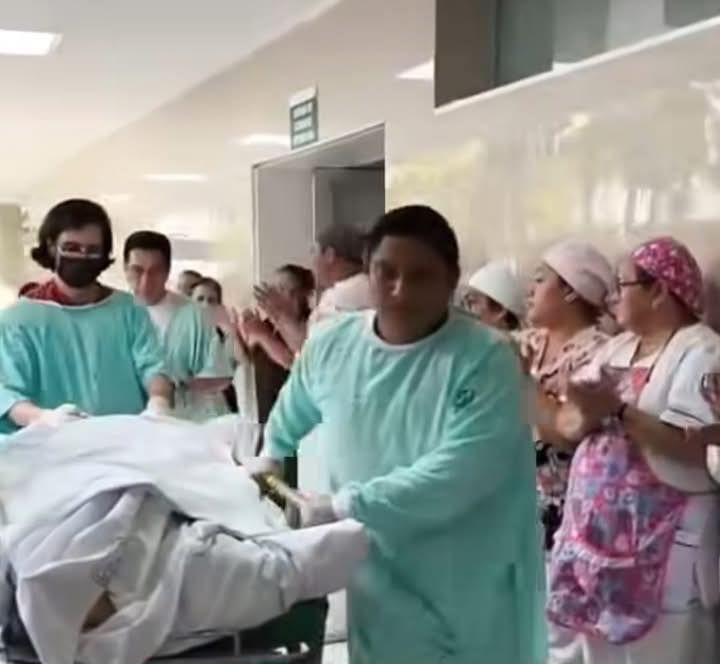
A 22-year-old man became the subject of a farewell after he was declared brain-dead at Hospital Benito Juárez in Mérida. The medical staff lined the hallways in a respectful tribute as the young hero’s gurney passed.
It was an honor walk — a procession for a patient who is legally and medically dead but kept on life support to preserve his organs for donation. His heart was still beating as staff paid their respects. His kidneys were already destined for Mexico City, where patients had been waiting for them — some for years.
The scene, captured on video and shared widely on social media, highlighted something that Mexico’s health authorities have been pushing hard to change: the country’s low organ donation rate, which remains among the worst in Latin America despite a large and well-equipped medical infrastructure.
Mexico has only 3 to 4 organ donors per million people, compared to 42 to 48 per million in the United States. That gap is enormous — and it has consequences. Roughly 20 people die in Mexico every day while waiting for a transplant. More than 15,000 patients are currently on the national waiting list, and over 90% of them need a kidney. High rates of diabetes and other chronic diseases keep demand relentlessly high.
Mexico’s federal health ministry is trying to change the math. Health Secretary David Kershenobich has announced a nationwide campaign called Por un México sin lista de espera — “For a Mexico Without a Waiting List” — aimed at boosting public awareness, correcting misinformation, and encouraging citizens to formally register as voluntary donors through the National Transplant Center (Cenatra). He has emphasized that a single deceased donor can save up to eight lives — a fact that gave added weight to the tribute paid to the young man in Mérida.
The numbers show that transplant activity has been growing, with a reported 30% rise in donations in recent years. Mexico performed 2,783 kidney transplants in 2025, with 76% carried out in public hospitals. Over the previous five years, the country completed 14,347 kidney transplants, with five-year survival rates of 93.5% for living donors and 84.2% for deceased donors.
But transplant capacity and donation rates are not the same thing. Of the organs transplanted, 52% come from deceased donors and 48% from living donors — a balance that reflects both the scarcity of cadaveric donations and the relatively high rate of living, often family-member donations. Researchers have long noted that Mexico has more than 250 authorized transplant centers — more than any other country in the world — yet its actual donation rate hasn’t kept pace with that infrastructure.
One persistent barrier is legal and cultural. Although a form of presumed consent exists in Mexican law, the deceased’s family still holds effective veto power over donation. Roughly 76% of families refuse consent when approached, making that conversation the single biggest bottleneck in the entire system. Cultural concerns about bodily integrity account for a significant share of those refusals.
Mérida itself has become one of Mexico’s most capable medical cities. Hospital Benito Juárez, a public facility serving lower-income residents, is one of several institutions here with the infrastructure to facilitate organ procurement. The city is also home to some of the region’s best hospitals, including internationally recognized private facilities that draw medical tourists from across North America. That concentration of medical talent makes organ retrieval and coordination far more feasible here than in many parts of southern Mexico.
The farewell for the 22-year-old donor followed a tradition that has taken hold in Mexican hospitals as a way to honor families who say yes in the hardest moment. Staff line the corridors and applaud as the donor is taken to the operating room. It is, in equal parts, a public ceremony and a private grief.
The federal campaign encourages citizens to register as donors through Cenatra’s telephone line or official website, and to discuss their wishes openly with family members. That conversation, health officials say, remains the single most important step.
Fast Facts: Organ Donation in Mexico
- More than 15,000 patients are on Mexico’s national transplant waiting list
- Over 90% of those waiting need a kidney
- Roughly 20 people die each day in Mexico while awaiting a transplant
- Mexico’s donation rate of 3–4 per million is far below the U.S. rate of 42–48 per million
- 76% of families refuse consent for donation when asked
- A single deceased donor can save up to eight lives
- To register as a donor in Mexico, contact Cenatra at cenatra.salud.gob.mx
Sources: Noticias Con Acento, Mexico Business News, SciELO México