

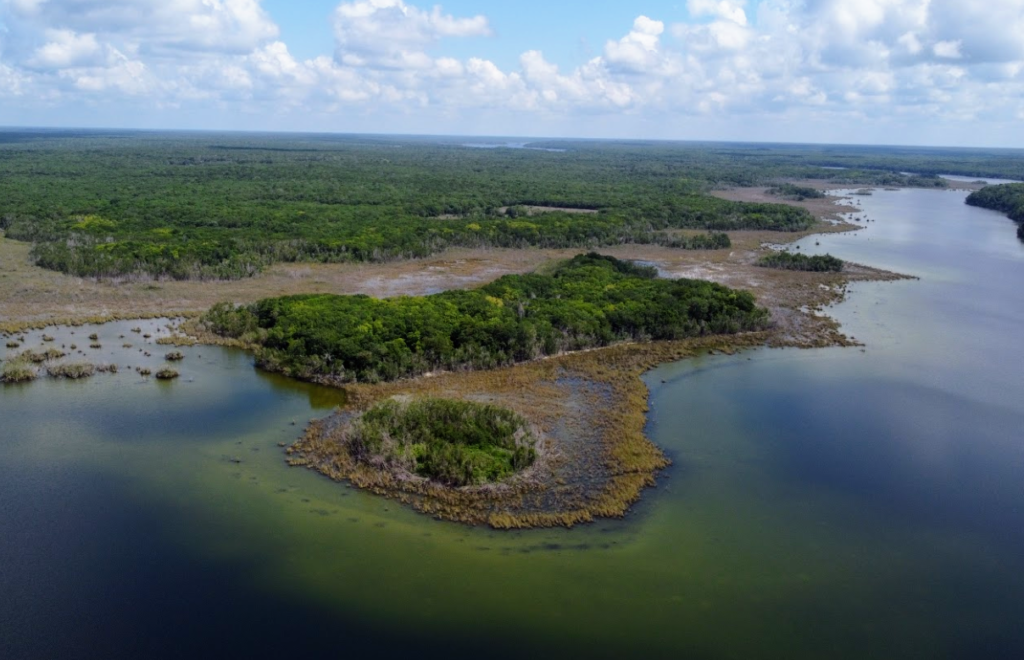
For the roughly 50 families living in Punta Laguna, life happens in a jungle clearing on an invisible line. The community sits on the disputed border between the Mexican states of Yucatán and Quintana Roo. After years of feeling abandoned, the residents recently decided they want to officially become part of Yucatán. However, they say officials are pressuring them to join Quintana Roo instead.
“We don’t want to be part of Quintana Roo because there is a lot of insecurity,” said Guadalupe Canul Abán, a community representative. “We are seeing that our lands could be invaded. There is a lot of real estate speculation because of the proximity to Tulum and Playa del Carmen, and we do not want to be victims.”
A History of Ambiguity
To understand why Punta Laguna is in limbo, you have to go back more than a century. The territorial disputes between Yucatán, Campeche, and Quintana Roo began in 1902, when President Porfirio Díaz created the Federal Territory of Quintana Roo.
For decades, the three states have argued over who controls what. Mexico’s Supreme Court is currently trying to resolve a major part of it by defining a specific coordinate in the jungle known as “Punto Put” where the three states converge.
The result of this ambiguity is that thousands of people living along state lines are often left without clear services. “When they want the vote, they come from Campeche and from Quintana Roo,” Alejandro Álvarez, a resident of the region, told El País newspaper. “They say, ‘We are going to give this,’ but when the time comes, neither of them makes an effort here.”
The Flip-Flop of Punta Laguna
Punta Laguna is a rich natural area home to spider monkeys and jaguars, but the people there struggle to get the basic necessities.
Recently, the community had started a process to join Quintana Roo. However, they dropped that request after authorities from Valladolid, Yucatán, promised to provide them with public services they had lacked for years.
Now, residents say officials from Quintana Roo are trying to change their minds. Ms. Canul Abán explained that the director of a protected natural area in Quintana Roo is pressuring them to resume the process of switching states.
Furthermore, officials from the municipality of Playa del Carmen (in Quintana Roo) recently visited the town to offer support projects. “The general population of Punta Laguna decided that they will not take any of their support,” Ms. Canul stated.
Impacts on Daily Life
The confusion is not just about old maps. It affects daily life. Because the community is located on the border, many adults have voter ID cards listing their address in Chemax (Yucatán), even though the land they live on is tied to Valladolid.
This paperwork mix-up often prevents them from receiving government aid or participating in federal programs. A local leader, Antonio Cupul Kuyoc, explained that while some politicians try to use the communities for votes, they are often left “in oblivion” with no streets or public services.
As of late 2025, the situation was still dire. Reports indicate that Punta Laguna has faced critical shortages, including the suspension of electricity and drinking water, due to legal uncertainty that prevents the government from investing in infrastructure.
For now, the families of Punta Laguna are clear on their identity. “We want to stay in Yucatán,” Ms. Canul said, “whether we belong to the municipality of Valladolid or Chemax,:
The final decision on what state Punta Laguna belongs to is likely to come down to decisions made in Mexico City.