

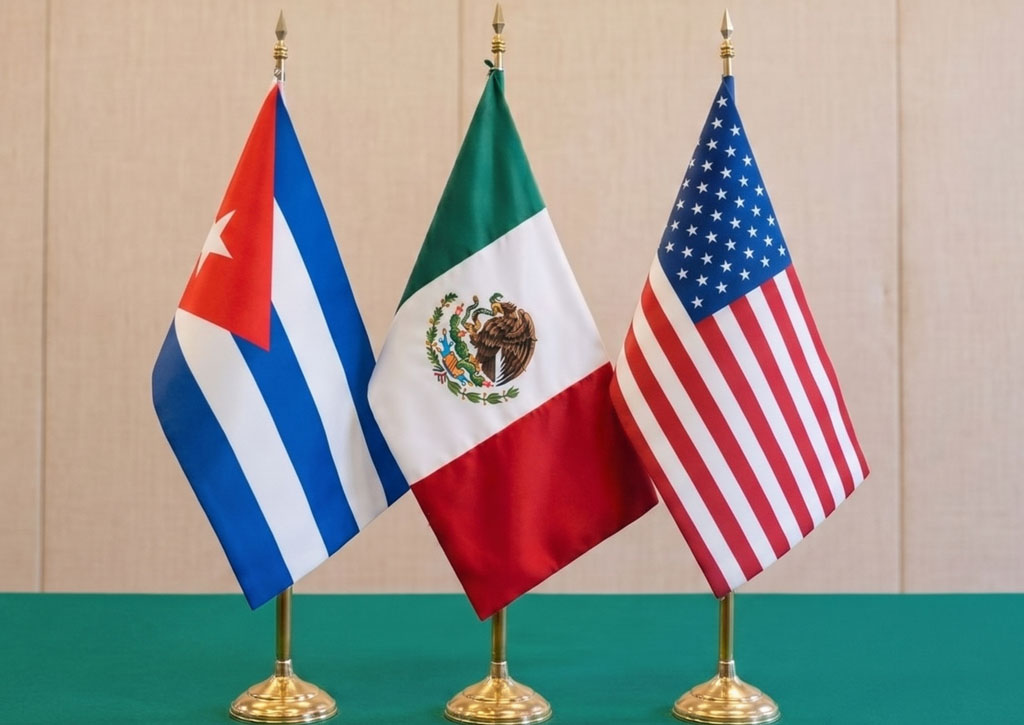
At this point, any discussion of a U.S. military invasion of Cuba remains strictly hypothetical. Yet given the current political climate in Washington, threats of military action against Latin American nations have moved from the fringes of political discourse to the floor of the Oval Office.
For this reason, dismissing such a scenario as impossible would be, frankly, naive. In January 2026, following a U.S. special forces operation to abduct Venezuela’s president, the Trump administration warned that Colombia, Cuba, and Mexico could be “next”. A new “Donroe Doctrine” (pardon the pun) has effectively asserted the United States’ right to intervene at will in the Western Hemisphere.
Meanwhile, U.S. military surveillance flights near Cuba have surged dramatically, with at least 26 intelligence, surveillance, and reconnaissance flights within 80 miles of the island between February and May 2026 alone, with flight patterns consistent with pre-invasion intelligence gathering.
For Mexico, and particularly for the Yucatán Peninsula, such a conflict would present a cascade of geopolitical, diplomatic, and practical challenges unlike any faced in modern memory. Here, it should also be noted that US drones have been detected above the Yucatán, a fact that adds credibility to the risk of incursions of another nature. To put it bluntly, the U.S. military does not fly drones for fun; in its most benign form, it does so to collect intelligence.
The Question of Airspace and Waters
Any U.S. military operation against Cuba would almost certainly involve U.S. aircraft and naval vessels operating in proximity to Mexican territory. The Yucatán Channel, the strait between Mexico’s Yucatán Peninsula and Cuba, is a critical maritime passage. U.S. surveillance flights have already been operating within 40 miles of Cuban shores, and a full-scale invasion would likely see U.S. military assets operating even closer to Mexican airspace and territorial waters.
The legal framework here is clear, but the practical reality is far more complicated. Under international law, U.S. aircraft and vessels would be required to respect Mexican sovereignty. However, the U.S. has demonstrated in recent years a willingness to interpret its own national security interests broadly. Mexican officials have already expressed deep concern. In March 2026, President Claudia Sheinbaum rejected any possible U.S. military action against Cuba, stating firmly that “no one should define the destiny of another nation but its own people”. Mexican legislators have gone further, denouncing U.S. threats as a “direct affront to international law, to the United Nations Charter, and to the historic principles of self-determination and non-intervention” defended by Latin American and Caribbean peoples.
Yet for all the rhetorical defiance, Mexico’s ability to physically prevent U.S. military overflights or naval incursions is severely limited. The U.S. spends more on its military than the next ten largest military spenders combined. Mexico’s armed forces, numbering approximately 412,000 active personnel, are structured primarily for internal security, counter-narcotics operations, and border enforcement, not for confronting the world’s most powerful military.
The Progreso Complication
Perhaps the most overlooked geographic factor in this equation is the port of Progreso, Yucatán. Progreso is the largest logistics port near the Cuban coast. Its location on the Yucatán Channel places it in a uniquely strategic position; any large-scale U.S. military operation against Cuba would logically require supply lines, and Progreso is the nearest major port capable of handling significant cargo.
This proximity creates a profound dilemma. If the U.S. were to seek access to Progreso for logistics or staging purposes, Mexico would face an impossible choice: grant access and be seen as complicit in an invasion of a fellow Latin American nation, or refuse and risk a major rupture in U.S.-Mexico relations.
Even if the U.S. did not formally request access, the mere presence of U.S. military assets in the vicinity would place the Yucatán Peninsula in a precarious position, potentially becoming a de facto staging ground whether Mexico consents or not.
The irony is palpable. Progreso has recently become a symbol of Mexican solidarity with Cuba, serving as the departure point for humanitarian aid shipments. In March 2026, a vessel dubbed the “Granma 2.0” departed from Progreso carrying 30 tons of food, medicine, and solar panels to Cuba. Activists have used the port to send supplies, with one stating that “Cuba deserves, like all countries in the world, to be a country free of foreign intervention”. That same port, should tensions escalate, could become the epicenter of a geopolitical crisis.
A History of Complicated Friendship
Mexico-Cuba relations have historically been positive, built on bonds forged over time. Let’s not forget that the Cuban Revolution was launched from Mexico.
The notable exception to this generally warm relationship came during the presidency of Vicente Fox (2000–2006). Fox’s administration, seeking to project a more active foreign policy based on democratic values and human rights, pursued a policy that led to a significant diplomatic crisis with Cuba. Tensions first emerged in 2002, when Fidel Castro accused Fox of acting in deference to the United States, and relations deteriorated further. This period remains the principal blemish on an otherwise stable bilateral relationship.
Today, that relationship has been fully restored. Under President Sheinbaum, Mexico has become one of the primary humanitarian aid providers for Cuba. Mexico has sent multiple shipments of food, medicine, and supplies, including two navy ships carrying 814 tonnes of food in early 2026. Sheinbaum has pledged to continue this support, stating that “no one can ignore the situation that the Cuban people are currently experiencing” due to U.S. sanctions.
The Sanctions Threat
All of this humanitarian aid comes despite explicit threats from the United States. In January 2026, the Trump administration introduced an energy embargo against Cuba, cutting off oil shipments and threatening tariffs against any country that shipped supplies to the island. The U.S. has threatened to issue tariffs against any country that seeks to circumvent its energy blockade.
Mexico has sought to balance its long-standing support for Cuba with pressure from Washington. Sheinbaum has acknowledged that Mexico does not want sanctions imposed on it, but has nevertheless reaffirmed that Mexico will continue to send humanitarian aid. “It’s a matter of solidarity,” she has said. “The people of Mexico have always done it, and we will continue to do it, because it’s a people that needs it”.
This balancing act becomes exponentially more difficult in the context of a U.S. invasion. Would Mexico continue sending aid to a nation the U.S. is actively attacking? Would Washington interpret such aid as material support to an enemy? These are not abstract questions; they are the kind of geopolitical dilemmas that define international relations in times of crisis.
Military Limitations, Diplomatic Possibilities
It must be acknowledged plainly that Mexico’s armed forces are far from capable of aiding Cuba in any military sense. Mexico ranks 32nd globally in military power, while Cuba ranks 67th; the United States dramatically outmatches both in every conceivable metric. Mexico’s military is structured for internal security, not external conflict. The idea of Mexican military intervention on Cuba’s behalf is simply not realistic.
However, Mexico possesses something potentially more valuable in this context: considerable soft power in the region and internationally. Mexico occupies a unique position, situated between North America and Latin America, and has long positioned itself as a symbolic mediator between the two. Alongside Brazil and Spain, Mexico has positioned itself as a leader in humanitarian initiatives, betting on consolidating its role as a balancing actor in Latin America, “sufficiently close to the United States to maintain structural cooperation, but sufficiently autonomous to lead regional initiatives”.
Mexico’s diplomatic tradition, rooted in respect for sovereignty, non-intervention, and self-determination of peoples, gives it moral authority in Latin American forums. President Sheinbaum has already proposed a declaration against military intervention in Cuba, calling for “dialogue and peace to prevail”. Mexico has been able to “show its autonomy from the United States” through its Cuba policy, and in a crisis, that autonomy could translate into meaningful diplomatic influence.
Political observers in the United States have perhaps underestimated the role that Mexican soft power could play. A U.S. invasion of Cuba would be met with near-universal condemnation across Latin America, a region that views the current U.S. oil blockade as a driver of humanitarian catastrophe. Mexico, as a respected voice in the region, could amplify that condemnation and potentially rally other nations to a coordinated diplomatic response. The United Nations has historically opposed the U.S. embargo on Cuba, and a military invasion would likely fracture Washington’s diplomatic standing with both the European Union and Latin American states.
Other Relevant Considerations
Several additional factors merit attention. First, the humanitarian dimension cannot be overstated. Cuba is already facing a dire economic crisis, with days-long electricity blackouts, dwindling food and medicine supplies, and a healthcare system crippled by fuel shortages. A military invasion would compound this suffering exponentially, and Mexico, as Cuba’s closest neighbor and largest humanitarian supporter, would face immense pressure to respond.
Second, the migration question looms large. Any military conflict in Cuba would almost certainly trigger a mass exodus of Cuban refugees. The Yucatán Peninsula, given its proximity to Cuba, would be the most logical first point of arrival. Mexico would face the challenge of managing a potential refugee crisis while also navigating U.S. demands to intercept migrants.
Third, the precedent set by a U.S. invasion of Cuba would have implications far beyond the island itself. If the United States can invade Cuba under the “Monroe Doctrine,” what stops it from targeting other nations in the region? Mexican officials have already warned that aggression against Cuba would have devastating human consequences, pain, death, displacement, suffering for entire families, and a regional escalation with unforeseeable consequences.
The likelihood of the scenario described could either escalate or even potentially deflate, depending on the result of the United States 2026 November midterm elections. The importance of this variable can not be overstated.
Finally, there is the question of Mexico’s own domestic politics. The Sheinbaum administration has staked considerable political capital on its principled stance regarding Cuba. Backing down in the face of U.S. pressure would be politically damaging; standing firm could strengthen Mexico’s regional leadership credentials but at the cost of a potentially severe rupture with Washington. Either path carries significant risks.