

The historic center of Yaxcabá, a municipality in eastern Yucatán, recently became the scene of a troubling event.
Workers demolished the interior of a colonial-era house located on Calle 22, intending to convert the property into a convenience store.
What made the case particularly alarming was that the demolition was carried out with the explicit authorization of the municipality’s mayor, Genri Alberto Pacab Herrera.
The building in question was no ordinary structure; its fabric was directly linked to the narrative of the Caste War, the great Maya uprising that began in 1847. Under Mexican federal law, such properties are protected as historical monuments.
The municipal government had granted a permit for the work, but when inspectors from the National Institute of Anthropology and History (INAH) arrived, they found that the necessary federal clearances had not been obtained.
The INAH, which is legally mandated to oversee all interventions on listed heritage, was forced to act. The personnel from the Junta de Monumentos Históricos placed official suspension seals on the site, halting the illegal construction and ordering the work to stop immediately.
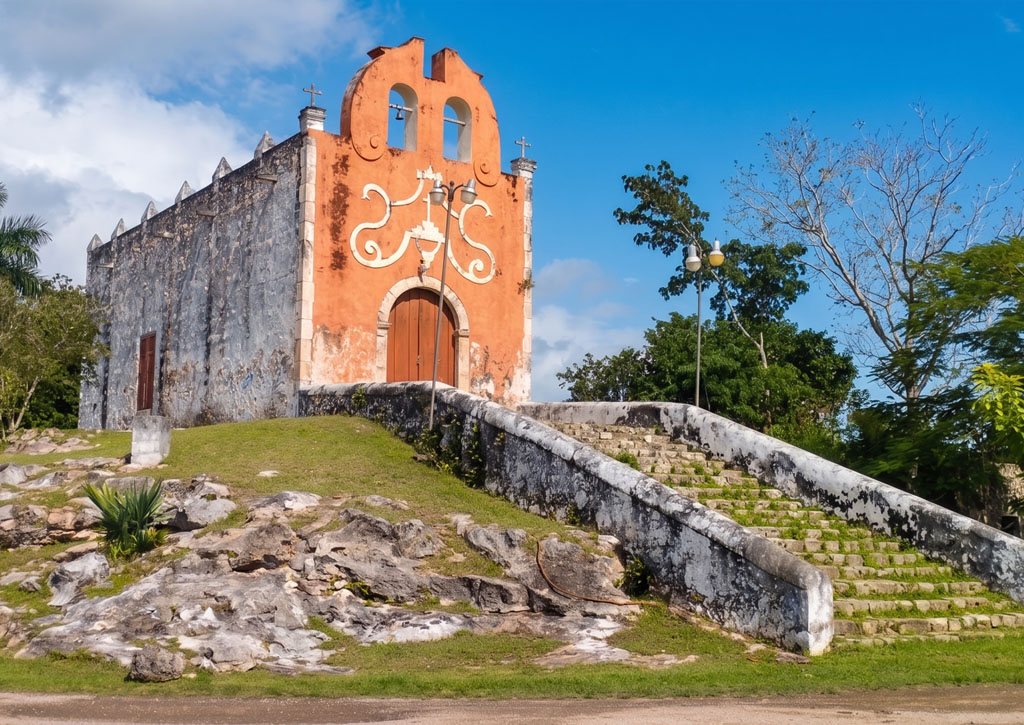
This event did not occur in isolation. It was, as local historian Joed Amilcar Peña Alcocer put it, the second chapter of a crisis that began less than a year ago with the looting of the church at Molipa (also known as Mopila), a small community within the same municipality. In late 2025, cultural advocate and photographer Leobardo Cox Tec publicly denounced that the 17th-century Franciscan church at Molipa had been systematically stripped of its stones.
Thieves removed the rectangular blocks that provided structural support, even prying stones from the archways and the main staircase. The result was catastrophic: the entire front wall collapsed, and more than half of the access stairway was lost.
The Molipa church was not merely an abandoned ruin. It had remained a living site of community devotion; every July 31, a procession carried an image of the Virgin of the Assumption to the church for an overnight vigil, a custom believed to be over a century old.
Despite the site’s cultural and spiritual significance, local efforts to secure its protection had been unsuccessful for years. Cox Tec noted that activists had been submitting preservation projects to municipal and state governments, with INAH advice, since 2013, but the consistent reply was: “there’s no budget”.
After the collapse, the INAH’s Yucatán director reportedly dismissed immediate conservation work, arguing that the structure was located in an uninhabited area. This inaction only encouraged further plundering, with looters later attempting to remove the church’s three-century-old stone baptistery.
Across Yucatán, the pattern of neglect and destruction is repeating. In the municipality of Hocabá, the 17th-century colonial-era municipal palace is on the verge of collapse, its roof timbers beginning to fall apart under the public’s gaze.
Residents point to deficient administration and a lack of investment as the primary causes. A similar situation exists in Tixkokob, where the historic town hall has been left without maintenance for years, its walls showing signs of moisture and decay. In Izamal, a designated “Pueblo Mágico” that receives specific federal funds for heritage conservation, citizens have denounced the neglect of historic portals, facades, and commercial buildings, suggesting mismanagement of the resources that are supposed to protect them.
Even the Hacienda Yaxcopoil, a well-known tourist site, has recently suffered acts of vandalism against its columns and sculpted figures, with no sign of effective surveillance or police intervention.
These cases point to a systemic failure. Municipal authorities in many rural communities display either ignorance of heritage protection laws or a permissive attitude that allows, as Peña Alcocer observed, the disappearance of the few remaining historic properties.
The drive for commercial gain is often a motivating factor; old buildings are seen as obstacles to modernization, and their replacement with conventional storefronts is justified by a short-term economic logic that ignores the irreversible cultural loss that results.
The lack of funds is a constant refrain, but as Cox Tec noted, the refusal to allocate even modest resources for basic maintenance has left sites like the Molipa church vulnerable to every passing looter.