

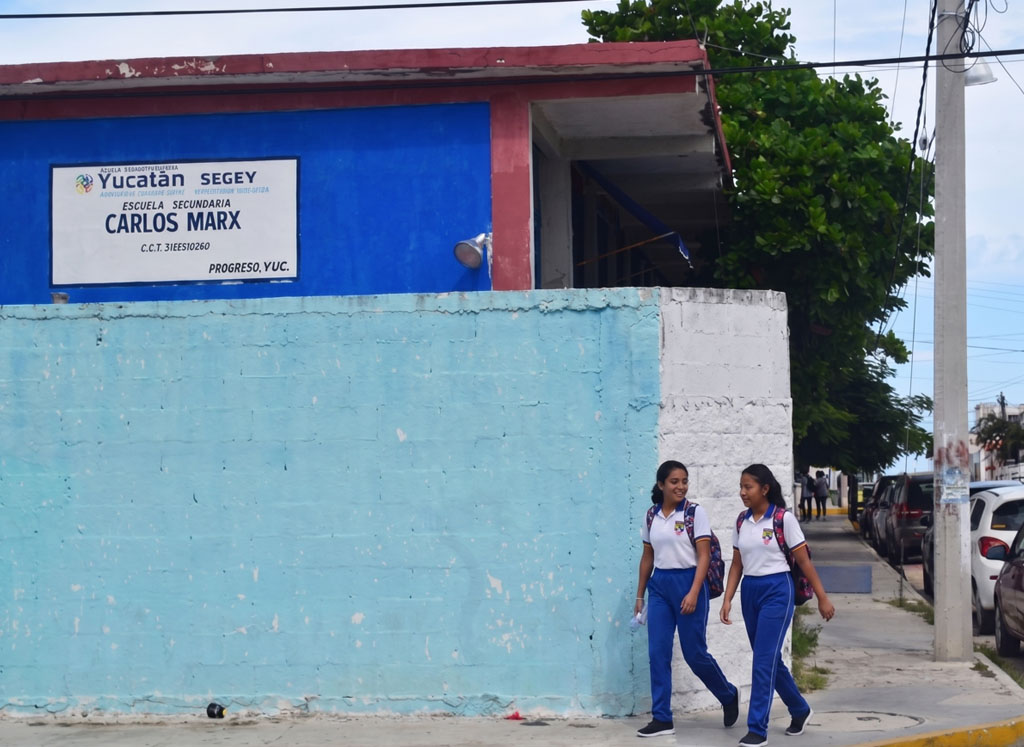
The Secundaria (Junior High School) Estatal Número 3 “Carlos Marx” in the port town of Progreso, Yucatán, just celebrated its 90th anniversary.
To the foreign observer, the name of a secondary public school named after Karl Marx might raise a curious eyebrow. Naming a high school after the father of Communism would be unthinkable in places like the United States or much of Western Europe.
However, in the context of 1930s Mexico, bestowing Karl Marx’s name upon a new institution of learning was not an act of political rebellion. It was, in fact, a reflection of the country’s unique and radical era of educational and social transformation.
The Revolutionary Roots of Socialist Education
The key to understanding this naming after Marx lies in the presidency of Lázaro Cárdenas, who governed Mexico from 1934 to 1940. Cárdenas did not simply flirt with leftist ideas. He worked systematically to weave the tenets of Socialist cooperation into the fabric of public life. The centerpiece of this effort was the implementation of “Socialist Education” (educación socialista). A constitutional amendment to Article 3, passed in 1934, mandated that the education imparted by the state would be Socialist in nature.
In practice, this meant that schools were tasked with combating religious fanaticism and creating a collective, scientific, and nationalistic consciousness. As educational historians have noted, the reform imposed socialist education to free the country from ignorance and instill a sense of social duty. It was during this fervent, state-sponsored push for social reform that the “Carlos Marx” school opened its doors in 1936.
The Rise of Communist and Socialist Parties in Mexico
This was also a period when explicitly Socialist and Communist parties were legitimate, influential actors in Mexican politics. The Mexican Communist Party (Partido Comunista Mexicano, PCM), founded in 1917, had been forced underground for much of the 1920s.
But under the protection of the Cárdenas administration, it regained legal status and influence. Recent scholarship on left-state alliances has shown that Cárdenas actively relied on the Communist Party to mobilize popular forces for his populist agenda of land reform and workers’ rights.
Mexico’s Pragmatic Relations with the Soviet Union
Mexico’s internal socialist leanings were mirrored by a bold, pragmatic foreign policy. `
The “Carlos Marx” school was named six years after Mexico had recently broken diplomatic relations with the USSR in 1930. That break followed Mexico’s controversial decision to grant asylum to the exiled Soviet revolutionary Leon Trotsky.
However, this rupture was temporary. By 1943, the two nations had re-established ties, and Mexico became a crucial ally of the Soviet war effort during World War II.
Trade and cultural exchanges flourished in the post-war period. Mexico recognized the Soviet Union not as a threat, but as a counterweight to growing U.S. influence in the hemisphere. This balanced foreign policy allowed Mexico to maintain its sovereignty while engaging with both superpowers. The positive relations were grounded in mutual non-intervention and economic cooperation, a hallmark of Mexico’s foreign policy doctrine.
The Special Case of Communist Cuba
Even more illustrative of Mexico’s independent leftist streak is its long-standing relationship with Communist Cuba. During the Cold War, Washington relentlessly pressured its neighbors to isolate Fidel Castro’s regime. In 1964, as the Organization of American States (OAS) voted to sever all diplomatic ties with Cuba, Mexico famously refused to follow suit. Mexico became the sole OAS member to maintain relations with Havana until 1970.
This stance was not without risk. It was a direct challenge to the Monroe Doctrine and led to periodic friction with the United States. In return, Castro agreed to a tacit non-intervention pact, keeping his distance from Mexican leftist guerrilla movements. This relationship demonstrates that Mexico’s affinity for Socialist movements was a consistent thread in its history, not just a momentary deviation of the 1930s.
A Lasting Local Identity in Progreso, Yucatán
Far from being an odd relic, the name “Carlos Marx” has become a deeply embedded part of Progreso’s local identity. Today, the school’s students sing its anthem with pride.
The 90th-anniversary celebration was marked by deeply emotional tributes from former students, teachers, and local authorities. The school is celebrated not for its political connotations, but for being the “first secondary school founded outside of Mérida.”